


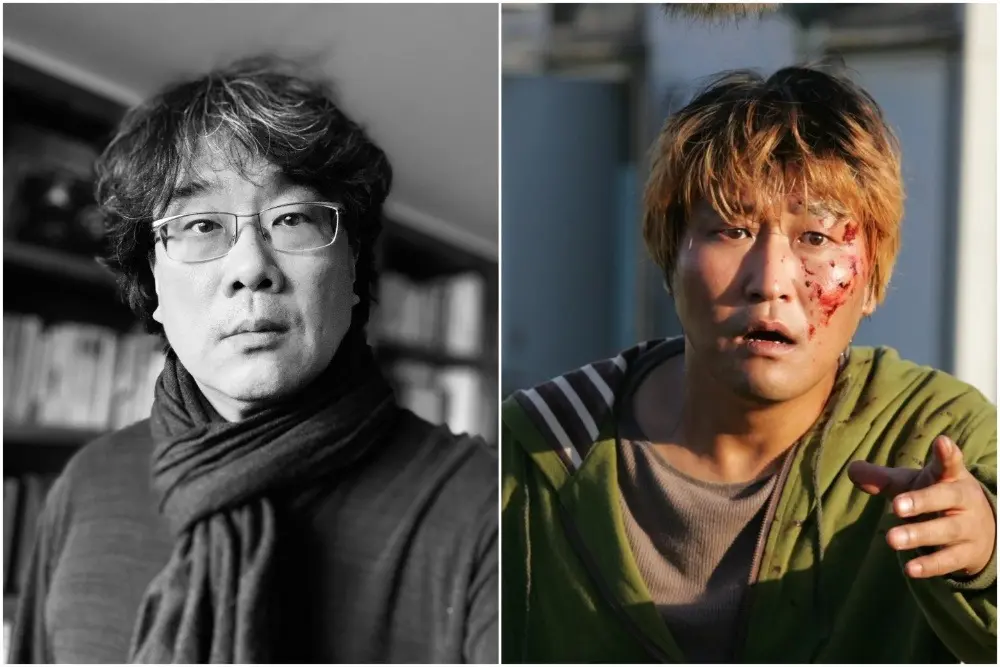
Two decades after it first terrified and captivated audiences along the banks of Seoul’s Han River, Bong Joon Ho’s monster masterpiece The Host is returning to the big screen. Magnolia Pictures is bringing a newly minted 20th-anniversary 4K restoration of the film to theaters nationwide on November 20. For cinema enthusiasts looking to dive deeper into the auteur’s vision, special screenings on November 21 and 23 will feature an exclusive, in-depth conversation between Bong and fellow acclaimed filmmaker Edgar Wright.
Looking back at the milestone, the Oscar-winning director admits that the passage of time still feels surreal. “I can’t believe it’s been 20 years since the release of the film. Time flies,” Bong tells Variety.
Released in 2006, The Host established Bong as a singular voice in global genre cinema, blending family melodrama, sharp sociopolitical satire, and creature-feature terror. The film follows Gang-du, played by veteran actor Song Kang-ho, a hapless father who nods off on the job at his modest snack kiosk beside the Han River. Suddenly, a horrific mutant creature—spawned by toxic chemical dumping—crawls out of the water, cuts a destructive path through the terrified crowds on the riverbank, and snatches Gang-du’s beloved schoolgirl daughter, Hyun-seo, portrayed by Ko A-sung.
When authorities declare the monstrous entity to be the carrier of an unknown and dangerous virus, the area is sealed off. But after Gang-du receives a desperate phone call from Hyun-seo, who is terrified yet very much alive, he resolves to slip past the military blockade into the quarantined zone to rescue his child. The stellar ensemble cast also features Byun Hee-bong, Park Hae-il, and Bae Doo-na as members of Gang-du’s fiercely loyal, if dysfunctional, family. Behind the scenes, New Zealand’s renowned Weta Workshop crafted detailed physical models of the creature, while visual effects and animation were handled by The Orphanage.
Long before he made history with Parasite—which won the prestigious Palme d’Or at the Cannes Film Festival in 2019 and subsequently swept the Academy Awards with four wins, including best picture, as the first non-English-language film to take the top honor—Bong was already using genre cinema as a vehicle to critique institutional failures.
When he wrote The Host, Bong drew direct inspiration from the global anxiety surrounding the SARS outbreak. One particular sequence in the film—in which U.S. lawmakers nonchalantly concede that there never actually was a virus spreading through Korea—served as a pointed satire of the official misinformation campaign surrounding the Iraq War, which was launched over weapons of mass destruction that ultimately turned out not to exist. In the years since the film’s premiere, Bong points out, humanity has lived through the devastating coronavirus pandemic and other global crises.
Reflecting on the state of the world today, Bong sees a depressing cyclical nature in global politics. “Now we’re in the thick of the Iran War and we’re still in the midst of an ongoing war, and whether it’s good history or bad history, it seems like we as a community, as a whole, are repeating our mistakes,” Bong says. “Although the film has stayed the same, the history is repeating itself and making the film relevant again.”
The decision to revisit the film for a 4K restoration was driven by a desire to preserve its original cinematic texture. Bong explains that the primary aim was to recreate the exact visual experience of watching a fresh 35mm print, just as audiences did when the film premiered at the Cannes Film Festival in 2006. Notably, The Host was shot on Fuji film stock rather than Kodak, and Bong was determined to bring back the subtle, specific color qualities that he and his cinematographer, Kim Hyung-ku, meticulously worked out during the original shoot.
“Ironically, we were using digital technology to enhance the film look of the movie,” Bong notes with a touch of irony.
Because the visual effects work was executed in 2005 and 2006, well before 4K resolution was an industry standard, those specific shots required careful upscaling. Bong reveals that his team took great pains to ensure that the digital creature still blended convincingly with the live-action actors and their physical environments, and he remains deeply satisfied with the final result. Even now, when he watches the film, he occasionally spots minor flaws in the CGI or encounters moments that leave him slightly dissatisfied, but he views these imperfections as historical artifacts of his own artistic evolution.
“But I believe that the film is a record of what I was as a filmmaker at the time, and so I do not have any wishes to correct that,” Bong says. “Just like we don’t edit or rewrite our journals, I feel like it should just be left as it is.”
In discussing the temptation to alter past work, Bong points to legendary director Ridley Scott, who famously removed a few shots when he re-released his original 1979 sci-fi classic Alien. “I also had that kind of impulse, but luckily I was able to hold myself back,” Bong admits. “It wasn’t a lot of shots. It was only one or two shots where I thought maybe I could cut that out, but in the end, I just resisted the impulse.” When asked which specific moment he had in mind, the director playfully declines to answer, keeping it a closely guarded secret.
Sound design has always played an integral role in Bong’s filmmaking, and for The Host, he completed the audio work at Livetone, the premier Seoul facility where he has collaborated with the exact same sound supervisor for 25 years, even as cinematographers and other crew members shifted from project to project. Remarkably, the studio still retains the original sound library from the production. While his subsequent films—from Okja onward, including Parasite—have been mixed in immersive Dolby Atmos, Bong notes that The Host could theoretically be upgraded to that modern format, though he still needed to confirm which sound format the North American theatrical release would ultimately utilize.
Among all the audio elements, the creature’s distinct voice was the aspect of the original sound design that required the most intensive experimentation and concentration. To achieve the haunting vocalizations of the beast, the sound team recorded and processed the real sounds of a sea lion, then layered in a raw vocal performance from Korean actor Oh Dal-su, expertly blending the two sources into the terrifying roar that echoed through theaters worldwide.
Despite the painstaking effort put into the 4K restoration of The Host, Bong sees little practical point in remastering his more recent filmography. Everything he has directed following Okja was shot natively in 4K and finished with cutting-edge Atmos sound. He has, however, explored alternative visual presentations for some of his other works, having crafted striking black-and-white versions of both Mother and Parasite, which have enjoyed selective theatrical releases and festival screenings.
“I have great admiration for black-and-white films,” Bong says. “It’s a process that I enjoyed very much.”
Looking ahead to his future projects, Bong previously confirmed to Variety that following the completion of his upcoming animated feature Ally, he plans to pivot back toward a compelling slate of gritty crime and horror films. Asked whether that remains his steadfast trajectory, the director offers a definitive confirmation, signaling an exciting return to his cinematic roots.
“I want to return home,” Bong says.