



The valuation of the S&P 500 index has experienced a remarkable surge over the past several years, climbing roughly 57 percent in the last two years alone and more than doubling over a five-year period. This rapid expansion has significantly altered household net worth calculations for millions of Americans, pushing many who felt halfway to retirement during the COVID-19 era well past their financial goals. Meanwhile, long-standing retirees find themselves navigating an environment where portfolios are ballooning, raising questions about whether current market levels reflect fundamental economic reality or a financial illusion driven by modern speculation.
This disconnect has prompted widespread inquiry among retail investors and retirement savers alike. A central question facing the financial community is whether the current market environment—heavily influenced by intense hype surrounding artificial intelligence—makes equities acutely vulnerable to a sharp correction and how that might impact long-term retirement security. To evaluate these risks, financial analysts often return to the fundamental definition of what a stock represents: a business arrangement functioning much like a rental property.

When an individual owns a rental house, the primary financial entitlement is the collection of rent. After covering operating expenses, the remainder constitutes profit. If the average market value of rental housing rises while tenants continue paying the same baseline rent, the appreciation looks positive on paper, but it yields no additional cash flow unless the property is sold. Even then, an investor selling at a higher price must typically turn around and purchase another property at similarly inflated market rates.
An investor’s actual income remains static unless the underlying business asset becomes more productive, such as through physical renovations, optimized expense management, or structural additions that increase net earnings. Consequently, when a property changes hands, the purchase price ought to be anchored to that anticipated stream of future income. For example, a property generating $24,000 in annual profit and selling for $240,000 carries a price-to-earnings ratio of 10. If a buyer agrees to pay $480,000 for that exact same income stream, the valuation doubles the price-to-earnings ratio to 20, creating a highly advantageous exit for the seller but a much narrower margin for the incoming buyer.

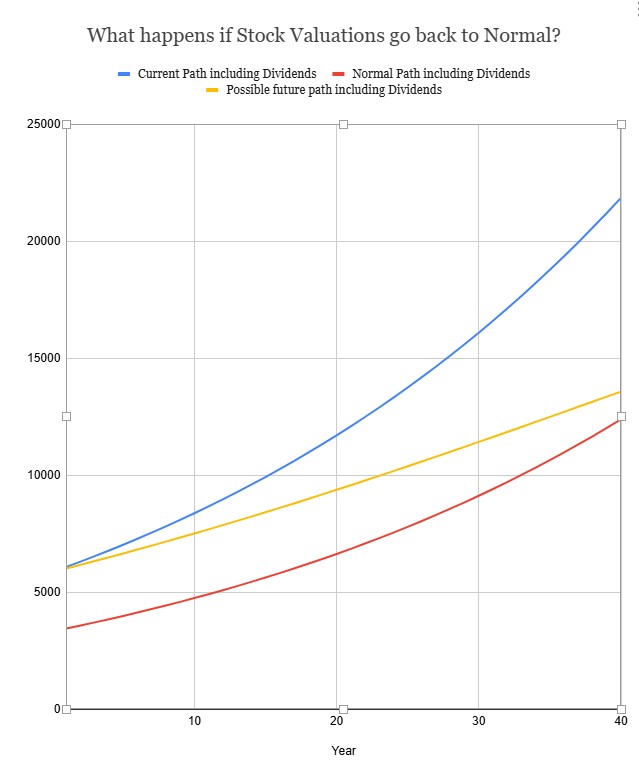
A strikingly similar dynamic has unfolded across the broader U.S. stock market. An investment of $100,000 placed into the market in 2019 with dividends reinvested would have grown significantly by 2025. However, over that exact same multi-year timeframe, the collective share of company earnings generated by that basket of equities experienced a much more modest increase. Consequently, the overall price-to-earnings ratio of the market has risen from approximately 20 to roughly 30.
Just like real estate investors confronting skyrocketing property values that vastly outpace rental income growth, contemporary stock market participants face a similar reality. Buying into equities at historically elevated price-to-earnings multiples naturally implies lower future yields relative to portfolio size compared to purchasing assets during broader market downturns. While ownership remains fundamentally viable and profitable over long horizons, basic mathematical principles dictate that the income derived from higher-priced assets will be more subdued.

Higher valuations can be justified if future earnings growth accelerates dramatically. For instance, an investor might willingly pay a premium for a rental property if a major corporate campus is slated for construction nearby, promising rapid and sustained increases in rental demand. Similar logic applies to individual corporate equities when positive catalysts emerge. During the pandemic, sudden shifts in consumer behavior temporarily drove up demand for home-exercise equipment, lifting the stock prices of companies like Peloton before market realities and normalized demand caused valuations to retreat.
However, when an entire equity index appreciates uniformly, the broader economic implications become more complex. A closer examination of the S&P 500 reveals that the lion’s share of recent market growth—approximately three-quarters of it—has been concentrated within just seven massive technology corporations. Frequently referred to as the "Magnificent Seven," this cohort includes Apple, Nvidia, Microsoft, Amazon, Alphabet, Meta, and Tesla.
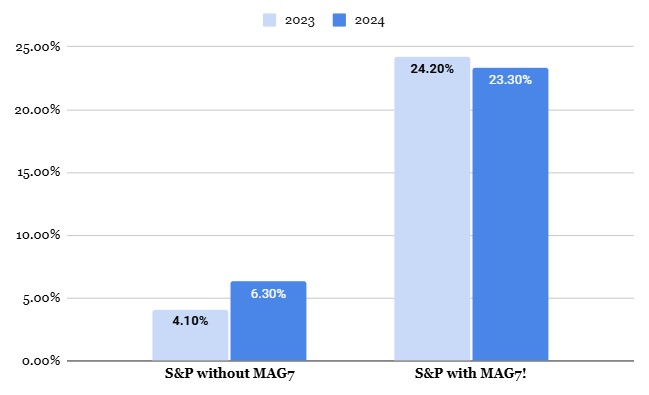
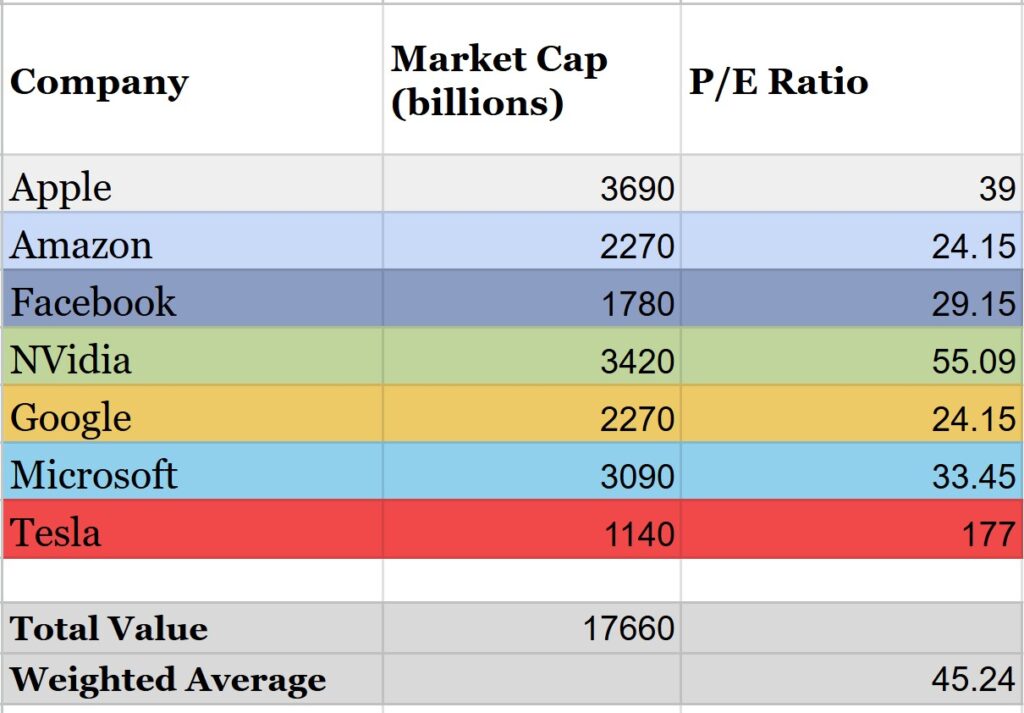
These highly profitable enterprises have captured the imagination of global investors, driving their collective market capitalization past trillions of dollars while commanding weighted price-to-earnings ratios averaging roughly 45. By contrast, excluding these seven giants leaves the remaining 493 companies in the index trading at a significantly more modest, though still elevated, average price-to-earnings ratio of 20. This divergence underscores that while the broader economy is anticipated to maintain steady performance, market participants are placing extraordinary growth expectations squarely on the shoulders of mega-cap technology leaders.
At the heart of this technology-driven surge is the rapid advancement of artificial intelligence, which has startled the corporate world by demonstrating sophisticated, human-like reasoning across complex tasks. Major technology firms are channeling hundreds of billions of dollars into constructing massive data centers housing specialized supercomputers. Meanwhile, semiconductor manufacturers sit at the center of this capital expenditure wave, fulfilling unprecedented global demand for advanced hardware.
Down the corporate chain, industries across the spectrum are exploring how AI integration might permanently alter productivity margins. Modern software tools can now analyze voluminous legal documentation, write and debug software code, assist in medical diagnostics, and accelerate pharmaceutical research. The speculative narrative driving current valuations rests on the premise that businesses are on the threshold of integrating an infinite labor force of highly capable digital systems, effectively removing the historical economic constraint of finite human labor and intelligence.
Whether corporate profits will ultimately materialize to match these lofty forecasts remains one of the central uncertainties facing modern finance. Potential hurdles include unexpected infrastructure costs, regulatory pressures, intense industry competition, and broader macroeconomic shifts. Furthermore, economists continue to debate the societal implications of rapid automation on employment and labor markets.

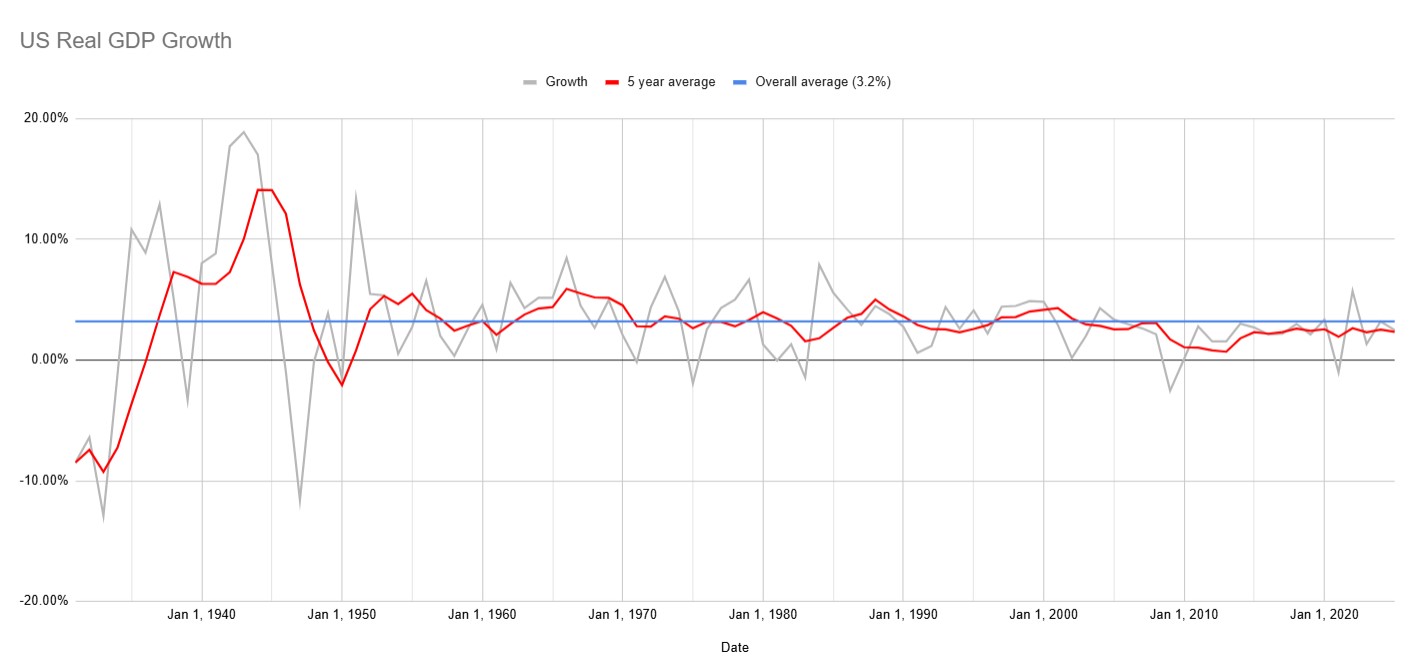
Examining historical economic data provides additional perspective. Over many decades, U.S. real economic growth has maintained a remarkably consistent long-term average of approximately three percent annually after adjusting for inflation. In fact, economic growth in recent decades has tracked slightly below that historical norm, highlighting the tension between moderate macroeconomic expansion and the aggressive pricing currently observed in equity markets.
Navigating these dynamics reinforces classic long-term investing principles. While cyclical market manias, panics, and corrections remain inevitable features of financial history, attempting to time the market by liquidating portfolios in anticipation of a downturn historically proves counterproductive. Over extended horizons, even if equity valuations normalize toward historical averages, continuous economic expansion and underlying corporate earnings growth tend to support steady portfolio progression.
Alternative asset classes offer different risk-reward profiles. Major financial institutions regularly publish long-term return forecasts suggesting that international equities and fixed-income instruments may offer competitive or superior annualized returns over the coming decade compared to U.S. large-cap stocks. This perspective is often rooted in valuation disparities, as international stock indices frequently trade at significantly lower price-to-earnings multiples than their U.S. counterparts, though U.S. markets have historically outperformed due to the concentration of dominant technology enterprises.
Similarly, conservative wealth management strategies that diversify holdings across multiple asset categories and automatically rebalance portfolios aim to moderate volatility over time. Meanwhile, seasoned market observers like Warren Buffett’s Berkshire Hathaway have maintained substantial cash reserves, signaling that bargains are scarce in an environment where many major equities trade at elevated valuations relative to current earnings.
Decisions regarding personal balance sheets—such as the choice between maintaining a mortgage or accelerating debt repayment—involve weighing guaranteed interest savings against the long-term expected returns of equity investments. While mathematical models often favor retaining low-cost debt while investing surplus capital, individual risk tolerance and the psychological peace of mind associated with being debt-free frequently guide household financial choices.
Ultimately, long-term investors are encouraged to maintain a disciplined focus on personal savings habits, ignore daily market volatility, and maintain perspective amidst shifting economic headlines. Focusing energy on pursuits outside of portfolio monitoring remains a steadfast recommendation for maintaining balance through various market cycles.