


For years, shoppers walking into Reformation boutiques around the world have found themselves admiring a design element that wasn’t actually for sale: the elaborate, whimsical rugs anchoring the showrooms. According to Lauren Caris Cohan, the sustainable fashion brand’s chief creative officer, one of the most common remarks from customers stepping into their retail spaces has consistently revolved around the decor.
"One of the biggest comments that we get is that the stores look so beautiful and the rugs are amazing," Cohan notes. Typically, she adds, that observation is immediately followed by a single, persistent question from captivated shoppers: "Where can we get them?"

Until now, the answer was nowhere. The custom floor coverings were strictly reserved for the brand’s brick-and-mortar footprint, largely due to the protective approach of Thomas Coccimiglio, the founder of the French rugmaker Les Editions de Tapis. Cohan explains that Coccimiglio has always been "really precious" about the bespoke designs he creates specifically for Reformation stores, maintaining a strict policy against reusing them for any other commercial or private clients.
That exclusivity, however, has finally come to an end. Reformation has officially launched a collaboration with Les Editions de Tapis, making these coveted, hard-to-find rugs available to the general public for the first time. The debut home collection features nine limited-edition styles, all produced on a made-to-order basis and priced between $1,000 and $5,000, depending on the scale and intricacy of the piece.
Long before he began outfitting Reformation showrooms with statement-making textiles, Coccimiglio spent more than 15 years working as a fashion textile designer across major style capitals including London, Paris, and New York. His trajectory toward home interiors took shape during his time at Tory Burch, where frequent professional trips to meet traditional embroiderers in Italy and India sparked a deep fascination with artisanal rug-making techniques. When the COVID-19 pandemic reshaped the global workforce and creative industries, Coccimiglio officially transitioned from fashion into interior design.

Despite the shift in medium, his foundational background in high-end apparel continues to heavily influence his creative process today. His perspective on designing a rug remains inextricably linked to his garment roots, neatly summarizing his artistic philosophy by noting that he approaches a floor covering almost the exact same way he would approach a piece of intricate embroidery on a luxury dress.
This fashion-forward sensibility aligns seamlessly with Reformation’s rapid physical expansion. Cohan points out that the brand opens more than 15 new stores every single year, and Coccimiglio designs a completely distinct, hand-sketched motif and custom colorway for every single location. This dedication to bespoke store design mirrors the brand’s distinct personality. Cohan describes the ethos of the company as possessing a particular brand of humor, noting a distinctly French, bone-dry sense of wit embedded within Reformation’s DNA—an intangible quality that she believes is flawlessly reflected in Coccimiglio’s playful yet sophisticated interior designs.
For the creation of this new capsule collection, Reformation granted Coccimiglio absolute creative direction. The foundational conversations that eventually launched the partnership drifted across an eclectic mix of historical and whimsical references, touching upon Marie Antoinette, regal swans, and an extensive palette of soft pinks and powder blues. Notably, all of these core visual components are concurrently reflected in a partnering 12-piece clothing campaign that launched alongside the home goods.

To help maintain a cohesive thread linking Coccimiglio’s new line directly to the long-term visual identity of the fashion brand, the designer spent time revisiting years of historical store designs, culling specific details and motifs to incorporate into the final rug patterns. The resulting pieces carry a distinct sense of emotional resonance. Coccimiglio describes the collection as possessing a nostalgic quality, comparing the experience of viewing them to encountering a literary memory, much like Marcel Proust’s famous madeleine. For loyal customers who have spent years walking through Reformation’s retail spaces, these new pieces are designed to feel strangely familiar, almost attaining the status of an iconic house signature.
Among the standout pieces in the collection are the Chintz rugs, which feature two crossed palm trees—an original concept proposed by Cohan and meticulously sketched out by hand by Coccimiglio—framed between trailing vine borders, complete with herons and swans quietly tucked away at their roots. Another prominent design, titled Swans Fans, places two stark, black-outlined swans directly among spiky fan palms against a vibrant French blue foundation. For those looking for a more minimalist approach, the Le Chat rug leaves a field of soft lilac almost entirely empty, save for a single striped cat casually walking along a broken black line. Meanwhile, Le Classique offers a more understated option with an ivory ground, bordered by two wavering oxblood lines and punctuated by a single dot, catering to anyone with a deeply French sensibility who prefers a design devoid of an elaborate menagerie.
Materiality and craftsmanship sit at the heart of the collection’s high-end positioning. The rugs are painstakingly hand-knotted from a luxurious blend of wool, silk, and linen. Coccimiglio manufactures his larger-format pieces in India, where he deliberately sources wool that is softer and more pliable, making it ideally suited for expansive dimensions. The smaller editions, on the other hand, are crafted in Nepal, where dense Himalayan wool allows for exceptionally ornate, highly detailed results that Coccimiglio compares to fine jewelry.

While consumers could certainly source less expensive floor coverings elsewhere in the broader marketplace, Cohan emphasizes that Coccimiglio’s creations are engineered for lifelong durability. Furthermore, she points out that the designer’s independent work outside of this specific Reformation partnership commands a substantially higher financial investment. By comparison, she notes, this capsule represents a significantly more accessible price point for a product of such extreme detail and custom craftsmanship.
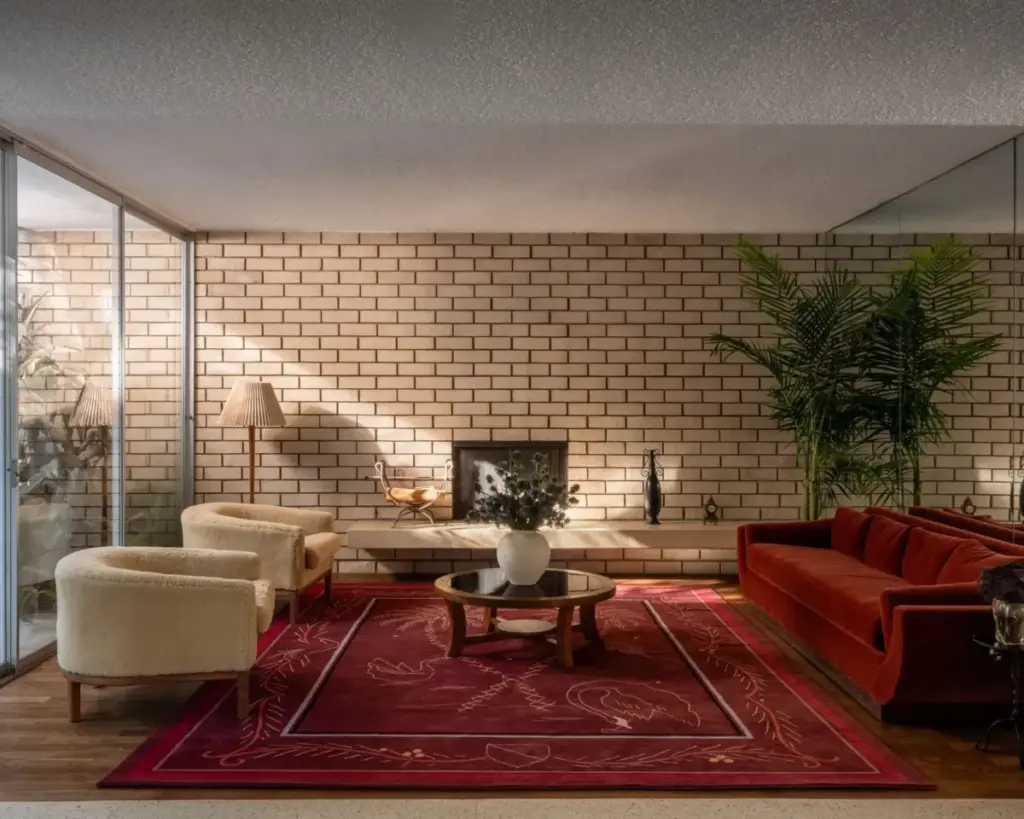
Cohan, who spends her time restoring midcentury modern residential properties throughout Los Angeles alongside her husband Matt Jacoby under their studio name Bob Audrey, envisions the collection fitting seamlessly into a diverse array of interior environments rather than being pigeonholed into a single aesthetic category. She suggests that while a piece would look entirely at home inside a midcentury modern architectural masterpiece in the Hollywood Hills, it would look equally stunning resting against the classic herringbone wood floors of a traditional New York City apartment.
The visual campaign for the launch was photographed inside a residence perched at the highest point of Wonderland Park in Laurel Canyon, a storied 1950s enclave known for its collection of single-story midcentury modern homes, which includes notable architectural landmarks like Pierre Koenig’s Case Study House No. 21. Coccimiglio, by contrast, operates out of a historic 17th-century hôtel particulier situated in Dijon, France. This transatlantic duality feels entirely appropriate for a collection whose core premise bridges old-world European heritage with contemporary Southern California culture, perfectly capturing Coccimiglio’s stated ambition to position his work somewhere directly between French heritage and modern life.

The Reformation and Les Editions de Tapis collection is available to shop online.