



Horde shooters have long occupied a unique space in the gaming landscape, serving as the ultimate digital hangout spots for groups of friends. Because their objectives are typically straightforward and clear, players can easily chat about daily life or exchange friendly banter over voice communications while simultaneously unleashing torrents of lead into digital hordes. Driven by this inherent social appeal and the breakout successes of several heavy hitters in the genre, co-op horde shooters have proliferated widely heading toward 2026.
However, after spending several hands-on hours with Exterminauts—an upcoming third-person co-op shooter that tasks players with wielding mad-science tools to defend and maintain the infrastructure of their capitalist overlords—that omnipresence feels like it might become the game’s greatest hurdle. While the title boasts a distinct visual identity and can whip up moments of genuine, chaotic fun during active rounds, it is difficult not to draw direct comparisons to the established genre giants that clearly inspired its creation. These inevitable comparisons leave lingering questions about whether Exterminauts possesses enough unique staying power to convince players to clock in for a long-term shift.
The core gimmick and satirical tone that bind the experience together are undeniably entertaining at first glance. Players and their squads are cast as exploited laborers working for a sprawling MegaCorp that relies on its personnel to protect and maintain valuable planetary assets from an implied native insectoid threat. This classic dynamic of evil corporate masters versus overworked laborers serves as a promising starting point for a satirical world, though the humor never quite anchors itself securely. The radio banter between the local dispatcher and the corporation’s Planetary Director certainly aims for a quippy, fast-paced delivery, but the jokes frequently miss their mark. There is an unmistakable slapstick aura surrounding every mission objective, yet many of the spontaneous barks and hollers performed by characters in the field often land closer to impressionistic imitations of Deadpool than genuinely sharp satire.
It is remarkably easy to catalog the elements of Exterminauts that mirror systems found elsewhere in the genre. Because of this, distinguishing what makes the game genuinely unique becomes essential. The tasks that lure players and their up-to-three-person squads down to planetary surfaces frequently demand interaction methods that step outside the ordinary. Where titles like Helldivers II heavily relied on directional pad inputs to resolve computer glitches or call down emergency support, Exterminauts opts for physical, hands-on resolutions when dealing with infrastructure damaged by local wildlife.
One such task that surfaces repeatedly during missions is welding, which requires the player to trace a flaming torch carefully along a fracture on the side of an industrial pump. While the pattern is not overly complicated, it features just enough deviation to require real-time adjustments without becoming so jagged or distracting that a player cannot manage it while simultaneously fighting off an enemy ambush. Another task requires two squad members to work in tandem, operating a mechanical ratchet from bottom to top. One player can only push the mechanism so far before their partner must step in and apply their weight to keep it moving.
While players can technically complete these chores solo, these cooperative moments shine by actively encouraging teammates to coordinate and solve problems together rather than simply pressing buttons in a predetermined sequence. Although the limited maps and restricted playtime of the preview build featured only a handful of these cooperative chores, the hope is that the development team will expand on this foundation significantly as production continues.
In addition to primary objectives, side jobs occasionally populate the player’s map when approached, offering smaller assignments in exchange for minor rewards, such as hunting down a specialized elite monster for a single-run bonus. However, players frequently stumble upon abandoned mechs scattered across the landscape—an asset that is neither small nor minor. The sheer firepower packed into these machines makes them exceptionally rewarding to track down, though balancing is maintained by limiting the mech to a single pilot at a time and permanently depleting its functionality once its ammunition runs dry. These discoveries highlight a noticeable dichotomy within the game’s field design, where minor side tasks feel largely forgettable, but stumbling upon heavy ordnance remains a thrilling highlight.
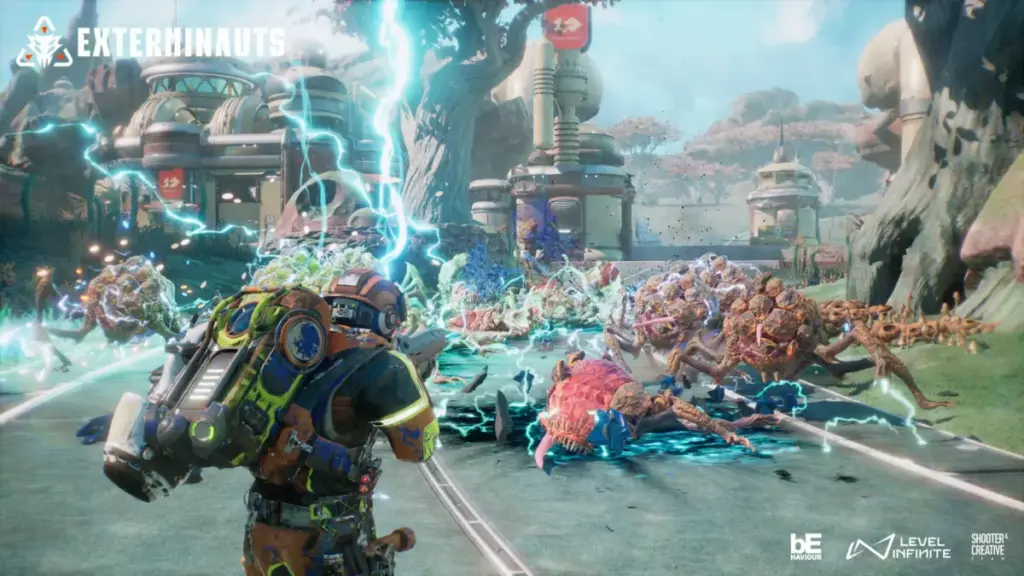
Traversing from one objective to the next inevitably brings squads into direct conflict with the insidious insectoid fauna that populate the environment. Fighting through waves of bugs to accomplish mission goals is practically a defining staple of the sci-fi extraction shooter genre, but the creatures populating Exterminauts manage to stand out through varied designs and novel behavioral quirks. Some enemies consist of little more than gaping maws, leaping vast distances to swallow players whole. Others feature elongated necks and frills reminiscent of the cinematic dinosaurs of the past, though instead of spitting poison, they fire concentrated lasers from a single prominent eye. Still others resemble floating holiday parade balloons that spawn flying parasites capable of delivering debilitating bioelectric shocks. Visually and mechanically, these bizarre alien bugs are a wonderfully strange assortment to encounter.
Managing these creatures becomes increasingly demanding when they coalesce into massive swarms of teeth and appendages, though coordinated squads should find manageable resistance during early missions. During the preview sessions, groups operated primarily between difficulty levels two and four out of a possible eight, learning the ropes and equipping basic gear. Solo play, by contrast, proves significantly more punishing, turning the alien menace into an absolute shredder of player lives. Raising the difficulty scale introduces larger quantities of tougher pests, more frequent environmental repair demands, and heightened risks from environmental hazards like extreme weather events.
Every extraction sequence requires players to hunker down and survive a grand finale of continuous enemy waves while waiting for transport, creating the most dangerous moments of any mission. These intense extraction finales also provide the ideal window for deploying rare support equipment, such as automated sentry turrets or portable attachment tubes that grant infinite ammunition for a brief, critical duration.
When it comes to the arsenal available for pest control, the results are decidedly mixed. The primary selection of kinetic bullet blasters falls squarely into familiar territory, offering assault rifles and submachine guns that operate exactly as expected. While functional, they fail to stand out in a genre overflowing with similar weapon archetypes. Although nobody expects the meticulous detail of a military simulation, incorporating punchier sound design and stronger controller haptics would elevate these basic firearms dramatically.
Fortunately, the secondary weapon class injects much-needed flavor into the combat loop. By default, players carry a plasma sludge launcher that coats targets in caustic goo, stacking corrosive debuffs and inflicting steady damage over time, which proves exceptionally effective against grouped enemies. Alternatively, players can acquire the CrossCut, a weapon that hurls comically oversized circular saw blades. Upon striking a target, these blades stick, spin in place, and relentlessly chew through whatever enemy happens to be trapped in their path. Players can even charge the blades to extend their whirling duration.
These special weapons can be further supercharged by deploying a jumper-cable-like apparatus, sacrificing a portion of battery power to make the next shot significantly more devastating. This intriguing mechanic hints at deeper utility, potentially offering enhanced armor penetration or unique status effects beyond standard stagger and health damage. The dynamism and utility provided by these secondary armaments naturally raise questions about why the standard primary weapons feel so conventional by comparison.
Access to specialized gear and playstyles is managed through Sponsorship systems, which function similarly to traditional character classes by granting unique passive abilities that influence team composition. The Bullet Crown sponsorship focuses on aggressive damage-dealing, increasing critical hit effectiveness and providing a rapid-fire submachine gun. Conversely, the Vardhan sponsorship leans into support, allowing players to share a portion of the healing they receive from recovery items with nearby squadmates. While brief preview windows limit deep observation of how these passive traits alter squad behavior, the tactical advantages of assembling a balanced team with complementary boons remain clear.
A robust meta-game further supports the core loop, allowing players to upgrade equipment using coins and materials scavenged directly from mission environments. Mirroring contemporary genre standards, Exterminauts includes a progression pass stocked with both functional gear and cosmetic items, unlockable through earned gameplay points or direct microtransactions. As players increase their profile level, they can equip trinkets that grant additional passive buffs, enabling customized builds geared toward specific combat styles. Resources required for upgrades flow at a relatively steady and comfortable pace during early hours, though determining the long-term value of these systems will require extended play—alongside the ultimate question of how much time players are willing to invest to earn them.
Having logged roughly five hours with the blue-collar bug-squasher, the experience demonstrates a steady charm that grows over time. The inclusion of specialized launcher weapons and a diverse menagerie of bizarre alien antagonists keeps skirmishes engaging, while ongoing exploration of new mission types and biomes preserves a welcome sense of discovery. Yet, Exterminauts has not yet made an airtight case compelling enough to draw horde shooter enthusiasts away from their current favorites. It lacks the open-ended procedural freedom of Deep Rock Galactic, the pitch-perfect dark atmosphere of Darktide, or the razor-sharp satirical comedy of Helldivers II. While those shortcomings are by no means fatal—particularly at this early stage in development—the title certainly has its work cut out for it.