


Apple has officially introduced the latest generation of its compact tablet, the iPad mini, bringing a sweeping array of substantial hardware upgrades that elevate the small form factor to near-flagship status. However, these major technological leaps come with a significant financial penalty, as the new model sees a notable price increase and pushes into territory previously occupied exclusively by the iPad Pro. While Apple does not update the iPad mini on an annual cycle—a scheduling cadence that typically guarantees a massive performance leap with each new iteration—the latest model represents one of the most comprehensive overhauls the small tablet line has ever seen.
At the heart of the new device is Apple’s cutting-edge 2nm A20 Pro system-on-chip (SoC), featuring a five-core architecture. According to Apple, this advanced silicon delivers graphics performance up to 2.7 times faster and artificial intelligence workloads up to 4.5 times faster than the A17 Pro found in its predecessor. The tablet maintains the same three storage tiers as the previous generation, but the top-tier 512GB model comes equipped with an extra CPU core and a dual 16-core Neural Engine, providing even more robust computational overhead for intensive professional workflows and complex local processing tasks.
Both storage configurations offer full support for Apple Intelligence and advanced Siri AI features, but the sheer processing power of the A20 Pro makes the hardware exceptionally well-suited for demanding on-device AI tasks that require rapid local execution. While Apple does not officially disclose the exact RAM specifications for its mobile devices and tablets, industry expectations and internal architectural indicators suggest that the new iPad mini has been upgraded to 12GB of RAM, up from the 8GB found in the outgoing model. Battery life expectations remain steady compared to previous generations, but the new tablet introduces faster charging capabilities, allowing the device to reach a 50 percent charge in just 30 minutes when paired with a compatible power adapter.
Despite the impressive internal improvements, consumers will notice a more restrictive aesthetic choice regarding color availability, as the options have been scaled back to just Midnight and Starlight. More critically, the pricing strategy has shifted upward. The new iPad mini commands a $200 price increase over the previous generation, with a starting price of $699 for the baseline 128GB model. For buyers who opt to configure the device with cellular connectivity and a specialized nano-texture glass finish, the fully loaded 512GB model reaches an astonishing $1,249, placing the compact device squarely into iPad Pro pricing territory.
The iPad Mini is Finally OLED
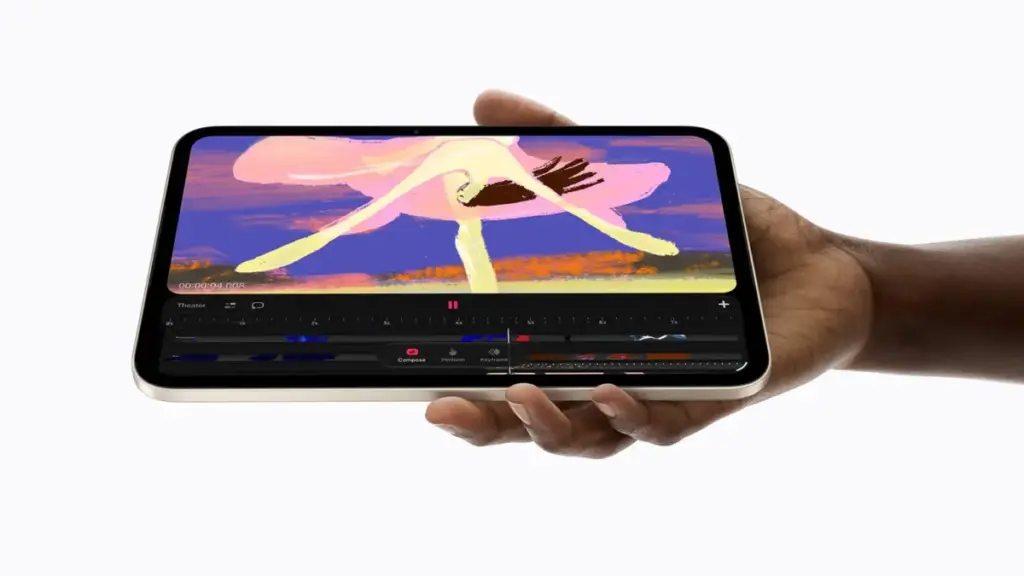
The most anticipated and transformative upgrade to the iPad mini hardware this year is the inclusion of an OLED panel. This strategic shift makes the iPad mini the only other device in Apple’s tablet lineup alongside the iPad Pro to feature advanced OLED display technology. While the physical resolution remains roughly identical to the previous generation, the new panel is capable of achieving a much higher peak HDR brightness of up to 1,200 nits.
The adoption of OLED technology also brings notable physical benefits to the device’s chassis. The new iPad mini retains the same height and nearly identical width as its predecessor, but it is noticeably thinner at 5.4 millimeters and lighter at 255 grams. This reduction in thickness and weight is largely attributed to the elimination of the backlight layers required by traditional LCD panels. By comparison, the previous A17 Pro-powered iPad mini maxed out at 500 nits of standard dynamic range brightness, weighed 293 grams, and measured almost an entire millimeter thicker at 6.3 millimeters.
Furthermore, the display real estate has expanded slightly to 8.5 inches, a change made possible by trimming the surrounding bezels by 24 percent. The most notable point of discussion among prospective buyers and tech commentators on platforms like X has been Apple’s decision to maintain a traditional 60Hz refresh rate rather than adopting ProMotion technology for a $700 product in 2026. Addressing these criticisms during an interview with technology creator Christopher Lawley, Apple’s vice president of Hardware Engineering, Dave Pakula, defended the design choice by emphasizing that the overall display experience relies on more than a single specification, noting that the significantly faster pixel response time inherent to OLED panels makes motion appear remarkably smooth.
For users transitioning from older iPad mini models, the visual upgrade will be substantial, particularly for creative professionals working with HDR content workflows. Continued support for the Apple Pencil Pro ensures that the device remains a highly portable, color-accurate digital canvas for artists, illustrators, and designers who require a compact form factor without sacrificing visual fidelity.
A Handful of Other Changes
Despite retaining a nearly identical external silhouette, the new iPad mini achieves a historic milestone for the product line by becoming Apple’s first water-resistant iPad. The device secures an official IP67 dust and water resistance rating, a feat accomplished in part by eliminating traditional speaker grilles in favor of an innovative Acoustic Display system. This system utilizes tweeters positioned internally between the glass and the aluminum body, while woofers project sound directly through the display panel itself. Apple claims this configuration results in punchier bass performance, enhanced treble clarity, and higher overall audio volume. The approach shares technical similarities with the acoustic display system seen on historical devices like the Huawei P30 Pro, though that setup was primarily engineered to function as an earpiece for voice calls rather than driving a full stereo speaker layout like the one integrated into the new tablet.
Connectivity features have also received a modern overhaul, including the integration of Wi-Fi 7, Bluetooth 6, and Apple’s proprietary C2 cellular modem system. Apple states that the new modem architecture is capable of delivering up to 50 percent faster cellular data speeds compared to previous generations. Biometric authentication continues to be handled reliably by the Touch ID sensor embedded in the top power button, while the optical systems remain largely consistent with past models. However, the front-facing camera has been repositioned along the tablet’s longer edge, significantly improving the user experience for video conferencing and casual calls when the device is held in landscape orientation.
Operating on iPadOS 27, the tablet fully supports Apple’s advanced on-device AI models, bringing enhanced dictation capabilities and user-customizable options for adjusting Siri’s pacing and expressiveness. While the hardware division allocates the extra CPU and Neural Engine cores exclusively to the 512GB configuration, the five-core A20 Pro SoC featured in the entry-level and mid-tier storage options still provides an immense performance leap over the preceding A17 Pro architecture. With an expanding library of complex, graphically demanding AAA video games such as Control and Death Stranding now available natively through the App Store, the new iPad mini positions itself as a remarkably capable portable gaming powerhouse for users seeking desktop-class entertainment in a pocket-sized package.