



The stock market has an enduring habit of surprising investors. Whether it is crashing and shrinking retirement accounts or soaring to record-breaking, seemingly unsustainable valuations, the market continually keeps financial observers on edge. Today, much of the market anxiety is fueled by the frenzied boom surrounding Artificial Intelligence. Investors worry that while AI is undeniably a major technological advancement, the surrounding mania is moving too fast and could trigger an even larger version of the early 2000s dot-com crash.

For veteran financial commentators who lived through the dot-com era—a boom that initially launched early careers and paths to early retirement before the subsequent crash nearly derailed citizenship applications and job security—this cycle feels uniquely familiar. Addressing these widespread market anxieties has become a frequent task, culminating in recent presentations delivered at events like Camp FI Midwest, with further discussions planned for upcoming gatherings such as the Bogleheads conference.

Putting Market Booms and Crises Into Perspective
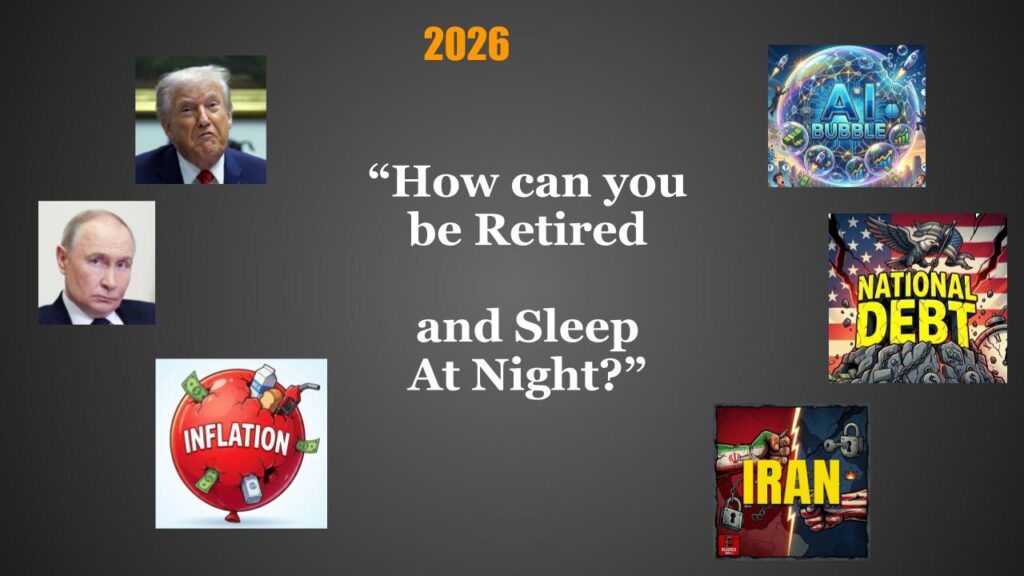
Reflecting on decades of financial independence and retirement reveals a common thread in human psychology: the persistent fear of impending doom. When friends or observers ask how anyone can remain comfortable in retirement while watching global events unfold, the anxiety usually centers on a rotating cast of headline-grabbing worries. Current concerns range from volatile geopolitical leaders and persistent inflation to towering national debts, ongoing international conflicts, and the looming shadow of the AI bubble.

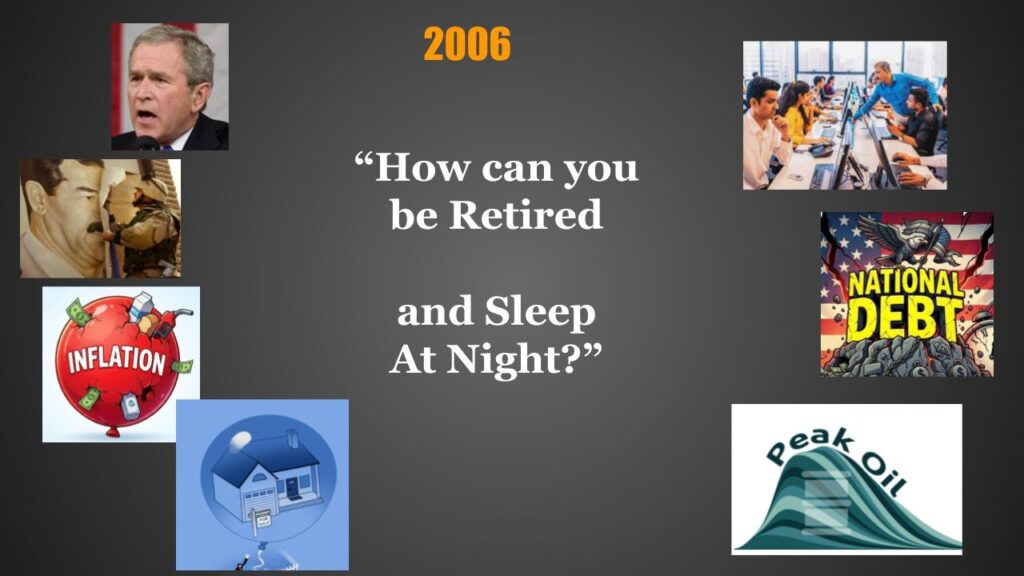
Yet, a look back twenty years reveals a remarkably similar pattern of anxiety. In 2006, investors were equally panicked about different geopolitical figures, the Iraq War, national debt, inflation, and a vastly overvalued housing market. Back then, the existential labor fear was not AI taking office jobs, but rather the outsourcing of labor to India and China. There was even widespread panic over "Peak Oil"—the absolute fear that fossil fuel consumption would outpace supply and plunge the world into resource scarcity.
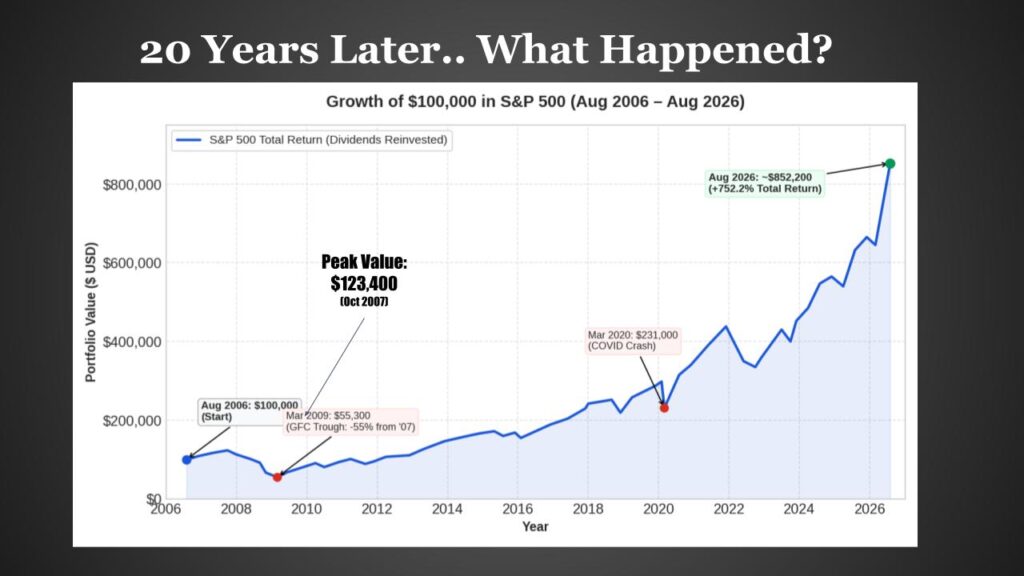
Instead of the predicted total collapse, the subsequent two decades saw the Great Financial Crisis, triggered by housing market exuberance and excessive financial leverage. While it was the largest economic downturn since the Great Depression, looking at the long-term charts shows that even a major crash looks like a minor dip in the grand sweep of history. A hypothetical long-term investment made back then continued to grow significantly, weathering subsequent disruptions like the 2020 pandemic crash.
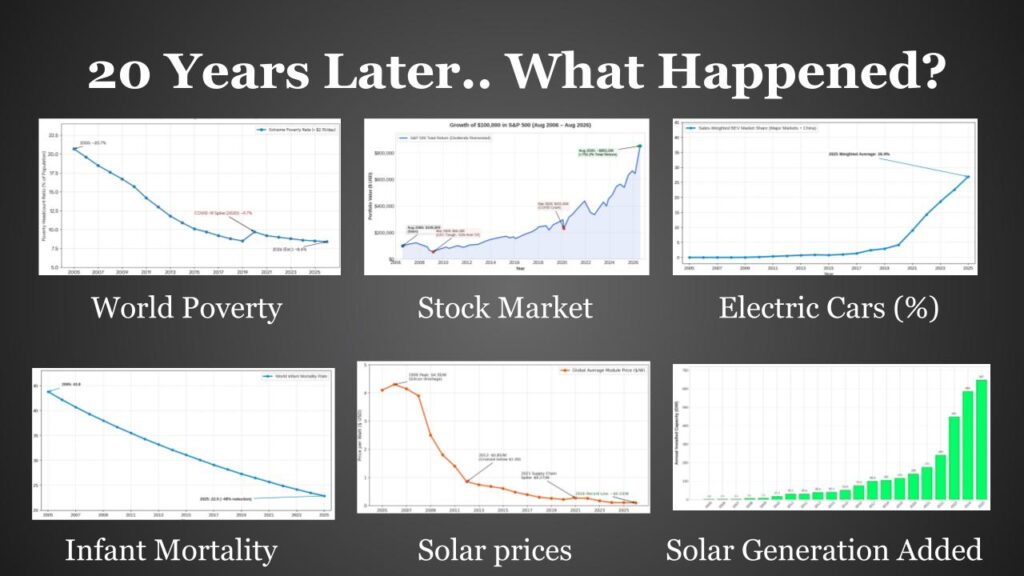
Simultaneously, the broader world experienced substantial improvements. Extreme poverty rates dropped significantly over a twenty-year span, infant mortality rates were cut in half, and clean energy adoption surged as solar panels became dramatically cheaper. Solar generation now accounts for the vast majority of newly added global power capacity, while electric vehicle adoption continues to climb worldwide. Looking back, energy and focus spent on blind panic rather than constructive optimism ultimately proved misplaced, prompting the central question: Is the current AI-driven era fundamentally different?
Prosperity, Productivity, and the Reality of Fear
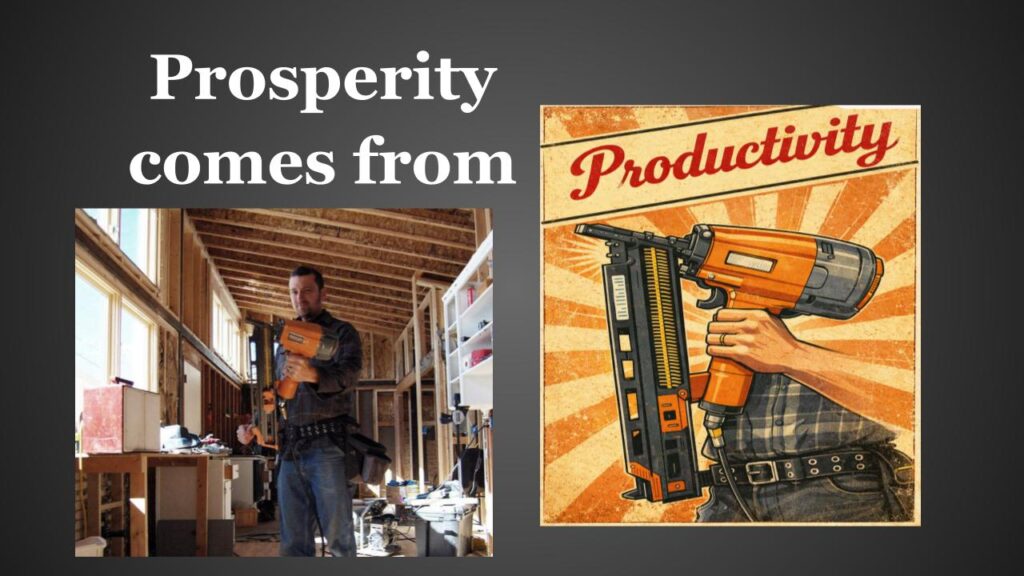
While financial media outlets routinely spin frightening narratives about national debt limits, AI bubbles, and technological displacement, these doomsayers often miss a fundamental economic truth. Prosperity does not originate from the abstract numbers housed within financial systems and stock markets; true prosperity stems directly from productivity.
The underlying mechanism of capitalism is inherently volatile, subject to wild market swings and cyclical panics. However, beneath the surface waves of the stock market, real people continue to perform real work, invent new technologies, and drive progress. An economy or a financial system is ultimately just a human invention. If a financial system experiences a catastrophic breakdown over arbitrary metrics, societies have repeatedly demonstrated the capacity to reset the parameters and return to productive labor. Standard of living, economic growth, and the viability of early retirement all rely fundamentally on high productivity rather than speculative market sentiment.
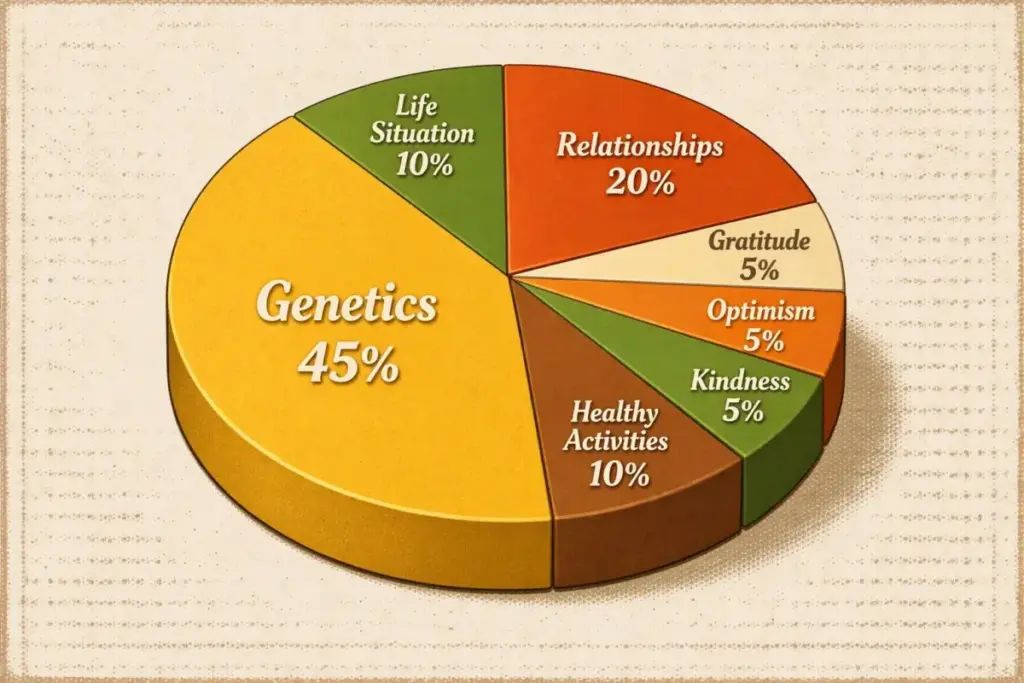
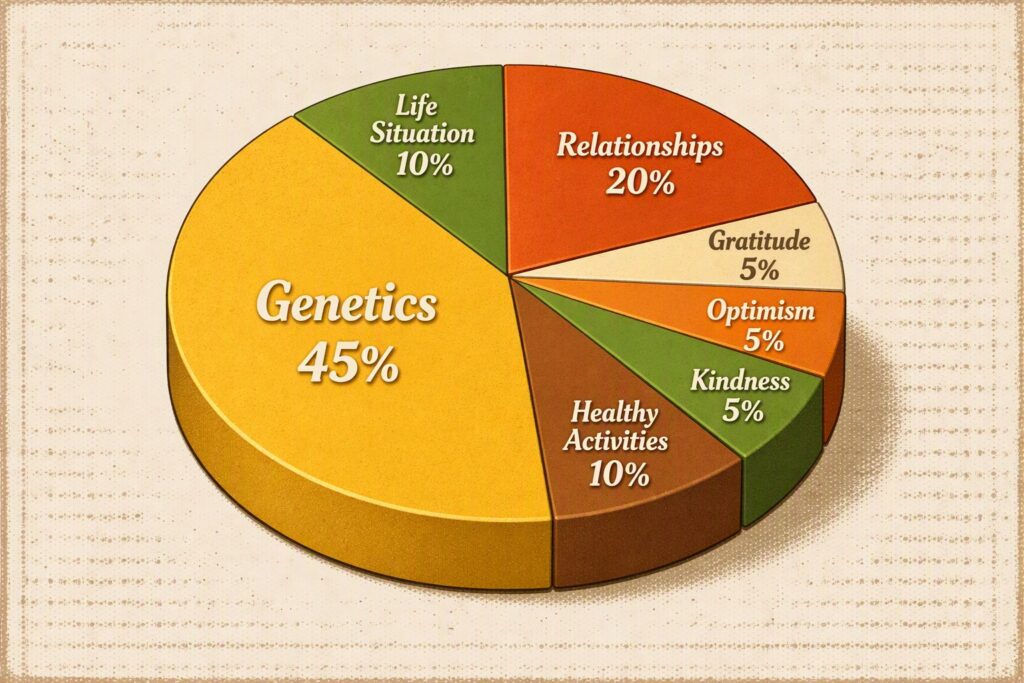
Furthermore, once societies achieve a certain baseline standard of living, human happiness tends to stabilize in that dimension. Wealth is only one small component of overall life satisfaction. Genetic disposition plays a major role, but controllable factors—such as maintaining strong personal relationships, practicing optimism, and engaging in healthy outdoor activities—have a far greater impact on personal well-being.
Despite these reassuring historical realities, persistent background fear remains a common hurdle, even among seasoned financial independence advocates. This pervasive anxiety largely stems from human evolution. Humans are fundamentally danger-detection machines, shaped by natural selection to identify threats to survival. Once immediate physical dangers like predators or extreme scarcity are resolved through societal progress, the human brain simply shifts its baseline and looks for new things to worry about, moving the goalposts from physical survival to social acceptance, economic status, or abstract financial scenarios.

Confronting Fear and Treating AI as an Experiment
Combating this cycle of irrational fear requires self-awareness and an understanding of personal history. Childhood experiences, family environments shaped by past economic depressions, or personal trauma often manifest as financial anxiety and scarcity mindsets in adulthood. Identifying these root causes helps distinguish between genuine present-day risks and inherited emotional responses.
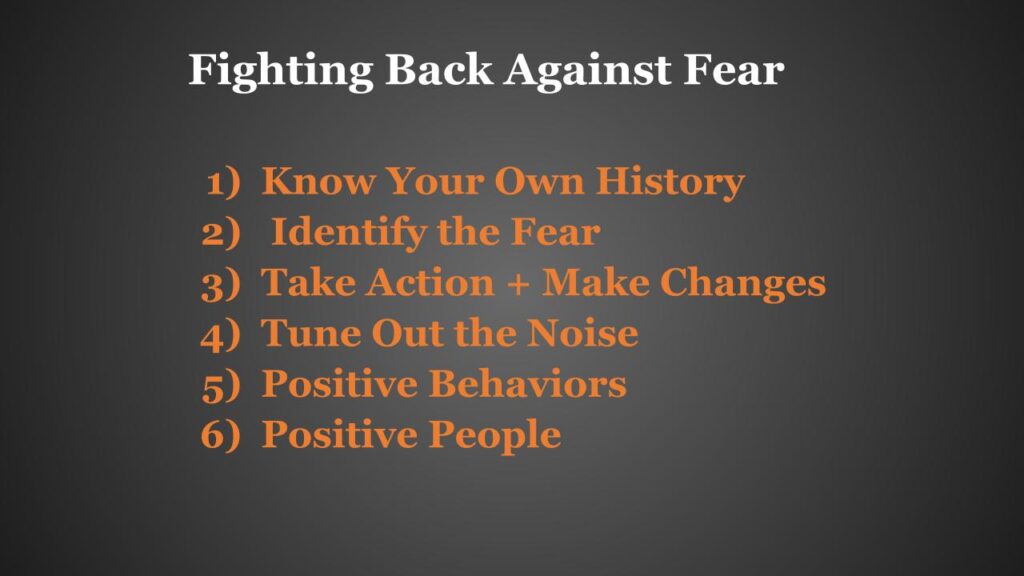
Taking action is one of the most effective ways to dismantle fear. Active engagement transforms the unfamiliar into the familiar, fostering resilience and adaptability. When individuals cultivate the mental and emotional capacity to handle diverse situations, abstract future scenarios lose their terror. Additionally, reducing exposure to the daily cycle of sensationalized news and surrounding oneself with positive, optimistic peers helps realign mental health with natural human needs, such as physical movement, problem-solving, and community connection.

Adopting a mindset where everything is treated as an experiment can fundamentally change how individuals approach uncertainty. Whether trying out a new career path, adjusting living situations, or navigating major life transitions like early retirement, viewing outcomes through an experimental lens removes the catastrophic pressure of failure.

This experimental mindset applies directly to the current Artificial Intelligence boom. Rather than succumbing to doom-scrolling and fear over technological displacement, AI can be understood as a powerful productivity multiplier—essentially functioning as a cognitive nail gun. While new productivity technologies inevitably disrupt traditional job sectors and concentrate certain economic rewards among business owners and shareholders, they simultaneously lower service costs and pave the way for entirely new industries, much like the advent of the internet and mobile computing.
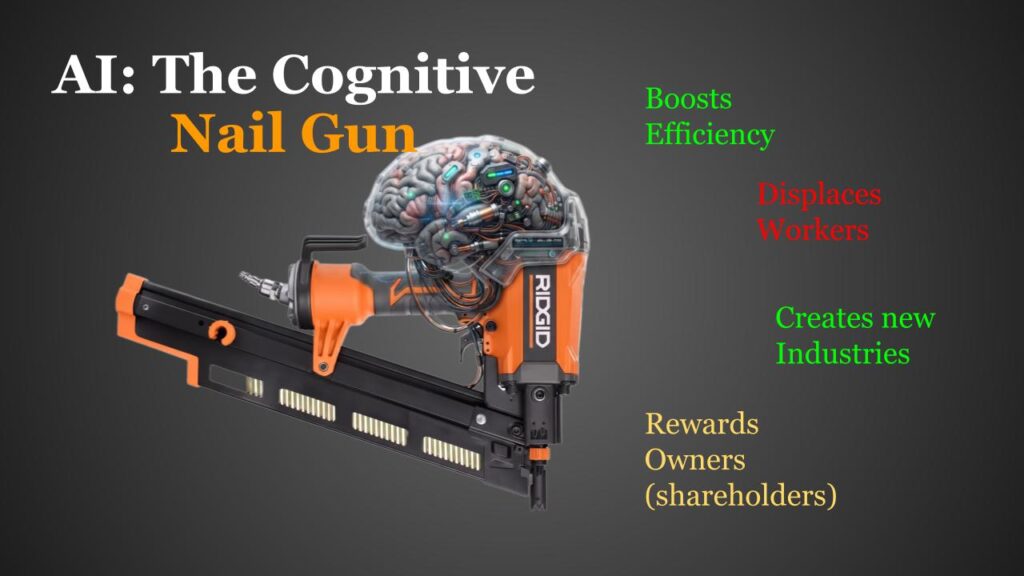
Artificial Intelligence presents a choice: it can be viewed as an existential threat to be feared, or as a catalyst for learning, adaptation, and constructive engagement. Ultimately, overcoming financial anxiety and navigating the uncertainties of modern technological revolutions requires recognizing fear as an internal symptom rather than an external reality. As many long-standing community philosophies suggest, everything worthwhile on the other side of uncertainty requires confronting and moving past the fear that stands in the way.