




For years, the consumer electronics market has sung the praises of organic light-emitting diode technology, commonly known as OLED. Beloved by home theater enthusiasts, cinematic purists, and casual tech consumers alike for its stunning visual fidelity, OLED has quietly conquered the living room. Yet, despite its rapid ascent in the broader display market, a notable exception remains: the professional esports scene. Major competitive gaming tournaments continue to heavily favor traditional liquid-crystal display monitors, a trend that often catches everyday consumers by surprise.
The preference for LCD over OLED in high-stakes competitive environments has little to do with the actual performance capabilities of the panels themselves. Instead, it reflects a combination of logistical realities, tournament sponsorships, and historical industry standards. While professional esports players operate under strict hardware constraints mandated by events, the everyday gaming public faces no such limitations. For the average gamer sitting at a desk at home, OLED displays remain the undisputed pinnacle of visual technology, offering a level of immersion and image quality that traditional LCD panels simply cannot replicate.
To understand the current landscape of gaming monitors, it helps to examine why professional competitors use what they use, how display technologies compare, and whether the average consumer should make the leap to self-emissive screens.

Are OLED Monitors Worse for Competitive Gaming?
The short answer is no. OLED monitors are not inherently worse for competitive or esports gaming than traditional In-Plane Switching (IPS) LCD monitors. In fact, when it comes to raw motion handling, OLED technology boasts a distinct advantage. Because individual pixels generate their own light and can alter their state almost instantaneously, OLED panels exhibit an exceptionally fast pixel response time. On a modern OLED monitor, visual ghosting and motion blur are reduced to nearly imperceptible levels, making them theoretically ideal for tracking fast-moving targets in competitive first-person shooters.
The primary reason professional gamers do not routinely use OLED monitors at major international tournaments is rooted in the economics and logistics of esports event management. Monitors used in competitive tournaments are almost universally chosen and supplied by corporate sponsors rather than individual athletes. This practice serves a dual purpose: it generates vital revenue for event organizers while ensuring absolute hardware consistency across the entire tournament floor. Every competitor plays on the exact same model to maintain a level playing field, eliminating any disputes over hardware advantages.
Because tournament hardware is typically supplied en masse, organizers lean toward display sizes and specifications that have been established as industry norms over many years. At the time of writing, 24-inch displays running at a 1080p resolution remain the gold standard for high-level esports events. This specific screen size is widely considered optimal for competitive play because it presents a compact field of view, allowing players to scan their entire in-game surroundings rapidly with minimal eye and head movement.

The logistical hurdle for OLED lies in product availability and form factor. As the display industry has evolved, manufacturers have largely focused their OLED development on larger panels. Most mainstream OLED gaming monitors start at 27 inches and scale upward in size and resolution. The generally larger physical footprint of these displays makes them less practical for cramped tournament stages where dozens of players sit side-by-side.
Furthermore, high refresh rates play a massive role in competitive hardware selection. While LCD panels can easily push past 600Hz, OLED technology has historically lagged behind in ultra-high refresh rates, though it is slowly catching up. Notable exceptions do exist, such as when Sony developed a specialized 480Hz M10S OLED display specifically for the Apex Legends Global Series Year 4. However, these specialized panels remain outliers in a competitive ecosystem heavily anchored to high-refresh-rate LCD technology.
Why OLED Monitors Are Great for Normal Gaming
Outside the specialized demands of professional esports, the calculus changes entirely. For the vast majority of consumers and enthusiasts, OLED represents a massive generational leap forward in desktop entertainment. The core strengths of the technology address virtually every historical compromise associated with computer displays.

OLED panels achieve absolute black levels by completely turning off individual pixels when displaying dark scenes. This capability generates a virtually infinite contrast ratio, making shadows deep, realistic, and free from the grayish haze that often plagues backlit LCD panels. Combined with near-instantaneous pixel response times and exceptional handling of High Dynamic Range content, the visual impact is profound. Furthermore, modern OLED monitors frequently feature ultra-slim bezels that enhance spatial immersion, alongside wider viewing angles that prevent color shifting when viewing the screen from an off-center position.
While early adopters of OLED technology harbored legitimate concerns regarding image retention and permanent screen burn-in, manufacturing advancements have significantly mitigated these risks. Modern OLED monitors incorporate sophisticated software and hardware protections, such as automatic pixel-shifting and panel-refresh routines, making burn-in far less common during normal, mixed-usage scenarios.
Pricing has also become considerably more consumer-friendly. While OLED displays historically carried an exorbitant luxury tax, aggressive market competition and manufacturing scale have driven prices down. During major retail promotional events such as Amazon Prime Day or Black Friday, standard 27-inch OLED gaming monitors can frequently be found for well under the $500 threshold. For consumers with the requisite budget looking to upgrade their desktop setup, the investment yields a transformative visual upgrade.
Should I Buy an LCD or OLED Gaming Monitor?
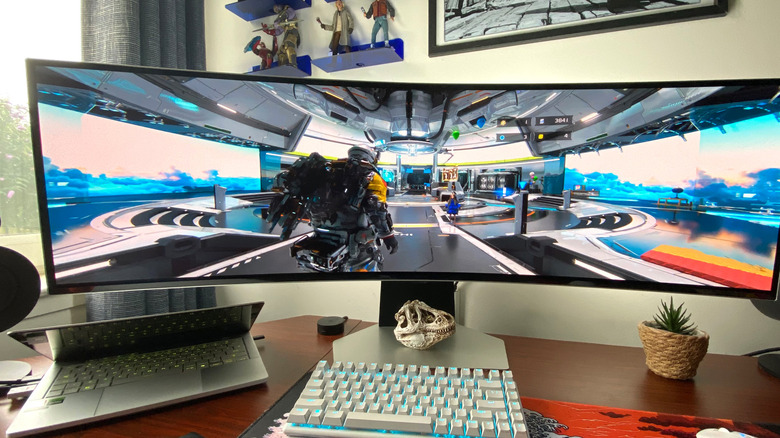
Deciding whether to purchase an LCD or an OLED gaming monitor requires weighing specific environmental factors and performance priorities. In the vast majority of visual metrics, OLED outperforms LCD, delivering superior contrast, motion clarity, and color uniformity. However, traditional LCD technology still holds a few distinct advantages that may sway certain buyers.
First, LCD monitors remain significantly more affordable than their OLED counterparts across almost every size and resolution category. Second, many traditional LCD panels achieve higher peak brightness levels than current OLED screens, making them better suited for brightly lit office environments or rooms with substantial ambient sunlight. Third, LCD panels are structurally immune to permanent burn-in, making them a safer choice for users who leave static user interfaces or productivity software open for extended, uninterrupted hours.
Beyond these points, the competitive advantages of LCD panels diminish rapidly. Image uniformity issues, such as vertical banding in near-black scenes, can occasionally affect OLED panels during subtle panning shots, but these minor artifacts are generally considered far less distracting than the "Dirty Screen Effect" common to many backlit LCDs. This persistent flaw stems from uneven backlight distribution, which creates visible blotches across the screen—a defect particularly noticeable when viewing bright, uniform content like sports broadcasts.
Ultimately, the choice between the two technologies hinges on the fundamental physics of light generation. While LCD panels rely on a uniform backlight shining through liquid crystals and color filters, OLED panels are entirely self-emissive, generating their own light and color at the pixel level. By eliminating the backlight entirely, OLED achieves true, infinite black levels that LCD panels simply cannot replicate, cementing its status as the premier display technology for immersive, high-fidelity gaming at home.