

Over the past several years, the financial landscape has experienced a dramatic and unexpected surge. The value of the S&P 500 index—the benchmark where countless individuals hold a substantial portion of their retirement savings through index funds—has climbed roughly 57 percent in just the past two years alone. Looking back over a five-year horizon, the index has more than doubled, triggering a massive shift in household net worth across the country.
For many investors, this unprecedented momentum has completely altered their financial timelines. Individuals who felt they were only halfway toward achieving their retirement goals as recently as the COVID-19 era may suddenly find that they have blown right past the finish line. Meanwhile, long-term retirees who secured their financial freedom years prior are occasionally eyeing expensive properties or engaging in other discretionary spending behaviors, driven by the wealth effect of a surging market.
Yet, this rapid accumulation of wealth raises a fundamental question: Is this extraordinary market growth real, or is it merely a bubble fueled by financial illusion?

The underlying anxiety was captured neatly in a recent inquiry from a concerned reader, who asked whether the widespread hype surrounding artificial intelligence has placed the market in a massive bubble. The reader questioned whether this environment makes equities acutely vulnerable to a severe future crash and how it might ultimately impact retirement security.
To address these concerns, it helps to examine the foundational mechanics of what a stock actually represents. At its core, a stock is a business arrangement that functions similarly to a rental property.
When an individual owns a rental house, they are entitled to collect rent from a tenant. After covering all operating expenses related to the property, the remainder constitutes profit. If the average market value of rental houses in a specific region escalates while the tenant continues to pay the exact same monthly rent, the higher valuation looks appealing on paper, but it changes little in practical terms unless the owner decides to sell. Even then, selling the property simply means the investor must turn around and pay an equally inflated price to acquire a replacement rental house.
A landlord’s regular cash flow remains entirely unchanged unless they can actively make their rental business more profitable. Achieving this requires operational improvements, such as building out a basement apartment, executing strategic renovations, streamlining expenses, or finding other avenues to increase net earnings.

When that rental property is eventually sold to a new investor, the purchase price should theoretically reflect that future stream of income. For instance, if a property generates $2,000 per month—totaling $24,000 annually—and commands a sale price of $240,000, the incoming buyer is acquiring a business with a price-to-earnings (P/E) ratio of 10. However, if a seller convinces a buyer to hand over $480,000 for that exact same property, the transaction occurs at a P/E ratio of 20. While this outcome heavily favors the seller, it signals a significantly less promising financial return for the incoming investor.
Translating this dynamic to the broader stock market reveals a striking parallel. An investor who placed $100,000 into the market in 2019 and continuously reinvested dividends would find that their portfolio has grown to approximately $256,960 today, representing a 157 percent gain on the original principal. Over that exact same timeframe, however, the share of company earnings generated by that $100,000 basket of stocks has crept upward from $5,290 to $7,540, marking a modest 42 percent increase according to financial data from multpl.com.
Consequently, the price-to-earnings ratio of the broader market has expanded from roughly 20 in 2019 to approximately 30 today. Stock investors participating in the market find themselves in a position akin to real estate investors discovering that property prices have doubled while rental income has barely budged. This compression makes the underlying business less lucrative relative to its cost, meaning investors should logically anticipate lower future returns as a percentage of their total portfolio value.
While owning stocks or rental properties under these conditions remains profitable over the long term, purchasing assets at elevated P/E ratios inherently limits future income generation compared to buying them during a market downturn. It is a matter of basic financial mathematics.

The Driver Behind the Surge: Earnings Growth and the "Magnificent Seven"
Of course, asset prices can justifiably rise if future earnings are projected to expand rapidly. Consider a prospective rental property located near the site of a major corporate campus development. Knowing that local demand will soon drive rental rates upward justifies paying a higher initial price for those anticipated future earnings.
This principle explains why individual company stocks often surge upon the release of positive corporate news. During the pandemic, consumer demand for home exercise equipment spiked, leading investors to project permanent growth for companies like Peloton. When consumer habits eventually normalized, the company’s sales and stock valuation receded accordingly.
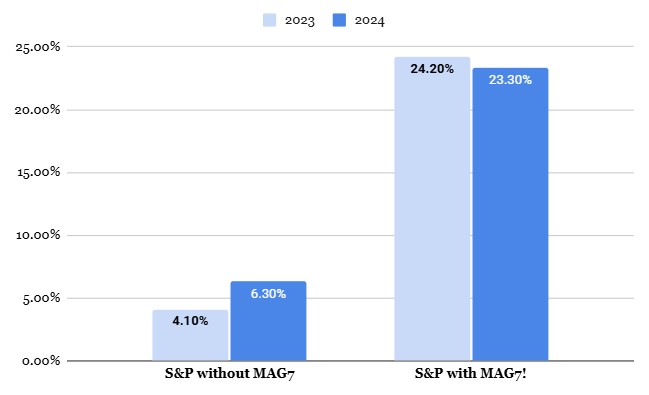
When the entire stock market experiences a broad-based elevation, however, it raises questions about whether the aggregate economy is slated for dramatic acceleration. In the context of the current market cycle, the answer is nuanced. An analysis of the 500 large-cap companies comprising the S&P 500 reveals that roughly three-quarters of the recent market gains stem from just seven dominant technology corporations: Apple, Nvidia, Microsoft, Amazon, Alphabet (Google), Meta (Facebook), and Tesla.
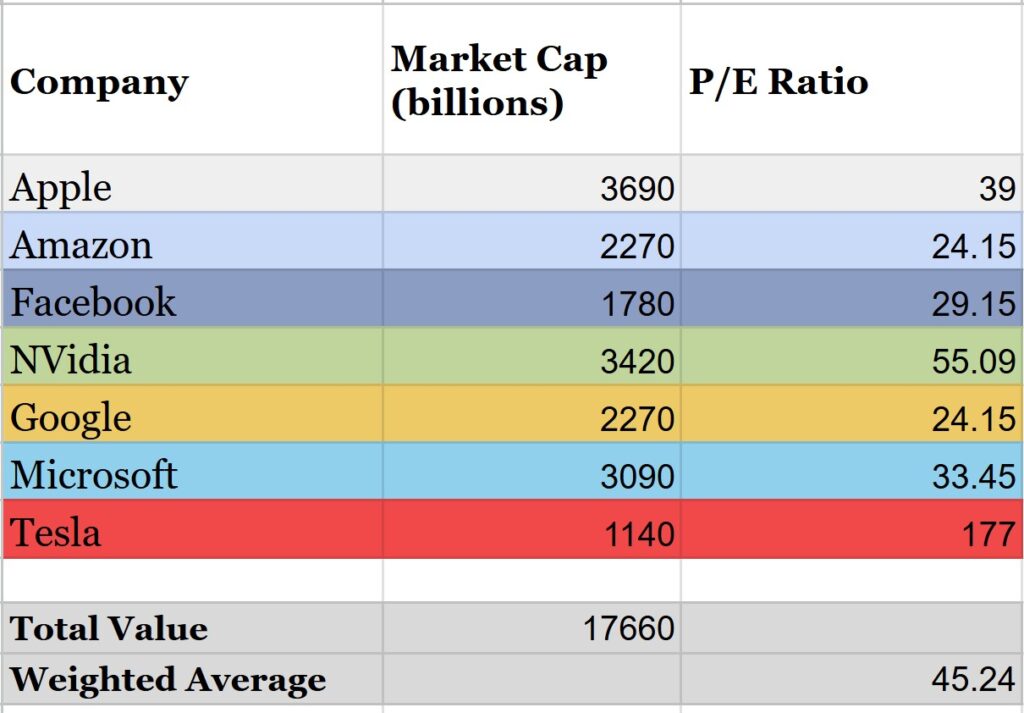
Often dubbed the "Magnificent Seven," these highly profitable enterprises have captured the imagination of investors, driving share prices skyward on expectations of sustained hyper-growth. Collectively, these seven companies account for more than 25 percent of the entire market’s capitalization—tallying an astonishing $17.66 trillion—while sporting significantly higher P/E ratios than the rest of the market, with a weighted average hovering around 45.
Excluding these seven tech giants and examining the remaining 493 companies reveals a more moderate P/E ratio of approximately 20. This disparity indicates that while the broader U.S. economy is expected to maintain steady health, market participants are placing a massive premium on the future earnings trajectory of the nation’s largest technology firms.
The Artificial Intelligence Boom and Infrastructure Spending
The primary catalyst uniting these tech giants is the rapid advancement of artificial intelligence. Recent breakthroughs have demonstrated that software can exhibit human-like reasoning across a rapidly expanding array of disciplines, igniting a frenzy across the corporate world.
Six of the Magnificent Seven companies are currently committing hundreds of billions of dollars toward the construction of massive data centers packed with advanced supercomputers. Meanwhile, the seventh company, Nvidia, sits at the center of this capital expenditure wave as the primary manufacturer of these specialized processors, allowing the firm to command exceptional pricing power amid unprecedented demand.
Beyond this foundational infrastructure layer, industries across the global economy hope that AI will usher in an unprecedented era of operational productivity and accelerated profits. Modern AI systems can analyze entire novels, legal documents, and software codebases in seconds to answer complex queries, identify contractual loopholes, or debug programming errors. Furthermore, AI applications are expanding into autonomous driving, early medical diagnostics, advanced drug discovery, and the development of humanoid robotic labor.
The underlying thesis driving the market is that humanity is on the threshold of an infinite workforce of highly intelligent digital entities capable of working continuously, thereby eliminating the historical constraints of finite human labor and intelligence. While many industry observers believe these technological transformations will ultimately materialize, the exact timeline and realization of corporate profits remain subject to intense debate.
Skeptics point to potential risks, including severe cost overruns, intense competitive pressures, regulatory hurdles, or broader societal disruptions if automation displaces large segments of the workforce. Despite these uncertainties, current market valuations reflect an immense vote of confidence in the future profitability of AI-driven enterprises.

Historical Context and Long-Term Market Realities
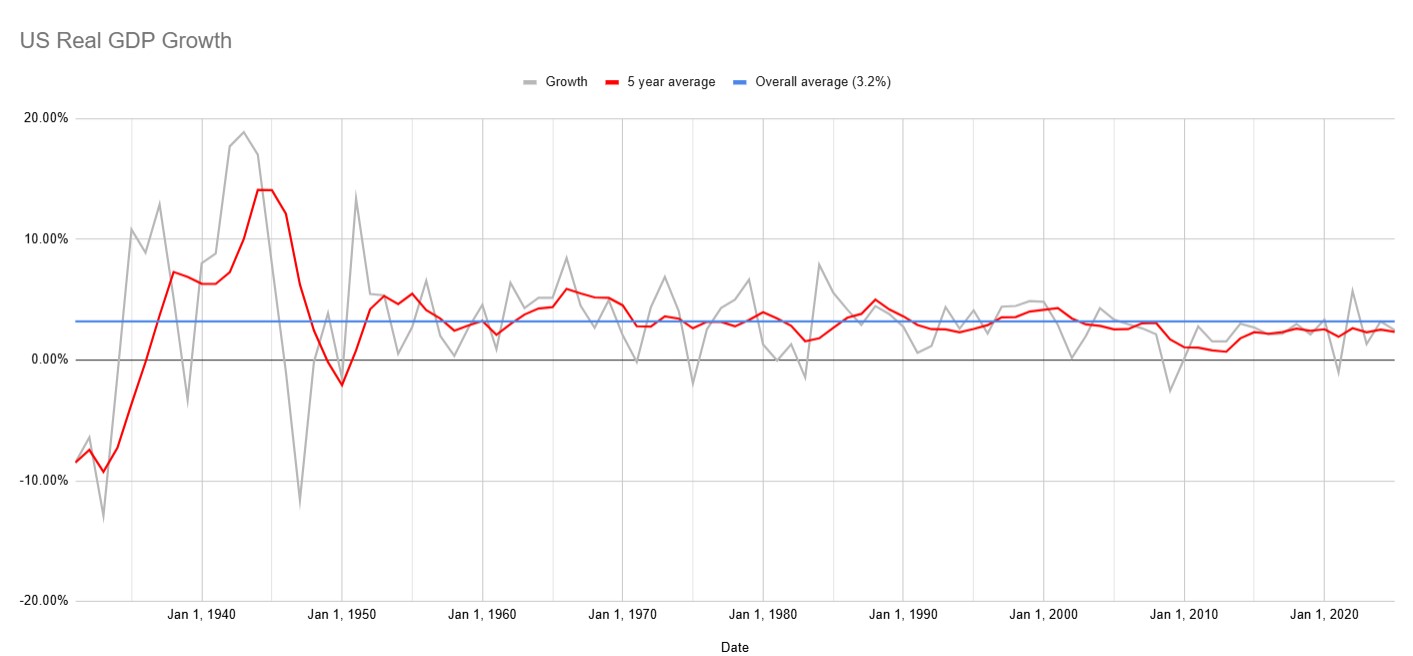
While the future remains inherently unpredictable, historical economic data offers a valuable baseline. Over long stretches of history, real U.S. economic growth adjusted for inflation has averaged a remarkably stable figure of approximately three percent per decade. Interestingly, recent decades have actually experienced slightly slower-than-average GDP growth, providing little historical justification for the elevated valuation multiples currently observed in the equity markets.
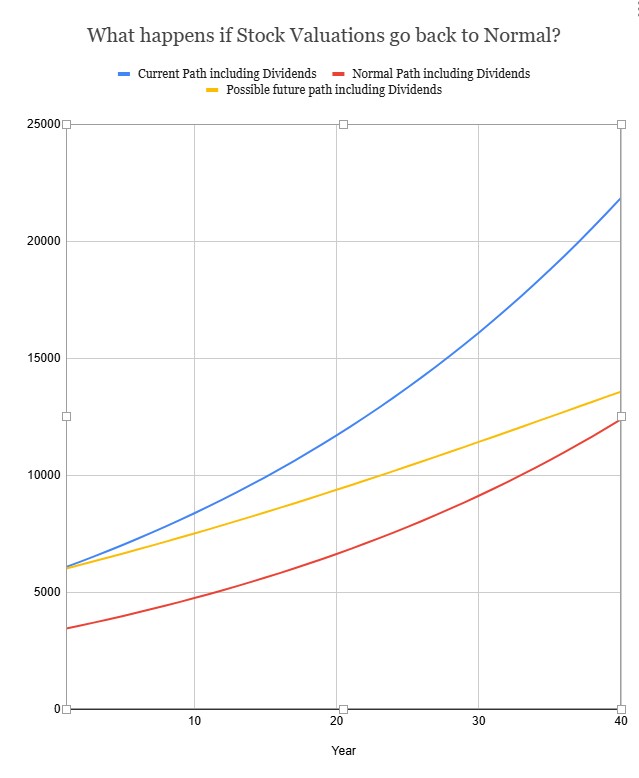
Nonetheless, owning stocks remains a viable long-term strategy for wealth accumulation, albeit one likely to yield more modest returns when purchased at higher initial valuations. Market corrections, manias, and panics will inevitably occur, but historical evidence consistently demonstrates that attempting to time the market by liquidating assets in anticipation of a lower entry point is a losing endeavor for most participants.
Even if stock market valuations eventually compress toward historical averages, the overall economy is projected to continue expanding alongside corporate earnings. Future investors may simply demand lower multiple valuations for those earnings, reflecting a normalization of the price paid for each dollar of corporate profit.
Alternative Asset Classes and Broader Perspectives
While the U.S. stock market remains a favored vehicle for many investors due to the strength of the domestic business environment, other asset classes offer alternative risk-reward profiles. Institutional forecasters, such as Vanguard, routinely publish ten-year annualized return projections for global markets. Their recent analyses suggest that international equities and fixed-income bonds possess the potential to outperform U.S. stocks over the coming decade.
This projection is supported by valuation disparities; international stock funds often trade at significantly lower P/E ratios—such as roughly 16 for broad international indexes—making foreign equities appear substantially more affordable than their U.S. counterparts. However, forecasters note that U.S. markets have consistently outperformed international counterparts in recent years, largely driven by the concentration of domestic technology and AI innovation.
Other investors utilize diversified robo-advisor platforms, such as Betterment, which allocate capital across a broader mix of domestic equities, international stocks, and bonds to balance portfolio volatility with systematic rebalancing. The weighted average P/E ratio of such diversified core portfolios typically sits lower than the U.S. large-cap average, offering a different exposure profile for long-term savers.
Meanwhile, prominent figures like Warren Buffett have signaled caution in the current high-valuation environment. Berkshire Hathaway has accumulated substantial cash reserves while exercising patience, reflecting a view that attractive bargains are scarce when overall equity valuations remain elevated.
On the real estate front, the calculus surrounding homeownership and mortgage debt depends heavily on prevailing interest rates and personal risk tolerance. While mathematical models traditionally favor maintaining low-interest mortgages while directing surplus capital toward index funds, rising interest rates have altered the equation. For many homeowners, paying down a mortgage functions similarly to securing a guaranteed fixed return, providing psychological peace of mind alongside financial stability.
Ultimately, navigating a surging, AI-hyped market requires perspective. For long-term investors, the fundamental prescription remains unchanged: maintain consistent investment habits, ignore daily news cycles, and focus on personal well-being. Investing time in physical pursuits and the outdoors often yields far more reliable returns than constantly monitoring portfolio fluctuations in an unpredictable economic climate.