




The question of how long a dog should remain on probiotic supplements is a growing point of discussion among pet owners and veterinary professionals alike. While these gut-health supplements have become staple products in many pet households, there is no single, universally applicable timeline for their use. A veterinarian may recommend a specific probiotic formulation for short-term support during a temporary digestive disruption, while in other cases, a daily supplement may become an ongoing component of a dog’s long-term wellness plan.
According to veterinary experts, including Athena Gaffud, DVM, the key to successful supplementation lies in defining a clear clinical purpose rather than simply continuing use until a product container is empty. Understanding the distinct differences between short-term targeted support and long-term daily maintenance is essential for determining when to continue, reassess, or discontinue probiotic administration.
Short-Term Support Versus Long-Term Daily Maintenance
To determine the appropriate duration of probiotic use, veterinarians recommend separating the initial reason for starting the supplement from the decision to continue it. When a dog receives probiotic support during a specific digestive episode, the administration plan should have a defined endpoint or review date. Conversely, an otherwise healthy dog utilizing a daily supplement for general maintenance may remain on a continuous routine, provided the specific formulation remains suitable for the animal’s changing life stages and dietary needs.
It is important to recognize that not all probiotics serve the same clinical purpose. Different products contain different strains of microorganisms, active concentrations, and secondary ingredients. Clinical studies do not support a single, blanket course length for the entire category of canine probiotics. A veterinary consultation can help clarify whether a probiotic is intended to address a temporary event, fit into a broader nutritional strategy, or assist in the management of an ongoing clinical condition.

Navigating Situational and Short-Term Use
Temporary life events often prompt pet owners to seek digestive support for their dogs. Common triggers include upcoming travel, a transition to a new pet food, or recovery from a recent course of veterinary medication. Rather than introducing a supplement after digestive distress has already begun, veterinarians advise planning ahead. For example, a planned trip represents a predictable disruption to a dog’s normal routine. Discussing the dog’s historical response to travel with a veterinarian prior to departure allows for a proactive strategy that may combine dietary adjustments with a selected probiotic, tailored specifically to the dog’s individual needs.
However, if a dog is already showing active signs of illness, such as repeated vomiting, diarrhea, or lethargy, probiotics should not be used as a substitute for a professional veterinary examination. In these situations, the immediate priority is diagnostic evaluation to identify the root cause of the illness. Any recommendation for supportive probiotic use should be integrated into a comprehensive veterinary treatment plan, complete with explicit instructions on when to contact the clinic if the dog’s condition fails to improve.
The Dynamics of Long-Term Daily Support
When pet owners discuss long-term probiotic use, they are typically referring to dietary maintenance rather than an active treatment course with a strict completion date. For suitable dogs, a daily, label-directed supplement can safely fit into this maintenance role. However, continuous use requires periodic evaluations to ensure the supplement’s formulation, serving size, and inactive ingredients remain compatible with the dog’s current health status, prescription medications, and primary diet.
Daily probiotic chews represent a popular option for consistent administration, particularly in households that find soft chews easier to feed than powders or capsules. While daily directions on a product label explain how the supplement is intended to be used, they do not imply that every dog requires lifelong supplementation, nor do they eliminate the need for regular veterinary reviews.
Understanding Dosing and Everyday Administration
When daily use is deemed appropriate by a veterinarian, adhering strictly to the manufacturer’s labeling and the agreed-upon veterinary plan is critical. The term "daily" refers purely to the frequency of administration; it does not suggest that larger servings will yield superior results, nor does it mean different probiotic products should be combined.

For instance, standard dosing directions for PetLabCo. Probiotic Chews dictate one soft chew daily for dogs weighing under 25 pounds, two chews for dogs weighing between 25 and 75 pounds, and three chews for dogs exceeding 75 pounds. Each of these standard 4-gram soft chews delivers 3 billion colony-forming units (CFUs) of beneficial bacteria. This weight-based dosing is distinct from other specialized ranges, such as tailored or clinical formulas, highlighting the importance of reading individual product packaging carefully.
To ensure daily routines are managed safely, households with multiple caregivers should establish a single, central record to track when a supplement has been given. Because many probiotic chews are highly palatable and resemble treats, a dog may easily receive multiple doses if communication is lacking among family members. A robust daily routine involves verifying the container, administering the precise weight-appropriate serving, and confirming that the dog has fully consumed the supplement.
In the event of a missed day, pet owners should not double the next serving to compensate. Giving an extra dose disrupts the planned daily concentration and does not safely recover the missed day. Since many maintenance routines are open-ended rather than fixed-term, a single missed serving is generally inconsequential. If missed doses occur frequently, it may be necessary to simplify the administration routine or designate a single family member to manage the dog’s supplements.
What Science Says About Probiotic Timelines
There is no uniform clinical countdown that dictates exactly when a probiotic will begin to show results in a dog. Scientific studies evaluate various markers of efficacy, such as visible stool characteristics, changes in fecal microbiota populations, or specific laboratory biomarkers. Because these measurements represent different physiological metrics, a positive change recorded in a laboratory setting may not immediately manifest as a visible improvement at home.
The timeline for expected outcomes should be defined in consultation with a veterinarian. A healthy dog on a maintenance supplement may show no visible changes because they have no pre-existing health issues to resolve. Conversely, a dog experiencing active digestive discomfort requires a holistic approach, where any observed improvement may be the combined result of dietary changes, medical treatments, the natural passage of time, and supportive supplementation.

To provide product-specific context, PetLabCo. conducted a 31-day randomized, placebo-controlled study involving 24 healthy adult Beagles. The published summary of this manufacturer-funded study noted positive changes in microbiome measurements and fecal calprotectin levels. While these findings offer valuable context, veterinarians caution that a 31-day study timeline should not be interpreted as a universal rule. The study was conducted on healthy adult dogs, meaning the data cannot be used to predict recovery times for sick animals, establish safety profiles for growing puppies, or guarantee permanent microbiome changes after the supplement is discontinued.
Furthermore, scientific research emphasizes that probiotic strains are highly specific. For example, a 2025 controlled study of Bacillus coagulans GBI-30, 6086 in healthy adult dogs observed specific improvements in stool quality and microbiota populations. However, these findings cannot be applied to other probiotic products that do not contain this exact, characterized strain.
Broader scientific literature also reveals significant variation in the quality and outcomes of canine probiotic trials. A 2019 systematic review described the existing clinical evidence as limited and heterogeneous. Similarly, a subsequent review focusing on acute diarrhea studies did not identify a clinically significant reduction in recovery times among dogs receiving the evaluated nutraceuticals. These findings reinforce the veterinary consensus that probiotics should not be viewed as instant cures for acute gastrointestinal disease.
Comparing Targeted Gut Support and Multifunctional Formulations
When selecting a daily supplement, pet owners must choose between highly targeted gut-support products and broader, multifunctional formulas. The optimal choice depends on the specific goals established with a veterinarian, and combining different multi-ingredient supplements without professional guidance is highly discouraged.
A targeted product, such as the PetLabCo. Probiotic Chew, is designed primarily for focused digestive support. This pork-flavored soft chew utilizes a three-species Bacillus blend combined with fructooligosaccharides (FOS) and galactooligosaccharides (GOS) prebiotics, alongside a postbiotic yeast blend. It is formulated specifically for dogs aged 12 weeks and older, meaning age and ingredient profiles are primary factors in determining suitability.

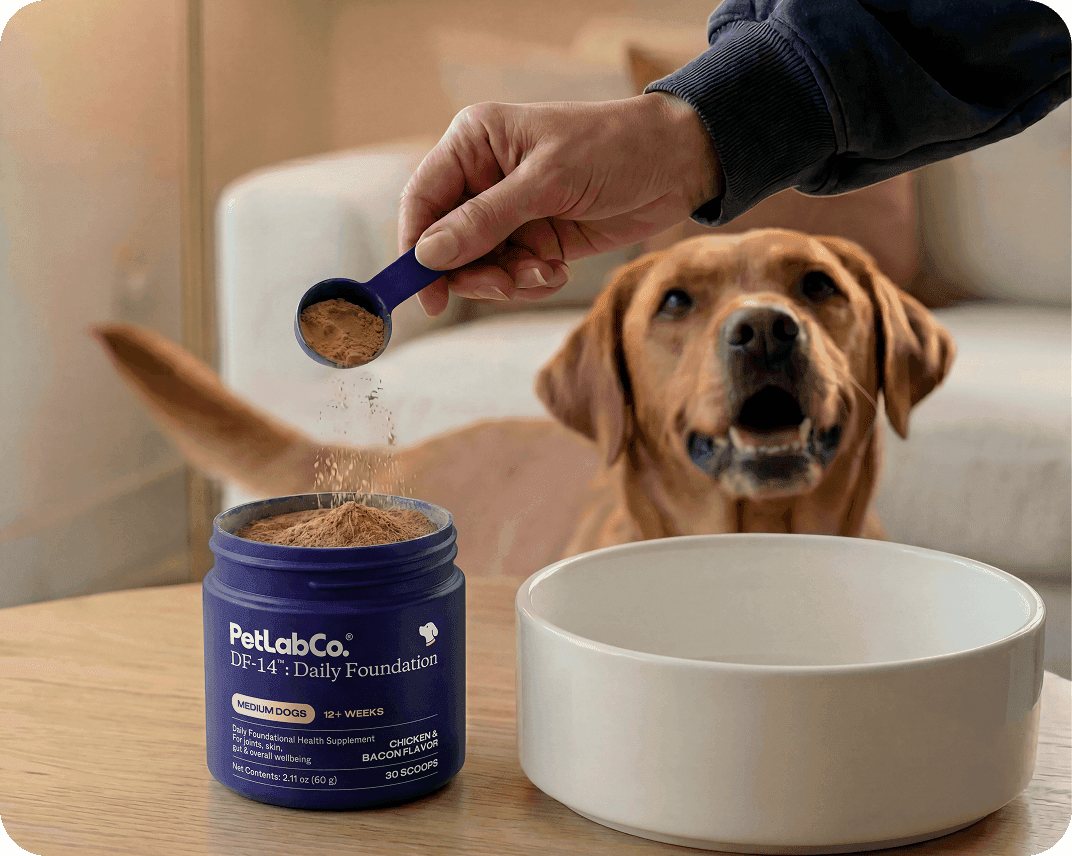
In contrast, a multifunctional powder like DF-14 Daily Foundation is formulated to provide broader, systemic support. In addition to probiotic strains, it contains a variety of active ingredients with distinct nutritional roles, such as krill, crawfish-derived glucosamine, and hydrolyzed chicken liver flavor. Because of this complex ingredient profile, DF-14 must be managed as a comprehensive supplement rather than a simple probiotic.
The administration of a powder also differs from a soft chew. DF-14 is designed to be mixed once daily into wet food or slightly moistened kibble at mealtime, using weight-specific scoops provided with the corresponding tub. For example, dogs under 4 pounds require the small scoop included with the specialized small-dog tub. When using a powder, owners must verify not only that the supplement was served, but that the dog consumed the entire portion of supplemented food. Additionally, because of the presence of shellfish- and poultry-derived ingredients, multifunctional powders may not be appropriate for dogs on restricted elimination diets or those with known food allergies.
Medications, Side Effects, and Veterinary Coordination
The introduction of any new medication can significantly alter a dog’s supplement plan. Pet owners should provide their veterinarian with a complete list of all over-the-counter supplements and chews, as inactive ingredients and specific bacterial strains can influence therapeutic outcomes.
Many probiotic product labels, including those from PetLabCo., note that the simultaneous administration of probiotics and oral medications may delay drug absorption. While this does not mean every medication will interact negatively, it underscores the need to discuss proper dosing intervals with a veterinarian.
This coordination is particularly important during antibiotic therapy. Antibiotics and probiotics serve entirely different medical purposes. Owners must complete the full prescribed course of antibiotics exactly as directed by their veterinarian, and should never shorten the treatment course simply because a probiotic has been added to the routine. The prescribing veterinarian can advise whether a probiotic is appropriate during or after antibiotic therapy, which specific formulation to use, and how many hours of separation are required between the administration of the two products.
Pet owners should also monitor their dogs for potential side effects when starting a probiotic. Some dogs may experience temporary flatulence or mild changes in stool consistency. While the PetLabCo. clinical study summary reported mild, transient digestive upset in both the active and placebo groups, any persistent or worsening symptoms warrant professional medical advice. If a dog exhibits severe signs—such as repeated vomiting, blood in the stool, extreme lethargy, or signs of abdominal pain—supplementation should be stopped immediately, and a veterinarian should be contacted. Emergency veterinary care should also be sought if a dog accidentally consumes an excessive quantity of probiotic supplements.
Implementing a Structured Reassessment Plan
An effective supplementation routine relies on a structured, written plan that outlines the initial reason for starting the product and establishes clear triggers for reassessment. Rather than relying on guesswork, pet owners should maintain a simple, consistent record of their dog’s progress.
A practical tracking routine includes recording the original clinical goal, such as daily support discussed during an annual veterinary exam. Owners should note the exact product name, the weight-appropriate serving size, and daily observations of the dog’s appetite and stool quality. It is also highly beneficial to document any concurrent changes, such as new foods, prescribed medications, travel dates, or missed supplement doses. Finally, the plan should define specific reassessment triggers, such as the appearance of new symptoms or a scheduled veterinary checkup.
Before purchasing a replacement container of any supplement, owners should evaluate whether the product remains appropriate for the dog’s current life stage and health status. If the probiotic was initiated to support a temporary event that has since passed, it may be time to discontinue use. Conversely, if a chronic issue has not improved after a reasonable trial period, extending the trial with another container is rarely the correct course of action; instead, the overall diagnostic and treatment plan should be reviewed with a veterinarian.
Ultimately, there is no scientific evidence suggesting that all canine probiotics must be permanently maintained, tapered, or cycled. The decision to continue, alter, or stop a supplement should always be based on the individual dog’s clinical response, current health status, and the practical feasibility of maintaining a consistent daily routine.