


Published: September 22, 2026
Last Updated: September 29, 2026
By: Ellyn Kail
The newly renovated Belmont Park has barely opened its gates to the public, yet it is already facing severe scrutiny and condemnation from animal welfare organizations following a grim start to its inaugural racing season. Having hosted a mere nine races on its inner turf track, the lavish, multi-million-dollar facility has already witnessed the tragic deaths of two young horses, sparking immediate outrage and urgent calls for accountability from industry watchdogs.
The most recent incident occurred on Friday, September 25, when a three-year-old horse named Main Thing suffered a catastrophic injury to his right hind leg during a race. The severity of the damage necessitated that the young animal be euthanized directly on the track. This devastating loss comes a mere six days after the fatal breakdown of another horse, Heat Missile, who suffered an identical fate on the exact same course during the opening weekend of the facility’s highly publicized relaunch.
In response to these rapid and fatal developments, People for the Ethical Treatment of Animals (PETA) has formally called upon the New York State Gaming Commission to immediately suspend all racing activities on Belmont’s inner turf track. Furthermore, the organization is demanding a comprehensive investigation into how a newly minted facility, backed by substantial public financing, has so quickly transformed into what critics are calling a lethal environment for racehorses.
The concern over the safety of the new Belmont Park is compounded by the immense financial backing involved in its creation. The facility’s extensive redevelopment was made possible through a $455 million taxpayer-funded loan provided by New York State, which contributed to a total project cost of $550 million spearheaded by the New York Racing Association (NYRA). For a project of this financial magnitude and prestige, the rapid succession of fatal injuries has intensified questions regarding track safety standards and the oversight of publicly supported sports infrastructure.
Animal rights advocates argue that the system has already failed Main Thing and Heat Missile, and that regulatory bodies must intervene decisively before another animal loses its life on the newly laid turf.
The Fatal Opening Weekend at Belmont Park
The operational troubles at the revitalized Belmont Park became starkly evident during a sprint race on the opening weekend of the facility’s high-profile debut. Heat Missile, a three-year-old mare who had entered the race as the betting favorite, suffered catastrophic injuries to her left front leg. Specifically, both of her sesamoid bones were fractured, and her fetlock joint completely dislocated during the run.
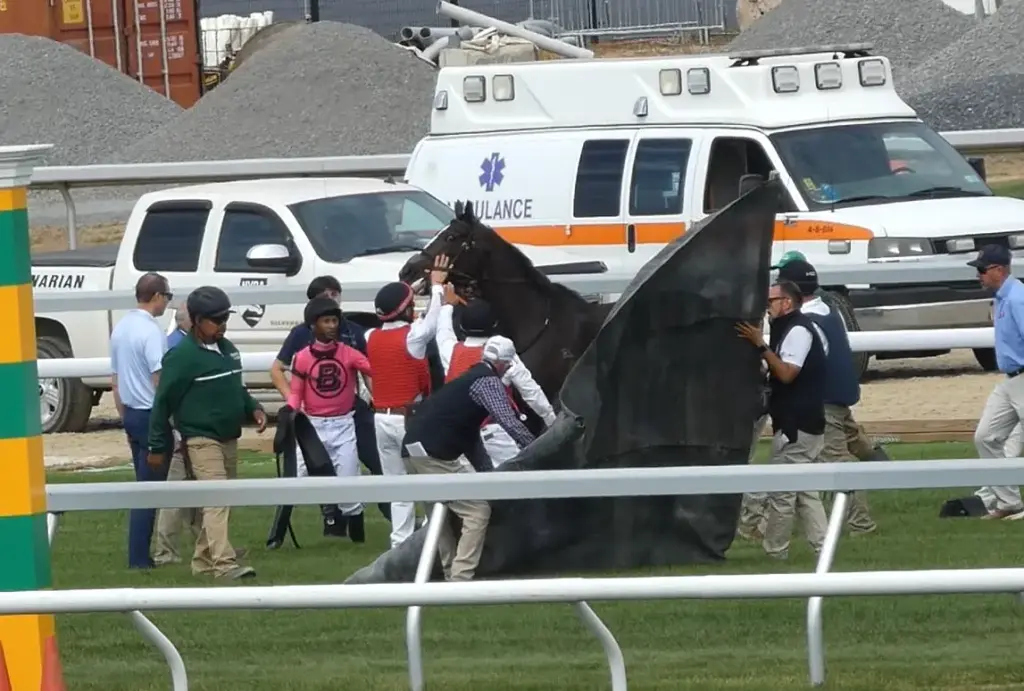
Track workers rushed to the injured animal, cradling her mangled leg as a veterinarian prepared a syringe containing the euthanasia drug. Eyewitnesses and media reports documented the distressed mare turning with wide eyes before track personnel quickly erected a privacy screen around her to obstruct the view of spectators seated in the grandstand. Workers covered her eyes to calm her final moments. Moments later, the favorite mare was dead.
The incident took place on Saturday, September 19, marking only the second day of racing at the newly renovated Belmont Park. PETA representatives were present at the grounds to document the event, capturing footage of the aftermath. Following the removal of Heat Missile’s body from the track, racing operations, public betting, and the broader opening weekend festivities resumed as scheduled.
The juxtaposition of public celebration and equine mortality has drawn sharp criticism from welfare advocates who argue that the racing industry continues to prioritize entertainment and wagering over the safety and well-being of the animals involved.
Concurrent Tragedies Across Triple Crown Tracks
The crisis at Belmont Park was not an isolated incident within the broader American horse racing landscape over that fateful weekend. Hundreds of miles away at Churchill Downs in Kentucky, another catastrophic fatal injury occurred, highlighting systemic safety concerns across major racing institutions.
A two-year-old horse named Lutkenhaus suffered a severe, fatal injury to his left front leg after falling on the track. The initial fall precipitated a massive, multi-horse crash involving five other two-year-old horses: Ritornello, Midnight Rumble, Shacklebolt, Steve Wood, and Industrious. The horses collided and tumbled over one another in an incident that left the track resembling a disaster zone.
Lutkenhaus was euthanized on-site due to the severity of his injuries, while Industrious and Shacklebolt were loaded onto equine ambulances for urgent medical evaluation. The multi-horse pileup also resulted in serious injuries to three jockeys, all of whom were transported to a local hospital for medical treatment. Footage capturing the chaotic aftermath of the crash was subsequently shared on social media platform X, drawing widespread public attention and concern.
The simultaneous occurrence of fatal breakdowns at both Belmont Park and Churchill Downs on the same weekend has intensified pressure on industry leaders. PETA and other animal advocacy groups are intensifying their push for the racing industry to adopt meaningful, binding safety reforms designed to prevent catastrophic injuries. Additionally, questions are being raised regarding the financial arrangements between private racing entities and public institutions, with critics asserting that taxpayers should not inadvertently subsidize an industry characterized by such high rates of fatal injuries.
The Debate Over Racing and Animal Welfare
The recent deaths at Belmont Park and Churchill Downs have reignited a broader ethical debate concerning the nature of horse racing itself. Animal behaviorists and welfare advocates emphasize that horses possess complex emotional ranges, intellectual capabilities, and social structures similar to those of humans. In standard industry practices, however, these social herd animals are frequently subjected to isolation and confinement.
While horses are athletic animals that naturally enjoy running in open spaces, advocates point out a fundamental distinction between natural equine movement and organized racing. Horses do not naturally choose to race under the stress of whips, nor do they willingly push their bodies to speeds and distances that frequently result in pulmonary hemorrhage, skeletal fractures, and fatal breakdowns. Because animals cannot provide informed consent to participate in high-risk athletic competitions, critics argue that the ethical responsibility for their safety rests entirely upon human operators, regulators, and spectators.
The use of privacy screens at tracks like Belmont Park—deployed primarily to shield spectators from witnessing euthanasia procedures—has also been a point of contention. Advocates argue that these screens serve to sanitize the reality of the sport, hiding the lethal consequences of racing from public view. By releasing documentation of incidents like Heat Missile’s final moments, organizations like PETA aim to pierce that veil of secrecy, urging the public to reevaluate their participation in or support of an industry where equine fatalities remain a recurring reality.