

For anyone growing up in the suburbs of Chicago, pizza was never a complicated philosophical debate. According to Brittany and Brennan Grosvenor, the culinary minds behind Proof in Portland, Oregon, ordering a pie on a Friday night always boiled down to a simple, localized binary: thin-crust, deep-dish, or double-dough. It was a weekly family tradition etched into the very fabric of Midwestern life. Today, the Grosvenors are slinging that very same style at Proof, though the terminology has evolved. The regional shorthand of “thin crust” has gracefully stepped aside for a nationally resonant designation: tavern-style. Over the past few years, this unassuming pizza trend has swept across the United States from coast to coast, capturing the imaginations—and appetites—of diners far beyond the Midwest.
Outsiders looking in often make the mistake of associating the Windy City exclusively with its famous, towering deep-dish pizza, a decadent tourist magnet that routinely graces the food sections of travel magazines. But as Brittany points out, that tourist-beckoning pie is simply not reflective of daily reality for locals. Deep dish, she explains, is reserved for special occasions or out-of-town guests—a much less frequent treat compared to the ubiquitous Midwestern thin-crust style steadily gaining ground nationwide. The pizza you actually get every week, or encounter naturally at a child’s birthday party, a local bowling alley, or a neighborhood sports bar, is invariably tavern-style.
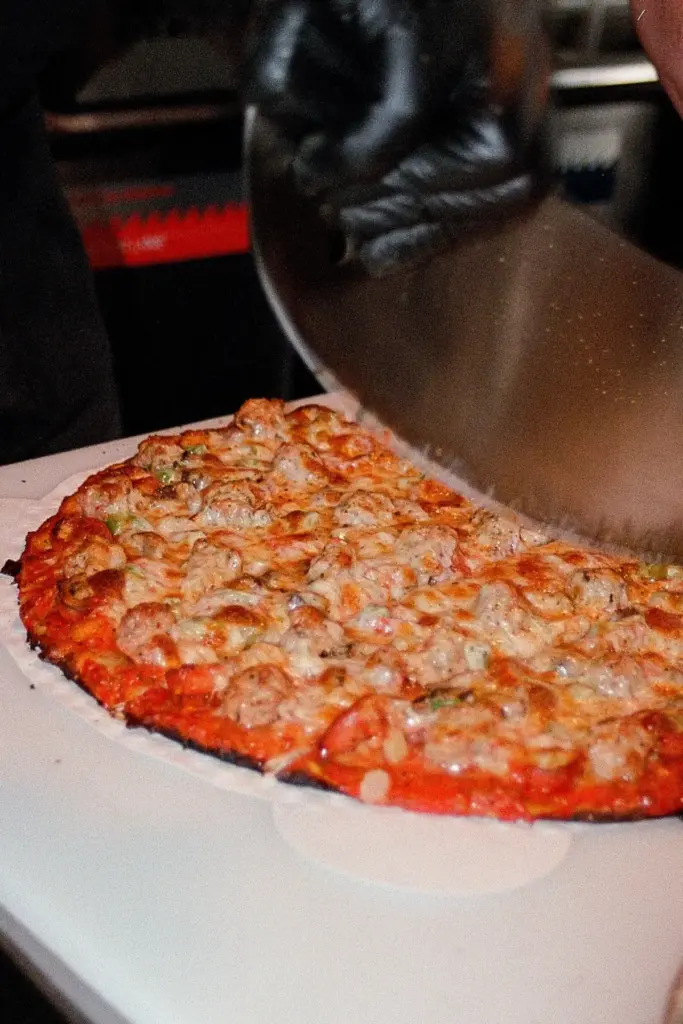
This beloved style of pizza is deeply prevalent across the entire Midwest. Major culinary hubs like Chicago, Milwaukee, Minnesota, and St. Louis all boast their own proud iterations of these similar pies. The defining characteristics of tavern-style pizza include its remarkably thin, cracker-like crust that bakes up crisp and structural, and its signature method of preparation: rather than being sliced into traditional triangular wedges, it is cut into a grid of small squares, commonly known as a “party cut.” Depending heavily on regional preferences and the specific nostalgia of individual neighborhood pizzerias, the sauce might lean noticeably sweet or feature a spicy kick. However, ultimate lightness and structural crispness remain the style’s unique selling points.
Writing for Esquire in 2023, critic Omar Mamoon aptly described the variant—which was then still rapidly ascending in popularity—as a direct “foil” to the famously thick, pillowy Detroit-style pizza that experienced its own monumental cultural moment in the late 2010s. The true beauty of the tavern-style pie lies entirely in its innate shareability. A single round pizza yields a significantly higher number of individual morsels when sliced into a grid rather than traditional triangles. This makes it exceptional drinking food, as Bradley Shorten observes. Shorten is the creative force behind Kim’s Uncle Pizza in his hometown Chicago suburb of Westmont, Illinois, as well as the recently opened La Merna in Washington, D.C.

Because the small squares easily fit on a casual cocktail napkin, they invite relaxed, communal grazing. According to Shorten, the hallmark of a truly great tavern-style pie is that every single square features a balanced distribution of toppings and ingredients, with the cheese, sauce, and meats extending all the way out to the absolute edge of the crust. While food lovers often joke that the four small, crust-heavy corner pieces might not technically be the best bites on the pie, Shorten notes they are invariably the pieces “everybody goes for first,” especially if those diners happen to hail from Chicago.
Over the past few years, as traditional neighborhood taverns have become growing fixations for a savvy cadre of restaurateurs across the country, the party-cut pizza and its accompanying aesthetic have become ubiquitous. Recent high-profile openings include Keepers in New York City; One Trick Pony in Fort Worth, Texas; Tillie’s Tavern Pizza in Wheat Ridge, Colorado; and spots like Zarella and Dimmi Dimmi Corner Italian in Chicago, where this style of pizza has always been abundantly available. For many displaced Chicagoans, these new openings across the country represent a long-overdue opportunity to correct the historical record regarding their hometown’s true pizza culture, while other Midwesterners are eager to proudly claim their own distinct stake in the region’s diverse pizza lineage.
The evolutionary path of tavern-style pizza often resembles a complex game of international telephone. When Mike Fadem opened the second location of his popular New York City pizzeria Ops—a spot famously known for its wood-fired, Neapolitan-esque pies featuring leopard-spotted crusts and delightfully pliant dough—he deliberately wanted to offer something entirely new. Fadem originally hails from St. Louis, where the local namesake pizza is notoriously ultra-thin. Despite his deep personal fondness for it, Fadem readily admits that it might not objectively represent the best version of tavern pizza, acknowledging its vocal critics who frequently take issue with its characteristic use of Provel, a gooey, highly processed local cheese blend.
Tracing the historical lineage reveals that St. Louis-style pizza actually derives directly from the thin-crust Chicago pizza tradition, which itself can trace its ancestry back to traditional Neapolitan roots. Yet, distinct culinary divergence has accompanied every single geographic jump. Meanwhile, one of Fadem’s key employees at Ops hails from New Jersey, a state that proudly champions its own historic thin-crust tavern and bar-style pizza tradition, much like the fiercely loyal following enjoyed by the bar pies of the greater Boston area. Inspired by these overlapping traditions, Fadem began wondering if they could craft an "Ops version" of the concept. Knowing Ops for its mastery of natural sourdough, Fadem wanted to highlight the rich, complex flavor profiles of whole grains while achieving an intense, shatteringly crisp texture that he knew would deeply appeal to New Yorkers.
The resulting creation was added to the menu under the regionally agnostic name “tavernetta.” Although St. Louis and New Jersey served as the initial conceptual inspiration, Fadem notes that the absolute best pizza discovered during his extensive research trips was actually found in Milwaukee. Today, the Tavernetta has not displaced the other beloved pies on the Ops menu; rather, it is frequently ordered as a complementary addition, with most dining groups opting to throw at least one into the mix for the table.

The momentum is not confined to the East Coast. In Los Angeles, the popular cocktail destination Bar Next Door recently celebrated its third anniversary by officially expanding its operations to include a dedicated food menu. Previously, the establishment had allowed patrons to conveniently bring in hot pies from Prince Street Pizza located right next door, largely because Prince Street co-owner Lawrence Longo is a partner in the bar venture. However, bar owner and beverage director Brynn Smith recognized a practical limitation to this arrangement. After having a traditional, heavy slice of pizza, customers would occasionally feel full and decide to head home for the evening. By introducing tavern-style pies into the space, Smith hopes to encourage patrons to linger longer and enjoy another round of drinks. The fact that these pizzas—technically listed on the menu as “bar pies” to better harmonize with the bar’s namesake—are crafted exclusively for the cocktail lounge by Prince Street only adds an extra incentive for locals to venture out for the evening.
The fundamental idea of the traditional tavern as a warm, social, and deeply convivial space is utterly inseparable from the phenomenon of tavern-style pizza itself. When Shorten opened La Merna alongside his wife, Meg Schmitt—who grew up in St. Louis—their core design and atmospheric goal was to recreate the comforting ambiance of a classic Chicago dive bar or a traditional Wisconsin supper club. They envisioned a welcoming establishment defined by rich wood-paneled walls, classic checkered floors, and comfortable red leather booths where groups of friends could comfortably slide in, order pitchers of cold beer alongside endless party-cut pizzas, and settle in for a long evening of conversation.
The rising appeal of this authentic tavern aesthetic across restaurants nationwide is rooted entirely in a collective cultural desire for spaces that feel genuinely homey, unpretentious, and lived-in. In these environments, diners are warmly invited to spread out, stay awhile, and strip away modern dining pretensions in favor of something comforting and familiar. For millions of people, this exact sentiment is perfectly exemplified by the comforting archetype of the hometown pizza shop, an institution forever tethered in our collective cultural imagination to the enduring charms of a simpler era.
It is precisely for this reason that out in Oregon, the Grosvenors have expanded their menu at Proof to include nostalgic regional specialties like house-made Bosco sticks—the iconic stuffed cheese breadsticks beloved in Midwestern school cafeterias—alongside classic Italian beef sandwiches piled high with spicy giardiniera. While the couple could occasionally track down certain isolated Midwestern food hits around Portland, they grew continually frustrated by their inability to find everything authentic under one roof. As Brennan Grosvenor aptly summarizes their operational philosophy, they are simply trying to embody the true feeling of home: walking into an old-school neighborhood tavern in Chicago and knowing you can order a little bit of everything that makes home feel close.