

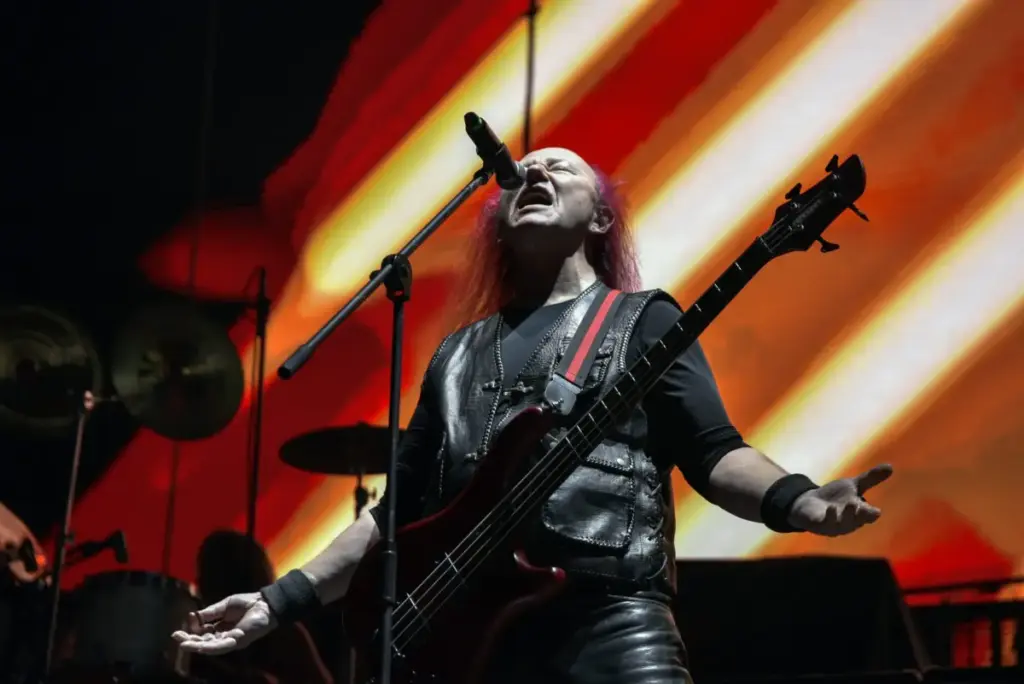
Conrad “Cronos” Lant, the iconic frontman, bassist, and creative visionary behind the legendary Northern British heavy metal band Venom, has passed away at the age of 63, according to statements released by the band on their official social media channels and corroborated by the Guardian. While no specific cause of death has been cited by representatives or family members, the loss marks the end of an era for extreme music, robbing the heavy metal community of one of its most fiercely original and enduring architects.
In a poignant and stirring statement released shortly after the news of his passing broke, surviving members of the group paid tribute to their long-time leader’s immense legacy. For more than four decades, Conrad’s distinctive voice, driving basslines, and uncompromising artistic vision remained the absolute heart and soul of Venom. The band reflected that he ultimately created something that changed heavy music forever, emphasizing that Venom never once followed the rules dictated by the mainstream music industry, but instead aggressively forged their own dark path. At the center of that turbulent, revolutionary journey stood Conrad—uncompromising, fearless, and utterly unmistakable to anyone who ever witnessed his thunderous performances.
To understand the profound weight of Lant’s passing, one must look back at the musical landscape of the early 1980s, a time when heavy metal was still defining its boundaries. When Venom released its landmark debut album in 1981, the group’s presentation and aesthetic were so wildly extreme that many casual observers and mainstream critics simply did not know how to process them, let alone take them seriously. The band draped themselves in an audacious mixture of skulls, bondage gear, medieval swords, and a relentless barrage of pseudo-witchcraft and Satanic imagery. Combined with their fiery, flamboyant stage antics, Venom looked and sounded like a nightmare brought vividly to life on a concert stage.
Yet, beneath the theatrical shock value lay a raw, ferocious musicality that exerted a vast and far-reaching influence on the development of heavy metal, particularly the explosive thrash metal subgenre. The sonic blueprint laid down by Lant and his bandmates echoed loudly through the decades, inspiring a generation of future icons. Pioneering thrash and death metal giants such as Metallica, Slayer, and Anthrax all drew heavily from the template Venom established. The band’s towering influence even stretched far beyond the traditional boundaries of heavy metal, capturing the imagination of alternative rock royalty like Nirvana drummer and Foo Fighters frontman Dave Grohl. Grohl’s deep respect for Lant’s contributions culminated in a memorable collaboration when Lant contributed to Grohl’s acclaimed 2004 heavy metal side-project, Probot. Furthermore, Venom’s seminal 1982 sophomore album, “Black Metal,” proved so profoundly monumental that it single-handedly gave birth to an entire extreme musical subgenre. That very subgenre would subsequently be taken to even greater, darker extremes by subsequent waves of Scandinavian bands in the decades that followed.
Conrad Lant’s journey into the annals of heavy metal history began far from the global stages he would eventually command. Born in London into a musical family, Lant relocated with his relatives to Newcastle during his childhood, where he would eventually find his calling in the gritty, industrial North of England. At the tender age of 16, Lant joined a local underground band called Guillotine. Over time, through a series of lineup changes and evolving musical ambitions, Guillotine gradually morphed into the entity that would become Venom. Initially, Lant entered the fold as a guitarist, bringing a sharp, aggressive edge to the group’s embryonic sound. However, as various members departed and the band reshuffled its creative core, Lant transitioned over to the bass guitar—an instrument he would master and play with thunderous authority for the remainder of his professional career—before ultimately stepping up to take on lead vocal duties.
With their definitive name, lineup, and notorious image firmly locked into place, the classic power trio consisting of Lant, guitarist Jeff Dunn (who performed under the moniker Mantas), and drummer Tony Bray (known as Abaddon) unleashed their explosive debut full-length album, “Welcome to Hell,” in 1981. The record was a watershed moment for underground music, featuring provocative tracks such as the single “In League With Satan,” a delightfully subversive composition that famously incorporated a chilling speech about the devil recorded entirely in reverse. This audacious artistic choice set the tone for everything the band would strive to achieve in the years to come.
The ferocious momentum established by their debut allowed the group to continue relentlessly along that dark, uncompromising track across a string of five studio albums throughout the turbulent landscape of the 1980s. However, the release that truly propelled them out of the underground tape-trading networks and into the broader public consciousness was their third studio album, “Possessed.” Released in April of 1985, the record arrived at a cultural crossroads, its timing coinciding perfectly with the sudden, fiery rise of the highly controversial Parents Music Resource Center (PMRC).
The organization, spearheaded by influential political figures including Tipper Gore, Susan Baker, and other prominent "Washington wives," famously testified before the United States Congress regarding what they argued were overtly sexual, violent, and Satanic lyrics and imagery woven throughout popular music. In their zealous crusade to police the airwaves and record stores, the PMRC compiled a notorious list known as the “Filthy 15,” identifying songs they deemed most offensive to public morality. To the surprise of many traditionalists, Venom’s album “Possessed” landed firmly at No. 14 on this infamous chart. Intriguingly, Venom found themselves listed alongside an eclectic and wildly diverse array of mainstream and pop superstars, sharing space with tracks by Prince, Madonna, Sheena Easton, heavy metal peers Judas Priest, and even pop icon Cyndi Lauper.
While the inclusion on the PMRC list brought Venom’s extreme brand of music to the attention of countless thousands of curious listeners who had previously never heard of the band, the political backlash ultimately yielded mixed results. Aside from successfully lobbying for the mandatory implementation of the now-familiar "Parental Advisory: Explicit Content" warning stickers that would henceforth be affixed to certain compact discs and vinyl releases, the congressional hearings largely functioned as a massive, free publicity campaign for the very artists the organization sought to censor.
Like many pioneering groups subject to the intense pressures of the music industry and internal friction, Venom eventually hit a breaking point, leading the band to go on an indefinite hiatus in 1988. Following the temporary dissolution of the group that made him famous, Lant embarked on a dedicated solo career, performing and recording under his well-known moniker Cronos throughout the entirety of the 1990s, keeping the spirit of the band’s aggressive aesthetic alive during a decade dominated by grunge and alternative rock.
Despite the passage of time and shifting musical trends, the enduring appeal of Venom eventually drew the founding members back together. The band reformed to unleash another series of punishing long-players, steadily building upon their storied discography with an additional seven studio albums. Their creative output remained remarkably consistent right up into the modern era, culminating in the release of their most recent studio effort, 2018’s “Storm the Gates.” Demonstrating an indefatigable work ethic and a deep-seated love for the live performance medium that defined his existence, Lant and the modern incarnation of Venom continued to tour aggressively, hammering out heavy metal anthems across international stages right up until this past summer.