


Watching Congresswoman Haley Stevens attempt to explain her eleventh-hour endorsement of Republican Mike Rogers over her fellow Democrat Abdul El-Sayed in the high-stakes United States Senate race in Michigan leaves viewers with a profound sense of relief. For many within the Democratic party, the primary feeling is one of gratitude that this individual did not defeat El-Sayed in the primary election, despite outspending him by a wide margin. It is a moment that brings into sharp focus questions about fitness for higher office and underscores the reality that Stevens will not be occupying television screens in an official capacity for much longer.
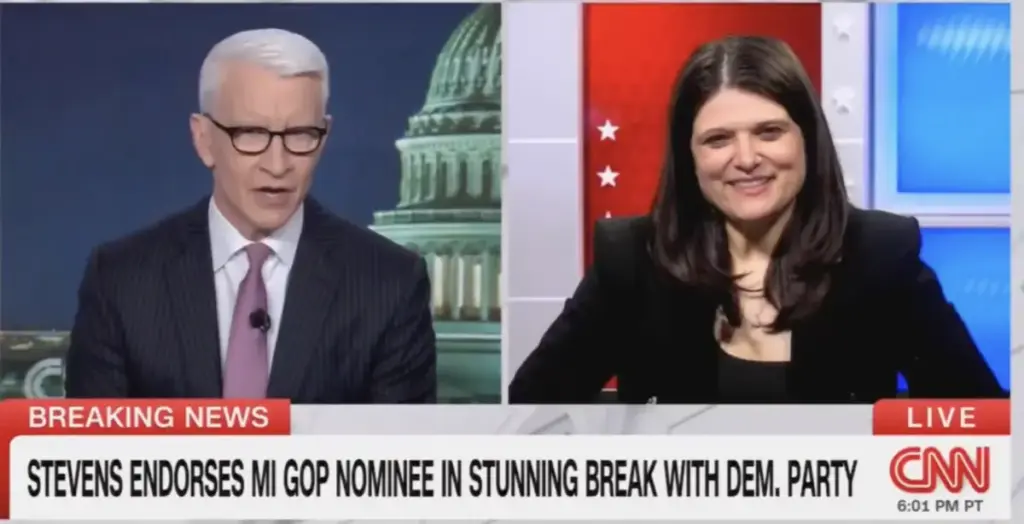
The controversy reached a national audience when Stevens appeared on CNN for a grueling 15-minute conversation with anchor Anderson Cooper. Throughout the segment, Cooper maintained a calm and quietly incredulous line of questioning, systematically dismantling the rationale behind the sudden political pivot. Cooper immediately zeroed in on a damaging allegation made by Stevens’ congressional colleague, Representative Debbie Dingell, a towering figure within the Michigan political delegation. According to Dingell, Stevens had explicitly assured her just hours before appearing alongside Rogers at a Detroit church that a cross-party endorsement was not forthcoming. This revelation set up the central, pressing inquiry of the interview: What changed between that private phone call and the following morning, and what was the definitive turning point in Stevens’ dramatic about-face?
As the interview unfolded, Stevens proved entirely incapable of answering these straightforward and direct questions. The exchange was so jarring that Dingell herself, watching the program in real time, publicly characterized the segment on social media as "one of the most painful interviews I have ever watched." In the realm of television news and politics—where a candidate’s demeanor and visual presentation have carried immense weight ever since Richard Nixon’s famous televised debate struggles in 1960—Stevens appeared visibly rattled rather than assured.
Reflexively beginning nearly every response with the word "Look," Stevens repeatedly failed to construct a coherent point. Instead, she blinked, scowled, and furrowed her brow while navigating a series of evasive non-answers. One of her primary talking points relied on a vague and non-specific complaint regarding El-Sayed’s supposed anger. However, viewers watching the broadcast noted the irony, as it was not El-Sayed whose evident frustration and distress were on full display, but rather Stevens herself as she struggled to defend her actions.
Throughout the grueling exchange, Anderson Cooper largely allowed Stevens the necessary room to articulate her position fully, which ultimately resulted in a self-inflicted political setback. As Stevens repeatedly insisted on her enduring love for the Democratic Party, Cooper refrained from pointing out the obvious paradox: her public refusal to vote for the nominee of her own party formed the very premise of their discussion. When Stevens attempted to pivot by invoking unrelated controversies—such as former Maine senatorial candidate Graham Platner’s past tattoos and sexual assault allegations—Cooper declined to take the bait or entertain false equivalencies. He did not ask what alleged actions of El-Sayed could possibly be compared to such severe allegations. Instead, Cooper anchored the conversation back to the immediate, narrow, yet apparently insurmountable question at hand.
The core puzzle remained unexplained: why were Stevens’ stated issues with El-Sayed—such as his campaign association with Hasan Piker or an outside group’s political advertisement linking Israel to high prices—surmountable during the primary and the campaign, yet suddenly severe enough to warrant a public defection at the most critical juncture of a high-stakes midterm election?
During the interview, Stevens also attempted to downplay the immense significance of her decision by declaring, "I’m an independent woman." This struck many observers as an unusual posture for a politician who was actively capitalizing on the national media attention generated by her defection to appear on primetime television. It was an irony that Cooper could not resist pointing out, noting the inherent contradiction in using a high-profile national platform to assert independence while simultaneously executing a politically explosive maneuver.
Political analysts noted that Stevens had multiple alternative paths available. She could have quietly confined her support for Rogers to the privacy of the voting booth—a private concession to personal animus over political principle. Instead, Stevens chose a path of public self-immolation, doubling down on her worst instincts during an exchange that clarified nothing except the profound wisdom of Michigan Democrats in declining to make her their party’s standard-bearer for the Senate seat.
At the same time, observers suggest that Stevens’ behavior reflects the desperate search for relevance by a politician facing the end of her current tenure. Many members of her congressional staff have reportedly departed, a vacuum that was clearly evident in her lack of preparation for Cooper’s easily predictable inquiries. As Stevens herself readily admitted during the broadcast, she is a lame-duck representative who will be vacating her seat in the House of Representatives in just a few months. By throwing her lot behind Rogers and securing the public praise of Donald Trump, Stevens effectively guaranteed a temporary spike in visibility, even if that relevance is destined to be vanishingly brief.
The stammering and evasive figure who appeared on CNN demonstrated quite clearly that she was not prepared for the demands of primetime political leadership. While her conduct has drawn widespread condemnation from within her party, the broader political establishment and the electorate can find solace in the reality that Michigan has avoided a much larger legislative crisis.