



The cast and creative team behind the highly anticipated “Godzilla Minus Zero” brought the radiant glow of a Hollywood-style standing ovation straight to the 39th Tokyo International Film Festival on Sunday. The triumphant homecoming arrived just two days before director Takashi Yamazaki’s direct follow-up to his Oscar-winning blockbuster “Godzilla Minus One” officially opens in theaters across Japan, setting the stage for what is expected to be another massive cultural and box office phenomenon.
Lead actor Kamiki Ryunosuke, who eagerly reprises his acclaimed role as the haunted veteran Shikishima Koichi, and Hamabe Minami, who returns to the screen as his devoted wife Noriko, had stepped off a transpacific flight only two days prior. The dynamic duo had flown directly back to Japan after attending a high-profile, electrifying world premiere at Los Angeles’ historic TCL Chinese Theatre, where international audiences gave the franchise its latest milestone moment.
Reflecting on the reception in Southern California, Kamiki shared his awe with the festival audience in Tokyo. The energy in the theater across the Pacific was simply extraordinary, he noted, explaining that feeling that raw, unfiltered enthusiasm firsthand made him realize all over again just how deeply and passionately Godzilla is loved on a global scale. It was, in his words, an invaluable and unforgettable experience for everyone involved in the production.
Reports from the Hollywood premiere indicated that applause inside the sprawling 900-seat theater rolled on continuously without a single break, creating an atmosphere of sheer cinematic celebration. Hamabe recalled that the cast later mingled with premiere-goers at an exclusive after-party, where attendees approached them with beaming smiles to share their immediate emotional reactions to the film. Many fans had gone out of their way to show their dedication, dressing in elaborate Godzilla-themed outfits or proudly wearing specialized Godzilla badges.
The red carpet outside the theater had been refreshingly open to ordinary passersby and dedicated local fans, a detail Kamiki recalled with vivid amusement. Enthusiastic crowds held up large posters and clamored for autographs, while spontaneous chants of the director’s first name echoed through the venue. It was not merely a polite utterance of “Takashi,” Kamiki described with a laugh; rather, the crowd roared with an infectious, sports-stadium-like energy: “TAKASHI! HEY, TAKASHI!” When Yamazaki graciously walked over to sign autographs and interact with the crowd, the sea of people erupted once more, leaving Kamiki thoroughly convinced that the world’s adoration of “Takashi of the world” is truly amazing.
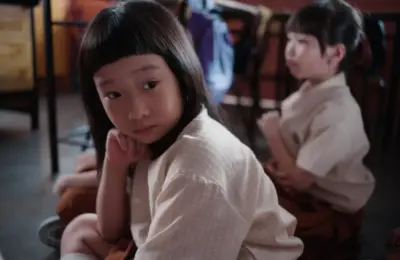
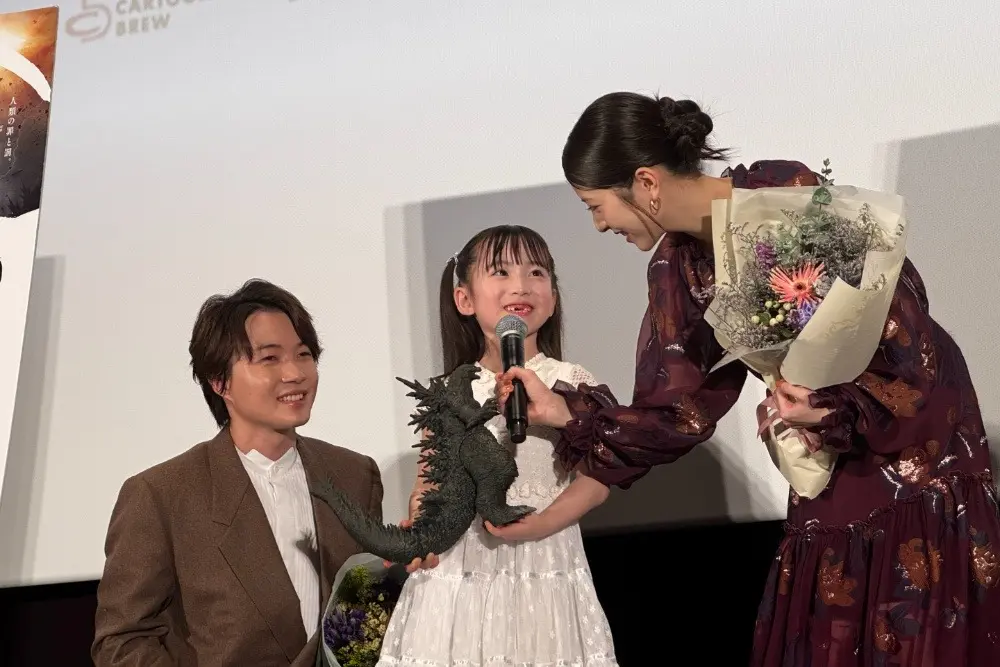
The glittering Tokyo event also served as a major milestone for young child actor Nagatani Sae, who officially made her very first stage appearance to the delight of the audience, reprising her role as Shikishima Akiko. As they stepped out to meet the hometown crowd, Kamiki gallantly walked her onstage, highlighting the protective and familial bond the cast shares both on and off the screen.
Looking back at how much the young star has grown, the cast marveled at her professional evolution since the first film. In “Minus One”—which notably aired on Japanese television’s popular “Friday Roadshow” programming block just days prior—Nagatani’s toddler-era performance consisted primarily of crying or uttering single, poignant words such as “Where?” For the new installment, however, the script demanded full, complex dialogue. The veteran actors initially harbored natural doubts, wondering among themselves whether she could possibly handle such a heavy dramatic burden at her tender age. But as soon as they stepped onto the active set, those concerns vanished entirely. She had memorized all of her lines with absolute perfection and delivered them flawlessly, earning the immediate respect of her adult co-stars.
Hamabe reflected on the stark contrast from the previous production, noting that Nagatani had barely left toddlerhood during the shoot for the first film and was easily frightened by the sheer number of unfamiliar adults populating the busy set. Reuniting for this second chapter, Hamabe confessed she was profoundly amazed by how much of a wonderful, articulate young girl Nagatani had grown into. She chatted animatedly with the cast between takes, taught them various playful things, and proved to be remarkably dependable and grounded in her acting choices.
For her part, Nagatani charmingly noted that she did not feel nervous at all while filming the complex new scenes. She fondly recalled Kamiki continuing to rub her back with comforting reassurance even after the director called cut on an emotionally draining scene in which her character breaks down in tears. During the festival events, she inquisitively asked her seasoned co-stars how she could successfully grow up to become a fine actor while still navigating elementary school. Kamiki responded by telling her that her talent already outshone both of them, adding that appearing prominently in both “Minus One” and “Minus Zero” at such a young age is an astonishing and rare achievement in its own right.
Discussing the narrative trajectory of the upcoming film, Kamiki revealed that “Minus Zero” picks up its narrative thread roughly two years after the tumultuous events depicted in “Minus One.” He expressed his heartfelt hope that viewers will take a moment to imagine what those two intervening years were like for the struggling family unit, and witness firsthand how they stand shoulder to shoulder to face whatever terrifying peril comes next. Hamabe placed the timeline gap at roughly two to three years, explaining that the family had finally begun to settle into a semblance of ordinary, everyday life together before the towering silhouette of Godzilla resurfaces once again to shatter their fragile peace.
When the conversation turned to the enduring legacy of the franchise and why the King of the Monsters has managed to captivate generations for decades, Kamiki echoed the prevailing sentiments shared by the director and his fellow cast members. He noted that each individual Godzilla film serves as a distinct mirror reflecting the specific sociopolitical era in which it is produced. Yet, on a deeply personal level, Kamiki reflected on the visceral impact of the monster’s iconic existence and its unmistakable theme music. He admitted that he cannot even remember the precise moment in his childhood when he first heard the tune or realized that it belonged to Godzilla, because the legendary monster has simply always been present alongside the fabric of everyday Japanese life—a constant companion that explains why it remains so beloved after all this time.
Complementing this perspective, Hamabe offered her own thoughts on the human element that anchors the cinematic chaos. From a purely mortal, human standpoint, she observed, Godzilla is an utterly overwhelming force of nature that appears completely impossible to defeat. Yet, the true magic of the narrative lies in the reaction to that despair: when Godzilla emerges to lay waste, ordinary humans unite and stand together as one to face the insurmountable threat. Witnessing that profound human resolve and collective resilience, she believes, is the primary catalyst that deeply moves audiences’ hearts across cultures and generations.
The immense anticipation surrounding “Minus Zero” is built upon the monumental, historic success of its predecessor. “Minus One,” which stands as the 30th Japanese live-action entry in the storied Godzilla franchise, went on to gross a staggering sum of more than JPY 7.65 billion, translating to roughly $50 million, at the intensely competitive local box office. Furthermore, it etched its name into entertainment history by becoming the first Asian production ever to take home the coveted Academy Award for Best Visual Effects at the 96th Oscars, while subsequently sweeping up more than 50 major industry honors both at home in Japan and around the world.
Building upon that legacy of technical and artistic innovation, “Minus Zero” arrives with its own historic distinction, having officially earned the designation of being the first Japanese film ever to be fully certified as Filmed for IMAX.