





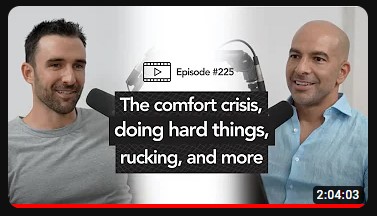
For many people, profound lifestyle epiphanies arrive in unexpected places. For one prominent commentator and financial blogger, it all started with a podcast episode hosted by Dr. Peter Attia. In this particular edition, the physician was interviewing Michael Easter, a young author promoting a newly released book. Initially dismissed as someone whose lifestyle might not offer broad application, Easter and the provocative title of his work quickly drew the listener in, sparking a deep exploration into the modern human condition.
The book, titled The Comfort Crisis, offered a phrase that neatly crystallized a core philosophy the blogger had been attempting to articulate for over a dozen years: the idea that modern society has engineered physical and mental struggle almost entirely out of existence, to its own detriment. While daily news headlines constantly broadcast warnings about nationwide personal debt crises, health epidemics, and other indicators suggesting that life is overwhelmingly difficult, a contradictory reality often goes unnoticed. On average, modern citizens in developed nations face a problem of ridiculous overindulgence and excessive ease. The primary issue is not the presence of hardship, but rather society’s failure to recognize comfort and the subtle, corrosive damage it inflicts on physical and mental health.
What began as a click on a podcast link turned into a two-hour listening session, followed by purchasing the book and digesting it slowly over the course of a month. Michael Easter, a former writer for Men’s Health magazine, brings a uniquely grounded perspective to these themes. Having once faced and overcome a catastrophic addiction to alcohol—an affliction shared by a long line of family ancestors—Easter survived a personal descent that nearly cost him his life. That biographical background imbues his writing with authentic gravity. While anyone who has watched loved ones battle addiction will find resonance in his personal story, his history with the hollow comforts of overindulgence also grants him sharp insight into the larger cultural battle between comfort and hardship in contemporary life.

Understanding The Comfort Crisis and the Science of Ease
The strength of Easter’s work lies in its compelling narrative structure. Like many engaging popular science books, it employs a split narrative that jumps back and forth, weaving together the harrowing story of an intensely difficult caribou hunting trip in a remote pocket of Alaska with relevant insights from science, psychology, and cultural commentary. This dual approach helps explain and contextualize the physical and mental endurance required during the trip, allowing readers to process and apply the lessons to their own lives.
Consider, for example, the type of bored suburbanites who populate homeowner association boards, frequently spending their time policing minor infractions like unacceptably tall weeds or unauthorized skateboarding in neighborhood chat groups. While these individuals may seem insufferable, modern psychological research reveals a scientific explanation for their behavior, as well as for many other modern societal frictions.
Humans possess an innate evolutionary tendency to constantly scan their environment for problems, regardless of how safe, secure, and technologically advanced that environment actually is. The book cites behavioral research in which subjects were asked to search for threats in an environment that gradually became safer and safer. As the actual threats disappeared, subjects did not relax; instead, they began looking for a wider range of alternative problems, even unconsciously or unintentionally, because their psychological framing remained keyed to threat detection.

As researchers noted, when people experience fewer genuine problems, they do not necessarily become more satisfied with their lives. Instead, the human brain simply lowers its threshold for what it considers a problem. In a society where daily survival is virtually problem-free, people frequently stop appreciating their good fortune and instead invent trivial complaints to fill the void. Political systems often pander to these insubstantial concerns, manufacturing wedge issues designed to provoke bickering over culture and identity—disputes that would scarcely register as problems if public attention were not repeatedly drawn to them.
Conversely, the exact opposite effect occurs in environments characterized by authentic hardship. Individuals who survive in rougher, more demanding circumstances routinely demonstrate higher levels of resilience and a significantly lower propensity for complaining. When populations living through active conflict zones are surveyed about safety, a surprisingly high proportion report feeling secure, reflecting a psychological adaptation to difficult realities. Similar adaptation principles explain why first-generation immigrants often build businesses and accumulate wealth, while subsequent generations raised in affluent ease are more prone to complacency and financial depletion. Human baselines naturally shift to match whatever environment is accepted as normal.
The Healing Power of Nature and Physical Exertion
Beyond the trap of pointless worry, The Comfort Crisis explores the biological reasons why spending time in the natural world bolsters mental and physical health, while prolonged confinement in climate-controlled offices and automobiles slowly grinds individuals down. Human biological wiring responds instantly and powerfully to natural stimuli in ways that artificial environments cannot replicate.
Scientific studies demonstrate that even placing a single living plant inside a hospital room can measurably improve recovery rates for patients across a wide array of medical ailments. The physiological benefits multiply exponentially when a person steps into a living forest for hours or days at a time.
The book also addresses human behavior regarding effort and reward, highlighting a well-documented psychological truth: the harder a person works to achieve something, the greater their subsequent satisfaction and happiness. Yet this is matched by a powerful natural aversion to physical exertion. Statistics tracking daily choices illustrate this paradox vividly, such as studies showing that only a tiny fraction of people choose to take the stairs when an escalator or elevator is readily available.
This avoidance carries a heavy toll. Regular physical movement offers enormous protective benefits against a vast spectrum of physical and mental illnesses. Engaging the body through sustained movement in a natural environment, particularly when paired with heavy load-bearing or periods of intense exertion, aligns closely with evolutionary biology. Yet much of modern life remains sedentary, spent indoors watching screens, driving to work, and subsequently seeking medical intervention for complex chronic conditions that stem partly from physical inactivity.

Health experts and lifestyle commentators argue that individuals would benefit from prioritizing foundational health pillars—such as maximizing daily outdoor time, engaging in heavy physical exertion, minimizing sedentary behavior, and reducing the consumption of processed foods, sugar, and alcohol—before relying entirely on specialized medical treatments and niche therapies. While medical guidance should always be followed, embracing physical and mental challenges remains a reliable avenue for improving overall well-being.
Real-World Application in the Colorado Mountains
The theoretical framework of The Comfort Crisis often finds immediate validation when tested against real-world circumstances. A recent solo journey into the mountains of southwestern Colorado provided a practical testing ground for these ideas. Packing a compact electric vehicle with food, bedding, and construction supplies, a journey was undertaken to tackle long-overdue property improvements, including repairing a small resort property in Salida and beginning construction on a cabin in Durango.
The trip quickly introduced elements of friction. Navigating a torrential mountain downpour, receiving a costly traffic citation in front of local law enforcement officers, and suffering a cracked windshield from a stray pebble within minutes of each other provided an immediate test of patience. Though objectively minor incidents in the grand scheme of life, these small disruptions temporarily unseated a mind accustomed to high levels of domestic comfort.

Arriving in the high-desert environment near Durango during the peak of summer brought further physical demands. Working outdoors under a scorching sun amidst a persistent blizzard of tree pollen, managing food supplies without standard household refrigeration, dealing with a lack of indoor plumbing, and sleeping alone inside a converted vehicle required conscious adaptation. Yet rather than generating depression or misery, the ongoing exposure to minor hardships produced a growing sense of vitality and resilience.
A recreational afternoon spent paddleboarding on the remote Lemon Reservoir further reinforced these lessons. Venturing out onto open water against a stiff headwind without modern conveniences or communication devices initially presented a daunting prospect. Paddling far from shore toward a secluded, wildflower-strewn meadow tested physical endurance while offering a stark reminder of the freedom found in unscripted, analog experiences. Floating back across the cold, deep water while relying entirely on the natural elements mirrored the book’s central thesis: that actively choosing difficult, unbuffered experiences often yields the deepest moments of peace and satisfaction.
The journey concluded with a final illustration of biological conditioning: after days of intense physical labor and a sparse food supply, the return to a normal caloric intake made a simple restaurant meal taste extraordinarily rich and rewarding.

Ultimately, the dialogue surrounding modern lifestyle choices often centers on the balance between financial security and the enjoyment of life. While financial independence movements frequently debate the merits of controlled spending versus overly austere saving, the broader challenge remains safeguarding human well-being against the deadening effects of excessive comfort. Maintaining a resilient life requires resisting the urge to constantly remove every point of friction, ensuring that modern tools serve to enhance capability rather than eroding fundamental human adaptability.