


For many modern 3D printing enthusiasts, managing filament moisture is a background task that rarely takes center stage until a print begins to fail. In the world of desktop fabrication, keeping hydroscopic materials dry is essential for achieving clean layers and structural integrity. Recently entering this accessory market, manufacturer Sunlu has introduced the AMS Lite Filament Heater, priced at $130, designed exclusively to upgrade Bambu Lab’s popular A1 printer ecosystem and its associated multi-material unit.
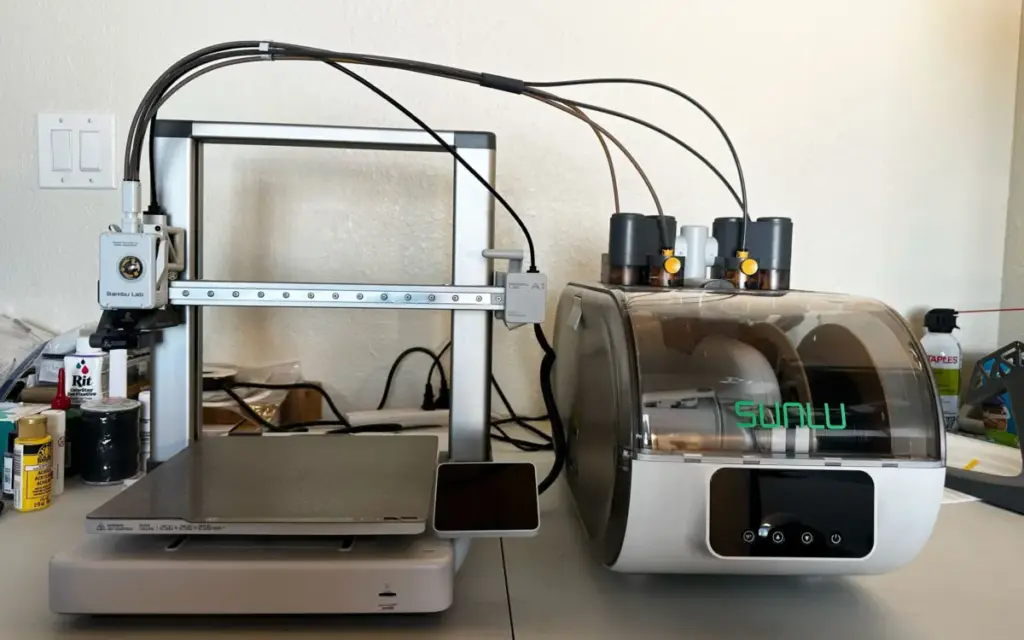
The device aims to solve a persistent challenge for multi-color and multi-material printing: maintaining dry spools while they sit mounted on an active printing system. Unlike standalone heating cabinets or separate dry boxes that require users to manually transfer filaments back and forth, Sunlu’s solution integrates directly with Bambu’s hardware. This creates a fully enclosed AMS Lite environment capable of drying filament both prior to and during active print jobs.

For users navigating the ecosystem, the physical installation process presents an initial illusion of complexity. What appears at first glance to be a daunting hardware overhaul—effectively splitting the stock AMS apart to insert the Sunlu heating unit directly into the middle—ultimately boils down to a straightforward mechanical modification. In practice, the installation process requires swapping out a few screws and plugging in two internal wires.
The engineering of the unit preserves key functionalities of the original Bambu hardware. The AMS remains powered directly by the 3D printer itself, meaning users retain the flexibility to print without activating the heating elements, or alternatively, to run the heater independently while the printer is completely powered off. While the reviewer noted minor alignment friction during assembly—specifically regarding a couple of screw holes that did not quite line up and a fussy plastic cover that required replacement—the overall integration manages to feel remarkably elegant for an aftermarket hardware modification.
Operating the Sunlu AMS Lite Heater involves a control interface featuring six pre-programmed temperature and humidity settings tailored for standard industry materials, including PLA, PETG, TPU, ABS, PA (Nylon), and PC (Polycarbonate). In addition to these presets, users can manually configure target temperatures ranging from 35 degrees Celsius to 70 degrees Celsius, alongside humidity levels adjustable between 25 percent and 50 percent.

The system operates on a default timer cycle of six hours of active heating. Once the initial timer concludes, the unit automatically switches back on when humidity drifts up to 50 percent, working to bring the environment back down to the user-specified target value. During operational tests, the chassis remained warm to the touch without posing any burn risks, and crucially, it did not leak excess thermal energy into the surrounding room environment. Furthermore, the internal fans and heating mechanisms operated at a fairly quiet volume, minimizing desktop distractions during long print sessions.
When evaluating real-world print quality improvements, results can vary significantly depending on geographic location and baseline environmental conditions. Operating out of the San Francisco Bay Area, reviewers note that while print quality enhancements were modest, those living in consistently humid climates are likely to experience much more dramatic benefits. Because the Sunlu unit continues actively drying the loaded spools while the printer runs, it provides continuous protection against ambient moisture absorption over multi-hour or multi-day print jobs.
However, the hardware integration does introduce a few spatial and operational considerations for users working within tight desktop constraints. Operators must account for additional side clearance to load and remove filament spools. Because the heater doors fold downward to allow access, and because the stock PTFE tubes provided with the Bambu setup are relatively short, accessing the specific side facing the printer can become cumbersome, sometimes requiring the user to physically rotate the entire combined unit to reach internal spools.

Another critical consideration involves material management. Because all four filament spools are enclosed and heated within a shared chamber simultaneously, the setup requires careful planning if different polymer types are loaded at the same time. Different thermoplastics require vastly different thermal thresholds; running the heating chamber at a temperature appropriate for a spool of PETG could potentially soften, melt, or fuse an adjacent spool of PLA if both materials occupy the enclosure simultaneously.
Ultimately, the Sunlu AMS Lite Heater presents a clever hardware concept that bridges the gap between active filament storage and multi-material printing. By maintaining roughly the same desktop footprint as the original A1 and AMS Lite combination, it offers an accessible path toward environmental control for users heavily invested in the Bambu Lab ecosystem, provided they manage their loaded material selections with care.