
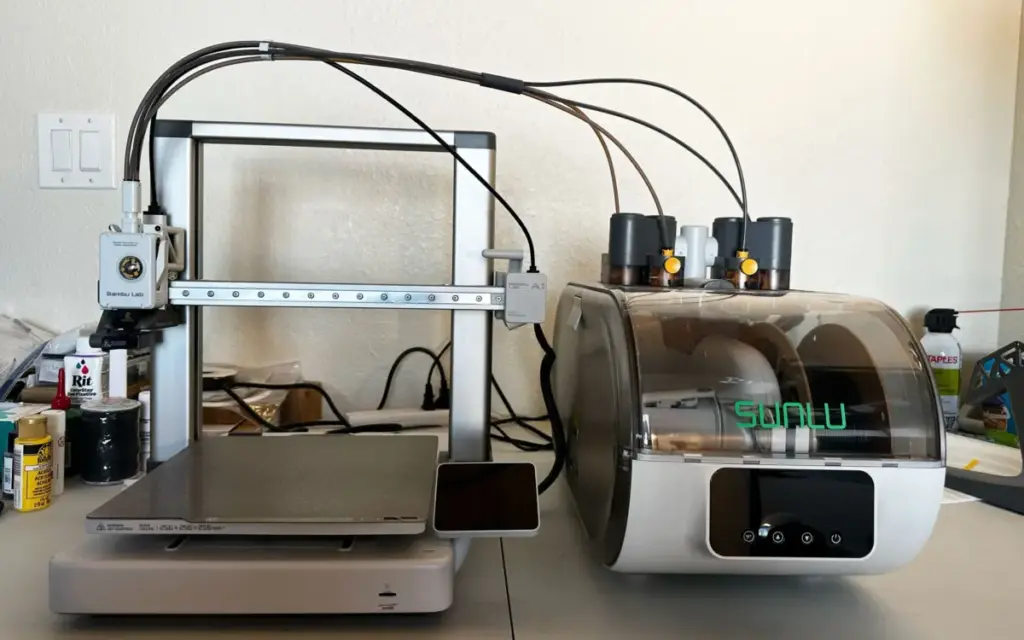
For many 3D printing enthusiasts, moisture in filament is an invisible enemy that quietly ruins prints with stringing, popping, and weak layer adhesion. Until recently, dedicated active drying solutions usually meant standalone countertop boxes completely separate from the printer, requiring users to manually feed dried spools into their multi-material systems. Seeking to bridge this gap, manufacturer Sunlu has introduced the AMS Lite Filament Heater, a specialized $130 accessory designed to integrate directly with Bambu Lab’s popular AMS Lite multi-material unit.
As a user of the Bambu Lab A1 paired with the AMS Lite, the prospect of drying filament dynamically during printing without altering the desk setup presents an appealing proposition. The Sunlu AMS Lite Heater aims to solve the moisture problem by transforming Bambu’s open-air multi-material system into a fully enclosed, heated drying chamber.

Looking at the hardware integration, the setup process initially appears straightforward before demanding a bit of technical patience. Rather than simply sitting alongside the printer, the Sunlu unit requires users to split the AMS Lite apart and sandwich the heating mechanism right into the middle of the assembly. In practice, this hardware modification involves swapping out a handful of screws and plugging in two internal wires.
Despite the initial intimidation of dismantling a manufacturer’s hardware, the mechanical integration proves relatively painless. The AMS Lite continues to draw its primary power directly from the 3D printer itself, allowing operators to run standard print jobs without engaging the heater, or conversely, to run the drying system while the printer remains powered down. Aside from a few screw holes that required minor alignment adjustments and a slightly fussy replacement plastic cover, the final result is a remarkably clean and cohesive desktop footprint.
Operationally, the Sunlu unit offers a robust set of controls tailored to modern engineering and common hobbyist materials. The system features six preset temperature and humidity profiles optimized for Polylactic Acid (PLA), Polyethylene Terephthalate Glycol (PETG), Thermoplastic Polyurethane (TPU), Acrylonitrile Butadiene Styrene (ABS), Polyamide (Nylon), and Polycarbonate (PC). For users who prefer granular control, the device also provides manual adjustment capabilities, allowing temperatures to be set anywhere from 35 degrees Celsius to 70 degrees Celsius, alongside humidity targets ranging from 25 percent to 50 percent.

A built-in timer manages the active drying cycles, defaulting to an initial six-hour heating window. Once this primary timer lapses, the system intelligently shifts into an automated maintenance mode, activating whenever ambient humidity within the chamber creeps back above 50 percent to bring conditions back down to the user’s targeted value. During testing, the chassis remained warm to the touch during active operation—well below any threshold that might pose a burning hazard—while successfully containing thermal energy without leaking excess heat into the surrounding workspace. Furthermore, the unit operates at a remarkably low noise level, ensuring it does not add disruptive acoustic hum to an office or workshop environment.
Assessing print quality improvements largely depends on the regional climate of the operator. For users located in arid or moderate microclimates like the San Francisco Bay Area, where ambient humidity rarely reaches problematic extremes, the installation of the Sunlu heater may yield subtle rather than dramatic visual improvements in standard prints. However, hobbyists and professionals working in genuinely humid environments stand to benefit significantly more, particularly given the unit’s ability to maintain a dry atmosphere continuously as the print head draws fresh filament from the spools over multi-hour jobs.
Practical usability reveals a few spatial considerations that operators must keep in mind regarding their workspace layout. Because the filament spools sit enclosed within the modified structure, users must account for clearance on the sides of the machine to load and remove materials. The heater doors require adequate clearance to fold downward cleanly. Paired with the relatively short Polytetrafluoroethylene tubes typical of standard Bambu configurations, accessing the side facing directly toward the printer can sometimes necessitate physically rotating the entire combined unit to reach specific spools comfortably.

Another important operational factor involves material compatibility when multiple different polymer types are loaded simultaneously. Because the filament spools share a single, unified enclosed chamber, heating the entire space to accommodate a moisture-sensitive engineering filament like PETG or Nylon can create complications if a spool of standard PLA shares the same enclosure. Different materials require vastly different softening and glass transition temperatures, meaning that aggressively heating a high-temperature spool could theoretically soften or fuse a neighboring spool of lower-temperature material if operators are not careful about their selection of preset profiles.
Despite these minor spatial and material management caveats, the Sunlu AMS Lite Filament Heater proves to be a cleverly engineered accessory. It delivers active thermal management and humidity control while preserving the desktop footprint originally occupied by the standard Bambu Lab A1 and AMS Lite combination. By blending directly into the existing multi-material architecture rather than demanding an entirely separate standalone appliance, Sunlu has crafted an intriguing option for 3D printing enthusiasts looking to combat moisture without sacrificing valuable workspace.