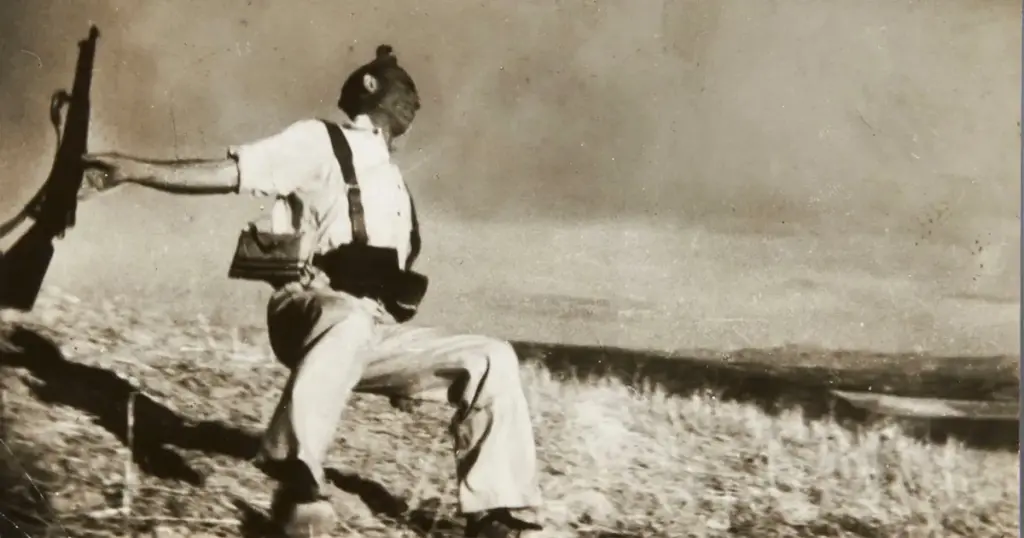
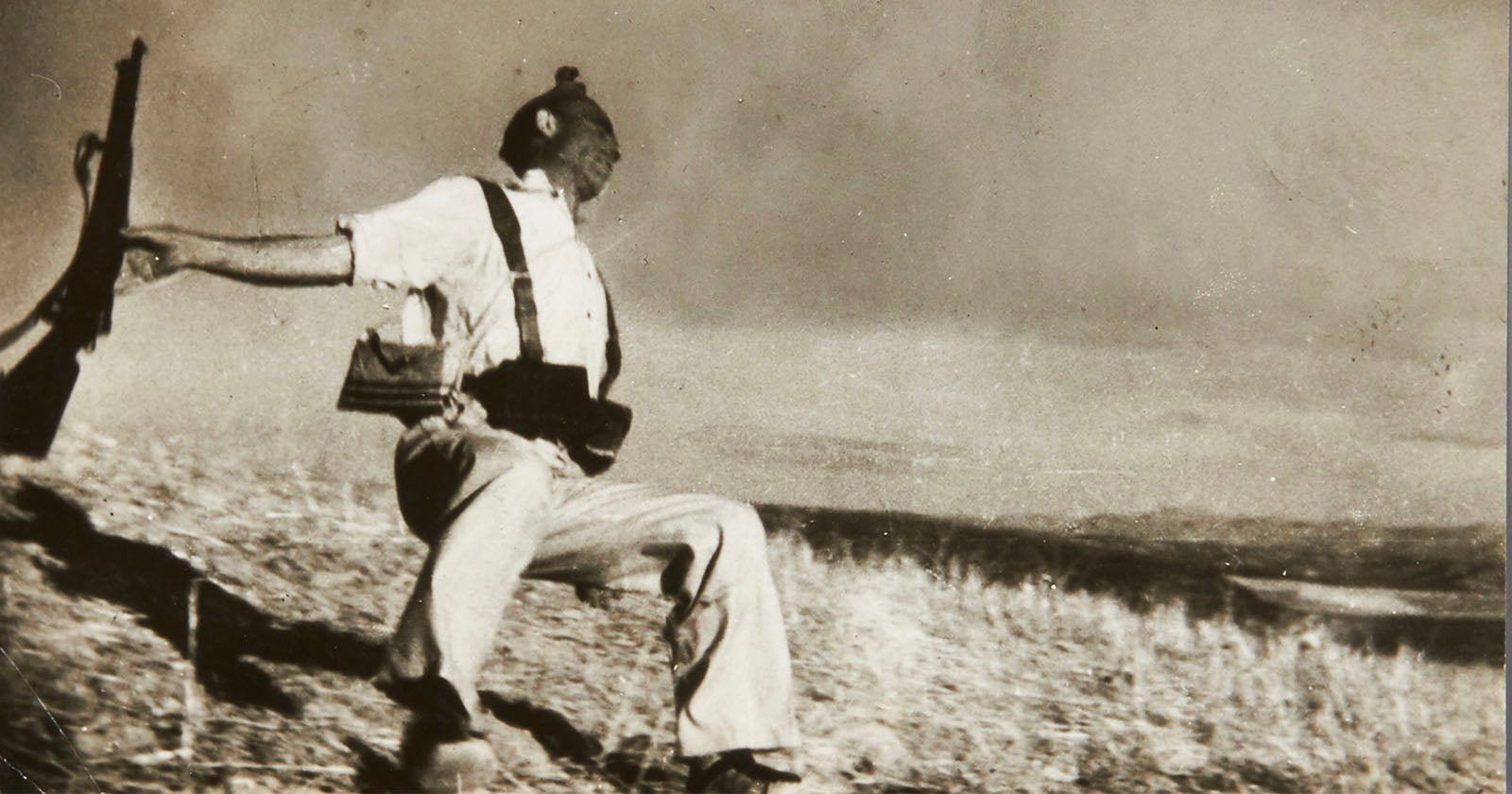
Robert Capa’s The Falling Soldier has endured for decades as one of the most iconic and recognizable photographs in the history of photojournalism. At the same time, the sepia-toned image has been mired in persistent controversy, dogged by long-standing claims that it was staged and that Capa falsified its original caption information. Now, nearly a century after it was captured, a startling new theory is upending the narrative surrounding the masterpiece: historians and researchers are increasingly convinced that Robert Capa did not even take the photograph.
Taken during the Spanish Civil War on September 5, 1936, the image depicts a Republican soldier in a white shirt and suspenders falling backward on a grassy hillside, a rifle clutched in his outstretched hand. Capa originally claimed that the photograph captured the exact, fatal moment a Republican soldier was struck in the head by a "fascist bullet" as he charged forward during the fierce Battle of Cerro Muriano. When the image was subsequently published in LIFE magazine, it caused an immediate international sensation, helping to cement Capa’s reputation and turning the Spanish conflict into a global news story.
However, historical scrutiny over the decades has chipped away at Capa’s original account. It has long been established that the photograph was not actually taken on the battlegrounds of Cerro Muriano. In 2009, researcher José Manuel Susperregui concluded after extensive geographic and archival analysis that the photograph was taken approximately 30 miles away, near the town of Espejo. Crucially, contemporary records show that no military battle was taking place in Espejo on the day the photograph was recorded.
The revelation that the scene was not captured in the heat of active combat did not come as a complete shock to historians of the era. It was well documented that staging photographs was not unusual during the Spanish Civil War. The brutal conflict severely restricted war photographers’ physical access to active frontlines, forcing journalists to find creative and sometimes collaborative ways to document the human reality and intensity of the war for international audiences.
Despite these geographical and contextual discrepancies, the debate over the image’s authenticity has largely focused on whether the soldier’s death was genuine or performed for the camera. Today, however, a profound new layer of controversy is emerging regarding the very identity of the photographer behind the lens.
Did Gerda Taro Take ‘The Falling Soldier’?
While questions concerning the circumstances of the shoot have circulated for decades, a fresh investigation has introduced the compelling theory that the person who clicked the shutter was not Robert Capa at all, but rather his close professional collaborator and romantic partner, Gerda Taro.
In a recent interview with The Telegraph, archeologist and historian Fernando Penco shared his findings while curating a forthcoming exhibition at the University of Córdoba. The exhibition is being prepared to mark the 90th anniversary of the photograph’s creation. Penco stated that he is now "convinced" that it was Taro, not Capa, who captured the legendary frame.
Penco’s historical detective work hinges on crucial technical details regarding the equipment the two photographers carried in the field. Last year, the International Center of Photography in New York, which houses the extensive Capa Archive, revealed technical findings indicating that The Falling Soldier was exposed on a medium-format 6×6 camera.
This technical specification is the linchpin of Penco’s argument. On that particular day in September 1936, Capa was shooting exclusively with a 35mm Leica camera. Taro, on the other hand, was operating a Reflex Korelle 6×6 medium-format camera. Furthermore, Penco reports that he has successfully uncovered historical photographs showing Taro actively holding and operating her Reflex Korelle on the exact same day the famous image was taken.
"For me, everything hinged on one premise," Penco explained in his interview with The Telegraph. "If the photo was taken with the Reflex Korelle, we would have to seriously reconsider whether Taro took it."
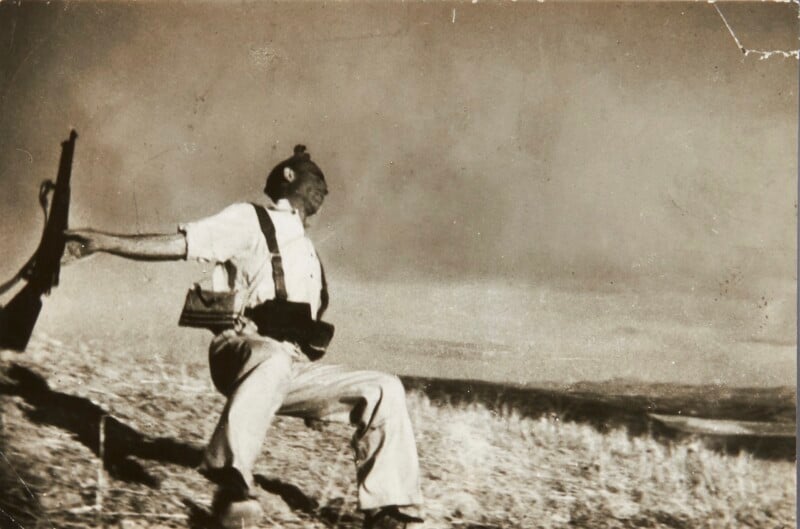
Although the original negative for The Falling Soldier has never been recovered—leaving researchers to rely on vintage prints and archival records—Penco notes that every other square-format photograph known to have been taken in Espejo on that specific day has been definitively attributed to Taro.
"I have found photographs taken by Capa with Taro holding her Reflex Korelle earlier that day in Villa del Río, from where they headed off to the front. Taken together, I think this is strong proof that it was she who took The Falling Soldier," Penco asserted.
The professional and personal partnership between Taro and Capa was deep, collaborative, and foundational to both of their careers. The two Jewish immigrants met in Paris in 1935 after fleeing Nazi persecution in Europe. Together, they forged a creative alliance that eventually birthed the persona of Robert Capa. Initially, "Robert Capa" was entirely fictional—a clever marketing invention cooked up by Taro and Friedmann to sound like a wealthy, established American photographer. They believed a U.S.-sounding identity would help them sell their work more easily to the lucrative American magazine market.
Over time, the line between persona and reality blurred. Capa, who was born Endre Friedmann, fully assumed the identity of Capa, while Taro, born Gerta Pohorylle, adopted the professional name Gerda Taro. They worked side by side in the field, documenting the turbulence of Europe on the brink of war.
The ongoing reassessment of Taro’s contributions to photojournalism arrives amid a broader cultural re-examination of her legacy. Last week, a new feature film chronicling the life and career of Gerda Taro received its world premiere at the Venice Film Festival, bringing renewed attention to her pioneering work. Taro’s life was tragically cut short while she was covering the Spanish Civil War; she is widely believed to be the first female photojournalist ever killed while reporting from the front lines of an active war. As historians continue to pore over archives and re-evaluate the foundational myths of 20th-century photojournalism, the new evidence brought to light by researchers like Penco ensures that the complicated history of The Falling Soldier will remain a subject of intense global discussion for years to come.