


The stock market has once again proved its capacity to surprise, leaving investors grappling with a familiar mix of awe and anxiety. As equities climb to record-shattering valuations—fueled largely by a frenzied boom in Artificial Intelligence—many savers are asking a recurring question: Does this towering valuation mean an even bigger market crash is just around the corner?
For those who manage to tune out the daily economic drama, the current landscape looks prosperous. But for anyone tracking the financial news, the narrative is dominated by warnings that the AI boom is moving too fast, setting the stage for a modern iteration of the early 2000s dot-com crash. That historical parallel carries personal resonance for early retirement advocates and internet financial commentators who lived through the dot-com era—a boom that launched early careers before a subsequent crash nearly derailed job security and immigration statuses.

To address widespread questions about this investment cycle, financial educators have taken the discussion on the road, recently presenting keynote talks at events like Camp FI Midwest, with further appearances scheduled at upcoming national gatherings such as the Bogleheads conference. These sessions address a central, pressing concern for modern wealth-builders: Will the AI bubble ultimately ruin retirement?
Echoes of 2006: A History of Market Worries
Hitting long-term financial milestones brings a degree of comfort, yet market participants frequently encounter inquiries rooted in deep-seated apprehension. Friends and peers often ask how anyone can remain retired and sleep soundly given the state of the world, citing a barrage of contemporary worries.

A snapshot of current anxieties in 2026 includes geopolitical tensions involving figures like Donald Trump and Vladimir Putin, stubborn inflation eroding purchasing power, the towering U.S. national debt, and ongoing conflicts in Ukraine and the Middle East, all alongside the looming specter of the AI bubble.
Yet, this brand of existential financial worry is hardly new. Looking back two decades to 2006, savers were plagued by an entirely different, yet strikingly similar, set of fears. At that time, the headlines featured leaders like George W. Bush, Saddam Hussein, and Osama Bin Laden. The Middle East was embroiled in the Iraq War rather than conflicts in Iran, and the financial press obsessively covered inflation, the national debt, and a severely overvalued housing market. Instead of fearing that artificial intelligence would eliminate jobs, workers worried about widespread outsourcing to India and China. Economists and doomsayers also debated "Peak Oil," predicting that rising fossil fuel consumption coupled with dwindling supplies would spell global economic doom.

The subsequent reality defied many of those apocalyptic predictions. The world did indeed experience the Great Financial Crisis—the largest economic downturn since the Great Depression—triggered by irrational exuberance in housing prices and overly complex financial leverage. Yet, viewed through the lens of a twenty-year horizon, even that catastrophic crash appears as a temporary dip in a much larger upward trajectory. A hypothetical $100,000 investment made during that era of peak anxiety would have ballooned significantly over the subsequent two decades, easily weathering both the 2008 crash and the subsequent 2020 pandemic downturn.
Beyond the stock charts, broader global conditions experienced measurable improvements. The proportion of the global population living in extreme poverty dropped dramatically from roughly 20% in 2005 to under 10% over the next twenty years. Global infant mortality rates were cut in half, while clean energy sectors expanded exponentially as solar panel costs plummeted by roughly 90%, allowing solar generation to dominate new energy additions worldwide. Meanwhile, electric vehicle adoption surged from near-zero to a substantial share of global automotive sales.

This historical context challenges the impulse to focus energy on predicting an uncertain future rather than fostering constructive optimism. Yet, it inevitably raises a critical question for today’s investors: Is this time genuinely different?
Prosperity, Productivity, and the Human Element
Skeptics argue that the U.S. national debt has reached unprecedented proportions, or that the AI bubble far surpasses the housing bubble in scale, suggesting markets may not recover from a future correction. Others worry about dystopian scenarios where artificial superintelligence outgrows humanity entirely. Financial media outlets capitalize on these fears, but they consistently overlook a fundamental economic principle: true prosperity is not derived from the financial system or the stock market, which ultimately represent numerical abstractions tracked on computers.

Instead, genuine prosperity stems from productivity.
Capitalism is inherently volatile, prone to wild swings driven by human sentiment. Beneath the choppy surface of financial markets, however, real people perform tangible work and develop genuine innovations. The concept of an economy or a financial system is itself a human invention; if a system breaks down because participants lose faith in its underlying numbers, society possesses the capacity to reset the parameters and resume productive labor—a strategy successfully deployed during the 2008 financial crisis and numerous historical precedents prior.

Society retains every foundational tool ever invented to enhance productivity, which directly drives standards of living, economic growth, and the viability of early retirement. Beyond productivity, however, human happiness operates independently of endless economic expansion. Once societies achieve a baseline standard of living—a threshold surpassed in the developed world several decades ago—additional wealth yields diminishing returns regarding subjective well-being. Individuals ultimately seek the most satisfying and balanced life possible.
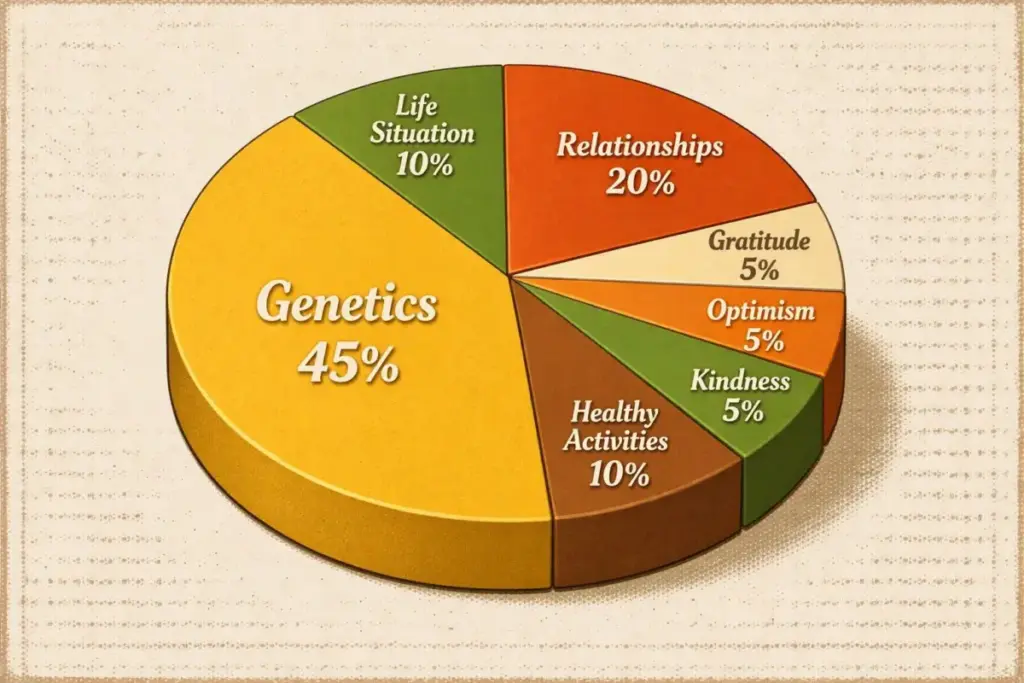
Behavioral studies suggest that wealth represents only a fraction of overall life satisfaction. Genetic disposition plays a major role, but controllable factors heavily influence personal happiness, including maintaining strong social relationships, practicing gratitude and optimism, and engaging in regular outdoor and physical activities. Despite these established principles, financial fear remains pervasive among savers, driven less by objective economic reality and more by human evolutionary wiring.

Confronting Fear and Framing the AI Era
Human beings evolved primarily as danger-detection machines. This pervasive background anxiety served as an evolutionary advantage designed to protect early humans from predators and scarcity. However, modern environments have largely eliminated those immediate physical threats, leaving the human brain to continuously shift the goalposts, seeking new targets for worry—ranging from economic scarcity and social exclusion to investment performance, tax strategies, and government-mandated Required Minimum Distributions.
Overcoming this persistent background fear requires self-awareness and rational evaluation. Examining personal history often reveals the roots of financial anxiety, whether traced back to childhood memories of scarcity or inherited mindsets from previous generations who survived historical traumas like the Great Depression. Identifying specific fears by playing out worst-case scenarios typically reveals that the anticipated catastrophes are far less devastating than imagined.

Taking concrete action remains one of the most effective antidotes to fear, transforming the unfamiliar into the manageable and building personal resilience. For many individuals, tuning out the relentless barrage of sensationalized daily news represents a vital step toward mental well-being. Modern media organizations thrive on broadcasting the most alarming stories of the day, whereas meaningful progress relies on constructive personal behaviors, continuous learning, and physical engagement with the world rather than passive consumption of digital panic.
This proactive mindset extends directly to society’s current preoccupation with artificial intelligence. Rather than viewing the AI era through a lens of doom-scrolling and apprehension, analysts with backgrounds in technology and economics view the phenomenon as a massive, fascinating experiment.

AI functions essentially as a cognitive tool designed to amplify human efficiency. Just as physical tools increased manufacturing output, artificial intelligence enhances cognitive productivity, driving broader economic prosperity. Naturally, this technological shift will also displace certain labor categories, particularly entry-level administrative roles in software development, finance, and transportation, much like previous industrial revolutions. Historical precedent indicates that while older job categories recede, lower service costs unlock capital for entirely new industries—a dynamic mirrored by the rise of the internet and the mobile app economy.
At the same time, the financial rewards of technological efficiency frequently concentrate among asset owners and shareholders, a dynamic that benefits broader market participants holding diversified retirement portfolios. Ultimately, artificial intelligence represents another transitional juncture requiring individual choice. Savers can choose to view technological advancement as a source of paralyzing fear or as a catalyst for continuous learning, adaptation, and an engaged life.