


Stock market watchers have long grown accustomed to the phrase, "How about that stock market?" As the years pass, the market continues to defy expectations, surprising investors with sudden plunges that shrink retirement stashes and dramatic climbs to record valuations. Yet, even when equities surge to unprecedented heights, a lingering anxiety remains: soaring valuations often invite fears of an impending, catastrophic crash. With the current market boom largely propelled by the frenzied rise of Artificial Intelligence, those anxieties have reached a fever pitch.
For observers who have tuned out the daily financial drama to focus on everyday life, this caution is easily missed. But the broader narrative surrounding the AI boom mirrors previous technological revolutions. Investors worry that while AI is undoubtedly a major invention, the mania surrounding its adoption is moving too fast and furious, threatening to trigger a modern, amplified version of the early 2000s dot-com crash. For veteran commentators who navigated that exact era—riding the initial wave that launched early retirement paths before surviving the ensuing fallout—the current cycle feels both familiar and deeply instructional.

Addressing these widespread concerns requires looking past the daily market ticker. Having spent more than two decades in retirement, financial commentators often encounter a recurring question from anxious peers: How can anyone remain retired, comfortable, and sleep peacefully at night given the state of the world?
The natural instinct for news-watchers is to point toward an endless list of modern anxieties. Today’s headlines feature volatile geopolitical landscapes, including leaders like Donald Trump and Vladimir Putin, persistent inflation eroding purchasing power, the towering U.S. national debt, and intensifying conflicts in the Middle East and Ukraine. Yet, historical perspective reveals that the specific characters and crises change, while the underlying human anxiety remains remarkably consistent.

A look back two decades illustrates this exact phenomenon. In 2006, investors and the public wrestled with their own distinct roster of existential dread: volatile leadership under George W. Bush, Saddam Hussein, and Osama Bin Laden; ongoing Middle Eastern conflicts in Iraq; rising national debt and inflation; and an overvalued stock market driven by a dangerous housing bubble rather than an AI boom. At the time, widespread anxieties also centered on economic outsourcing to India and China, alongside an intense global debate over "Peak Oil" and the fear that fossil fuel scarcity would spell doom for modern civilization.
Despite the heavy clouds of pessimism that hung over 2006, the subsequent two decades charted a vastly different course. Although the world ultimately confronted the Great Financial Crisis—a historic market crash fueled by irrational exuberance in housing prices and excessive financial leverage—the long-term trajectory of a diversified investment portfolio proved resilient. A hypothetical $100,000 investment made during those turbulent years still ballooned significantly over the long term, easily absorbing subsequent shocks like the 2020 pandemic crash.

Simultaneously, global standards of living underwent remarkable improvements. Over a twenty-year span, the proportion of the global population living in extreme poverty dropped dramatically, while infant mortality rates were cut in half. Clean energy transitioned from a fringe concept to a dominant market force, driven by a massive drop in the cost of solar panels, which now account for the vast majority of new energy generation capacity. Pure electric vehicle adoption similarly surged from near-zero to claim a substantial share of global automotive sales.
Prosperity Versus Productivity
The persistence of economic anxiety raises a fundamental question: Is the current era truly different? Critics point to the towering U.S. national debt, the unprecedented scale of the AI boom, and speculative fears of autonomous superintelligence as unique threats that may preclude a recovery. Financial media outlets readily capitalize on these fears to spin compelling narratives of impending doom.

However, these pessimistic outlooks often overlook a core economic reality: true prosperity does not originate from the financial system or the stock market, which ultimately represent numerical abstractions tracked on computer servers. Real prosperity is rooted entirely in productivity.
The underlying mechanics of capitalism are inherently choppy, prone to wild swings driven by sentiment and speculation. Yet beneath these surface waves, real people perform real labor and develop tangible inventions. The very concept of an economy or a financial system is a human construct. If a financial system collapses due to distorted valuations, society retains the capacity to restructure its metrics and resume productive work—a recovery mechanism demonstrated repeatedly throughout modern history, including in the wake of 2008.

Human societies retain every productivity-enhancing tool ever invented. Standards of living, economic growth, and the viability of early retirement paths all draw their strength directly from high productivity rather than speculative market valuations.
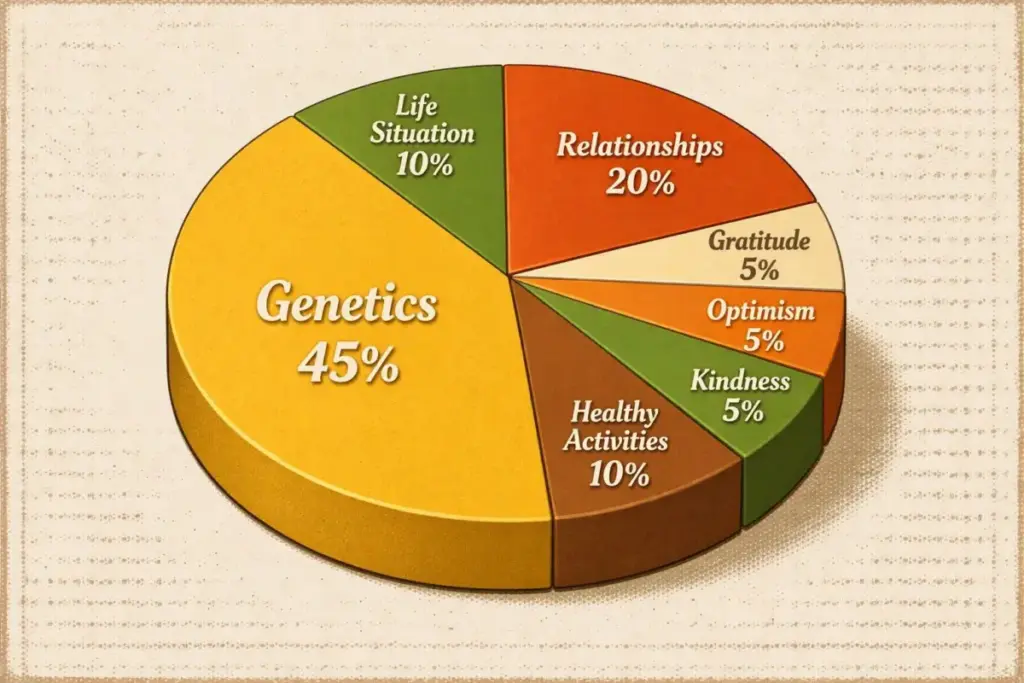
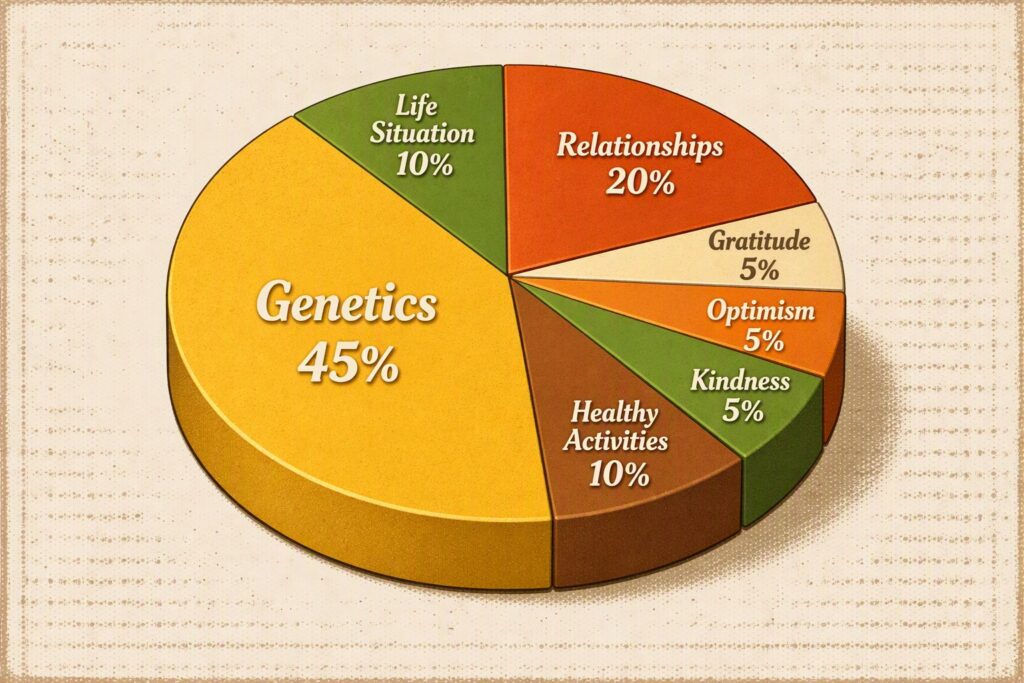
Moreover, once societies achieve a certain baseline standard of living, human happiness ceases to scale linearly with financial wealth. First-world populations surpassed these minimum economic requirements decades ago, shifting the focus of human fulfillment toward non-financial dimensions. Overall life satisfaction is dictated less by portfolio size and more by a combination of genetics, strong personal relationships, lifelong optimism, and healthy daily habits.

Confronting the Psychology of Fear
Despite these realities, a pervasive background fear continues to grip many investors. The root of this anxiety lies in human evolution. Humans function essentially as danger-detection machines, equipped with survival traits designed to protect against environmental threats.
The psychological machinery of fear is remarkably adaptable, yet it suffers from a systemic flaw: when genuine physical dangers recede, the mind continues searching for new sources of worry. Once scarcity and disease are mitigated, anxiety shifts toward social standing, tribe exclusion, and financial security. Even among affluent populations enjoying upper-middle-class stability, this anxiety manifests in hyper-specific worries, such as managing tax strategies, navigating required minimum distributions, or preserving vast inheritances.

Combatting this innate fear requires self-awareness and rational thought. Tracing personal anxieties often reveals roots in childhood experiences or generational scarcity mentalities passed down by parents who survived historic economic depressions. Acknowledging that these feelings stem from personal history rather than an objective assessment of the present moment serves as a critical first step.
Identifying specific worst-case scenarios helps demystify abstract anxieties. When examined closely, even the most feared financial outcomes rarely match the catastrophic narratives spun by fear-mongers. Taking decisive action further neutralizes fear by transforming the unfamiliar into the manageable, fostering resilience and confidence in the face of uncertainty.

Beyond internal reflection, managing anxiety involves filtering out unhelpful mental inputs. Modern media diets, dominated by a continuous stream of hand-picked negative news stories, frequently poison psychological well-being. True progress stems not from passive media consumption, but from deliberate, positive behaviors, physical movement, and engagement with the physical world rather than digital isolation.
The Artificial Intelligence Experiment
Viewing major technological shifts through the lens of experimentation neutralizes much of the panic surrounding emerging innovations. This experimental mindset applies equally to minor lifestyle adjustments and major milestones, including career transitions and early retirement.
The current Artificial Intelligence era represents the latest large-scale technological experiment. Rather than succumbing to doom-scrolling and ominous media coverage, understanding the underlying drivers of AI reveals both unprecedented potential and systemic challenges.
At its core, AI functions as a cognitive tool designed to boost efficiency, productivity, and, ultimately, broader economic prosperity. By providing advanced computational capabilities at a negligible cost, the technology accelerates problem-solving across numerous sectors.

At the same time, AI displaces certain types of labor, mirroring the historical trajectory of past productivity innovations. Entry-level administrative roles, software development tasks, and transportation logistics face imminent disruption, while new industries and economic opportunities simultaneously emerge, echoing the transformative impact of the internet and mobile computing.
The distribution of rewards from these technological leaps typically concentrates among the owners of the underlying infrastructure and corporate shareholders. Consequently, navigating the AI boom requires treating the shift not as an existential threat, but as an opportunity for continuous learning, adaptation, and proactive engagement. Overcoming apprehension about the future ultimately demands confronting the root causes of fear, recognizing that lasting personal fulfillment lies just beyond the boundaries of hesitation.