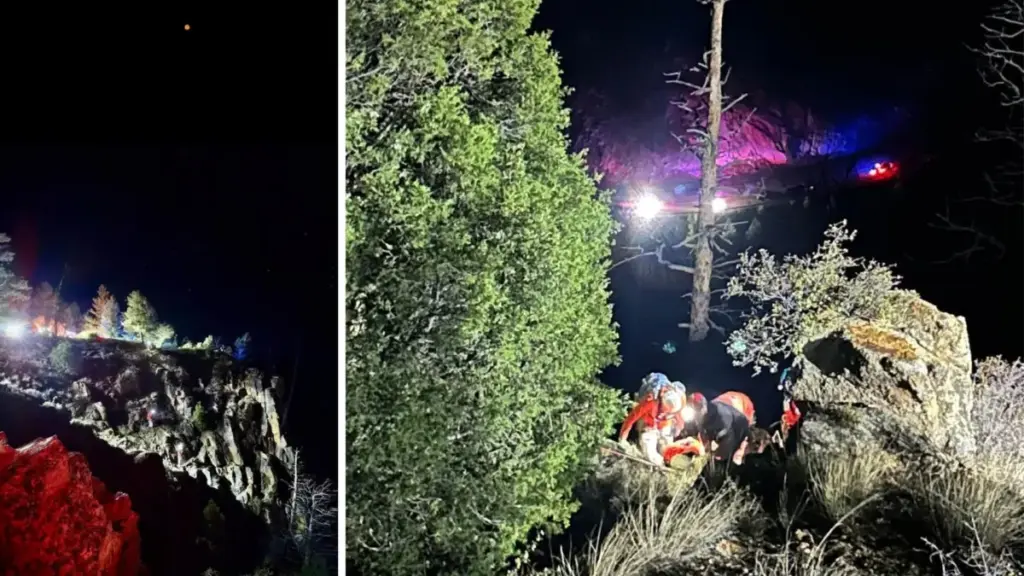
Just before midnight on September 18, a routine off-road excursion in the rugged terrain of Grand County, Colorado, turned perilous when a driver lost control of a utility terrain vehicle (UTV) and plunged 250 feet down a steep, treacherous embankment. The late-night incident, which occurred just outside the community of Hot Sulphur Springs, initiated a high-stakes, five-hour rescue operation. A dozen dedicated responders from Grand County Search and Rescue (GCSAR) mobilized quickly to save the stranded rider, deploying an intricate combination of technical rope systems and an innovative aerial lighting setup to navigate the hazards of the nocturnal mountain environment.
The accident took place in a remote area roughly 96 miles west of Denver, known among outdoor enthusiasts for its extensive off-road vehicle access and surrounding natural mineral pools. While the exact cause of the crash remains under investigation and authorities have not yet released the driver’s identity or current medical condition, the timing of the emergency compounded the physical challenges facing the rescue teams. Operating in total darkness on an unstable mountainside requires a delicate balance of speed, precision, and safety protocols that test even the most experienced emergency personnel.
Scott Sutcliffe of Grand County Search and Rescue highlighted the immediate obstacles posed by the late hour when speaking with Outside following the operation. The call for assistance came in at exactly 11:30 P.M., setting the stage for a grueling overnight mission. Sutcliffe explained that night operations inherently introduce distinct complications, noting that standard tools like headlamps and handheld spotlights can inadvertently create tunnel vision for rescuers. This narrow field of view restricts peripheral vision and makes maintaining comprehensive situational awareness exceptionally difficult on uneven and hazardous terrain.
Compounding the darkness was the unforgiving nature of the landscape itself. The accident occurred on a steep, exposed slope characterized by loose rock and a severe lack of natural anchor points—the essential fixtures around which technical rope teams secure their rigging. Without sturdy trees or solid rock formations readily available, the rescue team had to adapt creatively to build a secure infrastructure for the operation. According to Sutcliffe, the technical teams ultimately anchored their heavy-duty rope systems directly off a response vehicle to establish a safe and reliable anchoring point. It was this specific combination of environmental exposure, unstable footing, and limited natural anchors that transformed the incident from a straightforward vehicle extraction into a complex technical rescue.
To overcome the severe visibility limitations imposed by the midnight hour, GCSAR leadership implemented an innovative technological solution. Rescuers deployed several aerial drones equipped with powerful spotlights to hover above the crash site. This overhead lighting configuration proved instrumental, bathing the entire slope in a broad, even wash of light that handheld gear simply could not replicate. The bird’s-eye illumination provided the team with a wide-angle view of the terrain, enabling them to evaluate the topography clearly and coordinate their movements with greater confidence. To maximize safety, GCSAR also stationed dedicated spotters around the perimeter to continuously watch for potential rockfall and sliding debris triggered by the movement of personnel on the loose slope.
With the scene illuminated from above, the technical teams initiated the physically demanding extraction process. Rescuers utilized multiple interconnected rope systems to carefully lower primary response members, specialized technical equipment, and essential medical supplies down the 250-foot drop to reach the trapped driver. Once the medical personnel established contact with the patient and delivered preliminary care, the operation shifted to the upward phase. Using an additional configuration of rope systems, the team meticulously hauled the injured rider, along with the attending medical personnel and other assisting responders, back up the steep embankment to the safety of the trail above.
Safety remained a paramount concern throughout every phase of the arduous extraction. Sutcliffe emphasized that the overhead drone lighting played a vital role in maintaining continuous visibility of the shifting slope conditions, thereby protecting both the medical crew and the patient from secondary hazards. Adhering to strict safety protocols, every member of the GCSAR team operating on the rope system wore a protective helmet. Furthermore, rescuers sent an extra helmet down the line to the patient, ensuring their head was fully protected during the vertical ascent up the loose, rocky cliffside.
The meticulous coordination paid off as crews successfully stabilized the patient at the top of the embankment. The injured driver was transferred promptly to the care of Grand County EMS for advanced medical evaluation and stabilization, followed by a subsequent handoff to a Med Evac transport team for rapid transit to a definitive care facility. Despite the grueling nature of the midnight operation and the complex rigging required, the entire GCSAR team had successfully cleared the field and concluded their mission by 4:00 A.M.
In the wake of the successful rescue, Grand County Search and Rescue issued a formal reminder to the off-road recreation community regarding the inherent risks of navigating rugged mountain landscapes. Officials urged riders to thoroughly understand their personal limits, maintain speeds appropriate for the specific terrain conditions, and consistently utilize fundamental safety gear, including helmets and seat belts, whenever operating utility terrain vehicles.