


By Erin Grau
Updated Sept. 15, 2026

Gloria Steinem and I were in the back of a taxi, slowly crawling up the FDR Highway while coming home from a holiday party downtown. Our conversation drifted to my daughters, Matilda and Frankie, as it often did. Amid the steady hum of New York City traffic, Gloria looked at me and, delivering a profound truth with the casual grace that defined her character, told me that my primary job as a mother is to discover who they are.

There is something inherently humorous about receiving parenting advice from a world-renowned feminist icon who never had children of her own, yet something profoundly right about receiving that wisdom in the back of a classic yellow cab. Gloria famously loved to discover a new city by taxi, chatting with drivers and seeking the unique perspective that only a local could provide. She wrote extensively about that practice in her bestselling memoir, My Life on the Road, which happens to be the very book she signed for my daughters the first time I met her. When I told her their names that day, her face lit up, and she immediately began imagining out loud “the adventures of Matilda and Frankie.”

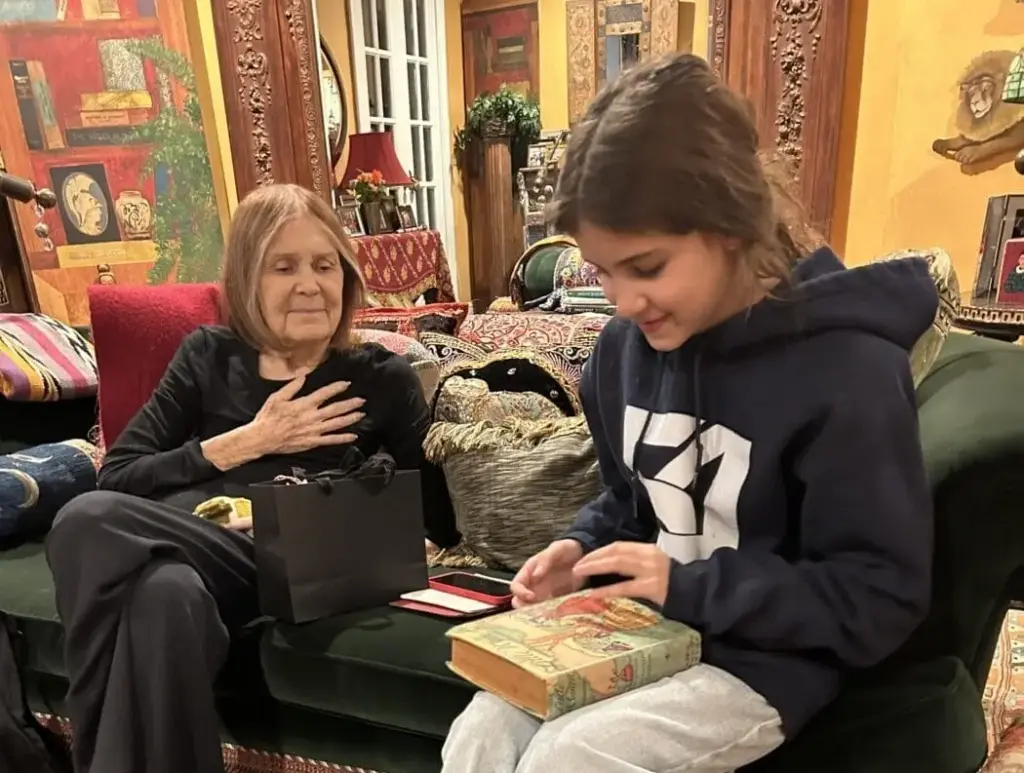
Years later, as one of the inaugural residents of her foundation, I spent countless afternoons in Gloria’s living room, working at the vital intersection of women, artificial intelligence, and power. One afternoon, I brought Matilda along. Over cups of hot chocolate and holiday cookies, Gloria eagerly shared her lifelong love of Louisa May Alcott’s classic literature. As Matilda cradled Gloria’s cherished first-edition copy of Little Women, Gloria kept her hand gently over her heart. Resting in her lap was a thoughtful Christmas present my daughters had carefully chosen for her: a miniature yellow taxi ornament for her holiday tree.

Seeing the World Through Our Daughters’ Eyes
Little Women was Gloria’s favorite book as a young girl, a foundational novel that profoundly shaped her worldview. It was a story about autonomy—about who gets to earn, who gets to decide, and who gets to want something genuine for herself.

Narratives and personal histories were always deeply important to Gloria. She often noted that facts are easy to forget, but stories stay with us, demanding that we step inside someone else’s life and imagine entirely new worlds. Gloria met Matilda exactly where she was, mirroring the way she approached every individual she encountered. She held a deep affection for children, and observing her interact with mine helped me understand why. Children are, by nature, natural philosophers. They do not accept the way things are today as an immutable destiny; instead, they boldly ask why things are structured a certain way and what else they could possibly become. Gloria maintained that inquisitive spirit throughout her entire life.

To truly discover who my children are, I realized I needed to borrow Gloria’s signature curiosity. I needed to ask more questions, listen more closely, and practice greater empathy—an emotion she consistently championed as radical and transformative. If my first major lesson from Gloria regarding motherhood was to discover the authentic identities of my daughters, the second was to shoulder the ongoing work of building a world that genuinely deserves them.

Creating a World Worthy of Their Adventures
Gloria lived long enough to witness the cultural backlash against the hard-fought achievements of the feminist movement, as well as the renewed, romanticized celebration of the traditional homemaker and mother. Family, Gloria once told me, is all too frequently the primary birthplace of inequality. Yet, whenever we discussed the cyclical nature of societal progress and regression, she never treated either direction as permanent. She remarked that a world without change would simply be boring.

Gloria gave me permission to feel genuine anger toward a society that still falls frustratingly short of true equality, while simultaneously urging me to hold firmly onto hope. Her truest wish was that we never stop doing the difficult, necessary work of advocacy. Activist Amy Richards, her close friend and longtime collaborator, aptly describes this ongoing commitment as a beautiful responsibility.

I believe Gloria’s greatest wish for me in the back of that taxi last December was for a world that comfortably fits Matilda and Frankie—now ages 12 and 9—and everything they hope for themselves, rather than a world that requires young girls to shrink themselves to fit in.

A few days after Gloria passed away, my daughters and I took a taxi directly to her Manhattan apartment. We brought along a fresh copy of Little Women, placing it among the hundreds of floral tributes left outside her door. Frankie wrote the accompanying note—a simple, heartfelt message that read, “Thank you, Gloria.”

Together, we chalked messages onto the sidewalk. Near a massive heart bearing the words “We shall walk in your light,” Matilda carefully drew her best taxicab alongside a portrait of Gloria wearing her iconic aviator glasses. Meanwhile, Frankie sketched a book over and over until she got the drawing right. We read through several of the cards left by other admirers to honor and thank Gloria. Around us, other mothers stood on the sidewalk with their daughters, and we shared quiet smiles and knowing nods of solidarity.

Then, we headed out across town and straight into Gloria’s unfinished business, with my daughters running ahead of me. The adventures of Matilda and Frankie continue.

Erin Grau is an inaugural fellow of Gloria’s Foundation, a nonprofit organization dedicated to advancing the feminist movement and preserving Steinem’s Manhattan apartment, which served as a bustling hub for grassroots activism for nearly six decades.