



When examining the pantheon of classic newspaper comic strips, critics and pop culture historians quickly realize that no two strips operate under the same creative rules. Charles Schulz’s enduring masterpiece, Peanuts, leaned heavily into heartfelt, inspirational territory, featuring relatable characters whose everyday struggles resonated deeply with generations of readers. Bill Watterson’s Calvin and Hobbes championed philosophical introspection, utilizing the imaginative bond between a six-year-old boy and his stuffed tiger to prompt audiences to contemplate the complexities of human nature, society, and the natural world.
Gary Larson’s legendary single-panel cartoon, The Far Side, however, operated under an entirely different paradigm. Larson never aimed for lofty philosophical depth or sentimental inspiration. While his bizarre scenarios frequently forced readers to pause and analyze what they were looking at, this requirement for thought stemmed purely from the brilliant construction of his punchlines rather than any profound meditation on the human condition.
Consider, for example, a vintage Larson cartoon depicting an artist painting a portrait of a woman who appears half-fly. At first glance, a reader might stare at the bizarre subject matter, wondering why the painter would choose such a grotesque and surreal transformation. Only upon closer inspection does the subtle detail emerge: a dead housefly resting squarely on the artist’s eyeglasses. Larson’s humor often invited the audience to investigate visual clues, but this investigation rarely ventured into territory that could be classified as overly serious or academic.
The Far Side was—and remains—a monumental achievement in comedic art, but it was never designed to make people ponder life’s deepest existential questions. Instead, Larson channeled his sharp, singular genius entirely into joke-telling, establishing a standard for absurdist humor that has rarely been matched. Because of this, determining the single greatest quote or caption from The Far Side requires a shift away from searching for profound wisdom, even though approaching the catalog through an analytical lens is a natural first instinct for any retrospective project.
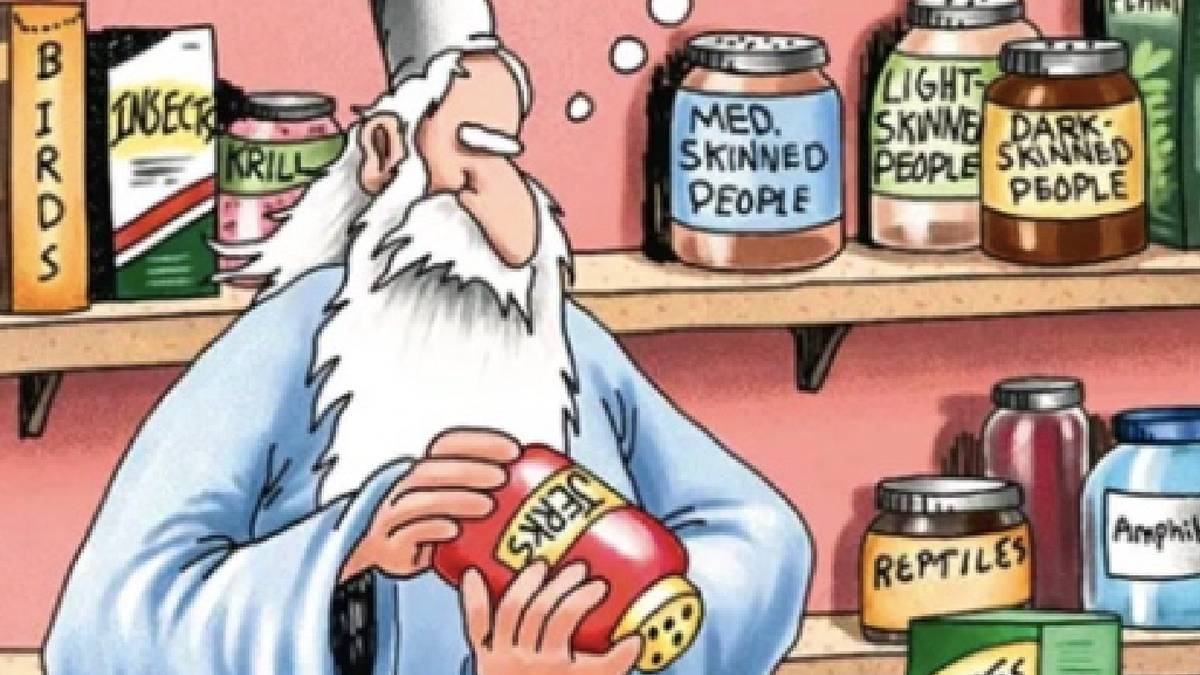
Initial attempts to isolate a definitive quote might lead a researcher toward Larson’s frequent depictions of higher powers. Several classic strips feature God as a prominent character, interacting directly with humanity or managing the cosmos from a heavenly control room. Yet, upon closer examination of these divine strips, it becomes clear that Larson’s version of God is not particularly wise, majestic, or deep. More often than not, the deity is simply portrayed as a bit of a cosmic jerk, tampering with human lives or engineering minor inconveniences with deadpan indifference.

Naturally, the search might then shift toward themes of mortality. Given Larson’s signature penchant for dark, macabre humor, death appears with notable frequency across The Far Side archive. Yet, even when dealing with the ultimate end of existence, Larson resisted the urge to make grand, weighty statements. The grim reaper and various forms of fatal mishaps are treated with such casual absurdity that any sense of genuine gravity is instantly defused—a realization cemented immediately upon stumbling across a cartoon featuring a snake that has somehow managed to hang itself with its own body.
The Far Side Was Never Meant to Be "Deep"
Confronted with the reality that Larson’s work purposefully avoided profound messages, the quest shifts entirely toward locating pure, unadulterated comedy. Yet, navigating thousands of individual cartoons presents its own challenge, as Larson’s comedic style varied wildly from week to week. Some strips relied on dark shock value, others on pure silliness, and many others on the clever deconstruction of well-known idioms, pop culture tropes, nursery rhymes, or classic songs.

For a critic attempting to isolate the absolute best quote from the entire run, the ideal candidate would ideally capture multiple facets of Larson’s comedic identity. Furthermore, finding a quote where the visual component was not strictly required to understand the joke added an extra layer of criteria. Because Larson’s work was overwhelmingly visual—relying on a single drawing to establish the premise and a caption to deliver the punchline—the vast majority of his gags required the artwork to function. A truly transcendent quote, however, would theoretically stand entirely on its own merits.
For a brief period, consideration turned toward one of Larson’s most famous observations on the afterlife: “Welcome to hell… here’s your accordion.” This classic cartoon contrasts Heaven, where souls are graciously handed harps, with Hell, where the damned are forced to play accordions. The concept is wonderfully dark, delightfully silly, and distinctly attributable to The Far Side alone. Eventually, however, that contender recedes when acknowledging that the visual remains the stronger element of the gag. Without seeing the miserable expressions of the residents saddled with the accordion, the line itself risks reading as a simple non-sequitur. The full comedic impact relies heavily on the visual contrast of musical instruments.
Moving past that hurdle leads directly to a brilliantly concise panel from 1992 that captures the essence of Larson’s comedic genius without relying on complex imagery. The drawing depicts a lone mime standing in a dense forest just as a massive, heavy tree comes crashing down directly on top of him. The accompanying caption poses a darkly hilarious question:
“Question: If a tree falls in the forest and no one’s around, and it hits a mime, does anyone care?”
This specific strip succeeds because it encapsulates everything that made The Far Side a cultural phenomenon: it is funny, dark, silly, and brilliantly subversive. By taking the classic philosophical thought experiment—the famous tree falling in an empty forest—and subverting it with the introduction of an unsuspecting mime, Larson created a masterclass in punchline writing. While it may not incorporate every single stylistic trick Larson ever employed, it concentrates an immense amount of his sharpest qualities into a single frame.
More importantly, unlike the vast majority of The Far Side catalog, this specific joke functions almost entirely on the strength of its words. While Larson’s gags almost universally relied on a visual setup, this particular cartoon operates on a level where the visual is almost secondary to the brilliance of the phrasing. While the illustration of the crushed mime adds an undeniable layer of slapstick amusement, the question itself requires zero visual reinforcement to land its comedic blow. Completely devoid of emotional or philosophical depth, it stands as the ultimate embodiment of what made Gary Larson’s work timeless, proving that sometimes the best humor comes from simply asking the most absurd questions imaginable.