



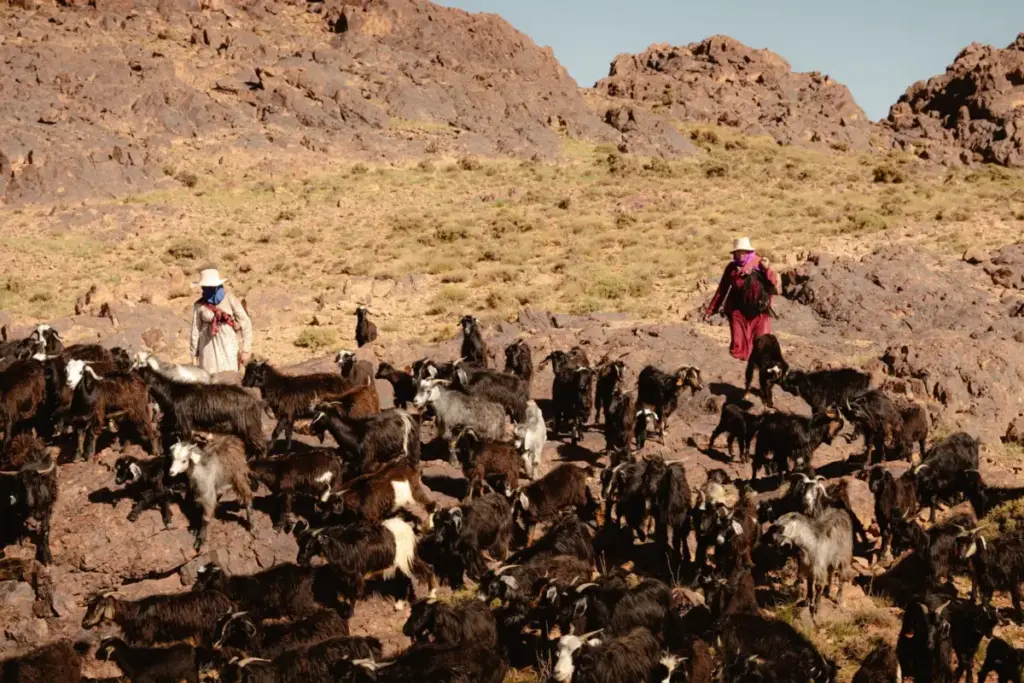
A persistent chorus of shrill bleats and guttural baas echoes across the canyons and basalt towers of Jebel Saghro in southeast Morocco. Squinting against the glaring midday sun, one can spot a flash of a red djellaba high on a rocky peak, worn by Telhou Belcéawane, the matriarch of the Berber family traveling through the rugged terrain. Her presence confirms that the goats are near, though to an untrained eye, their onyx coats remain frustratingly indistinguishable from the volcanic landscape.

Jebel Saghro serves as the ancestral homeland of Telhou’s people, the Aït Atta, a historically powerful Berber—or Amazigh, meaning "free people"—tribe in southeast Morocco. This rugged region unfurls from the High Atlas Mountains to the edge of the Sahara, and twice each year, it provides the backdrop for one of the oldest migrations in Africa. For millennia, Aït Atta and other Berber families have moved their livestock upwards of 180 miles from the summer grazing grounds of the High Atlas to the winter pastures of Jebel Saghro. This seasonal pastoral journey, known as transhumance, defines a semi-nomadic way of life that is rapidly disappearing.
It is late September, and Telhou, her husband Hmad, and their daughter Saédia are ten days into their trek when they are joined by a support team from the luxury travel operator Black Tomato. Hiking alongside a family and their herd forms one of five immersive experiences that comprise "The Keepers," Black Tomato’s collection of itineraries. Each trip is built around people whose knowledge continues to be practiced and passed down through generations, ranging from a 28th-generation Daoist master in Chengdu, China, to a mariscador on Chiloé Island in Chile who has spent a lifetime reading the ocean’s tides.

As a pioneer of off-the-grid luxury, Black Tomato identifies shifting traveler desires. With The Keepers, co-founder Tom Marchant predicts that in a world where nearly anything can be looked up or generated in seconds, human knowledge and connection represent the ultimate luxuries. More than ever, contemporary travelers want to act as students rather than mere spectators.
Before travelers arrive, the Belcéawane caravan traditionally comprises around 200 goats, two dogs to help herd the animals, two chickens for eggs, and three donkeys to transport chickens, tea kettles, jugs for water, blankets, and other food and camp supplies. For this specialized itinerary, Black Tomato integrates five mules and a dozen additional personnel—two drivers, four logistics workers to pitch canvas tents equipped with beds and flush toilets, a chef, and five mule handlers whose animals carry food, luggage, and additional comforts. Many of these handlers are cousins of the Belcéawane family, and several, including head mule handler Zaïd Oukhazaid, have reluctantly abandoned nomadic life for permanent village housing due to environmental pressures like climate change.

On the day of arrival, Zaïd and another mule handler meet travelers roadside in Tagdilt, a village situated at the edge of the Dadès Valley. Both wear coarse sheep’s wool djellabas over trekking pants and plaid shirts, with turban-like scarves known as shesh piled high on their heads. Zaïd displays a wide smile revealing the gap left by four missing front teeth. Diminutive in stature, he possesses an outsized personality and a deep, abiding pride in his Aït Atta heritage.
He extends a sinewy arm, offers a firm handshake, and pulls visitors into a bear hug while exclaiming "welcome, welcome"—one of a handful of English phrases mastered while working with international tourists. Because visitors’ Arabic, French, and Berber language skills are typically rudimentary, a local translator, Noureddine (Nouri) Bachar, joins the party to facilitate conversations. Over subsequent days, participants discover how much can be effectively communicated through simple phrases, smiles, and shared laughter.

With rain looming, the family starts earlier with the herd and arranges to meet the support team at camp. As Nouri explains, the nomads dictate the daily rhythm. Once the pack mules are loaded with luggage, Zaïd leads the group into the Martian-like landscape ahead. The terrain clarifies why Saghro is known as the "Land of Thirst" in the Berber tongue, revealing an endless expanse of flat-topped mesas, dry riverbeds, and umber cliffs. Addressing any lingering traveler uncertainty, Zaïd remarks that while he would be lost in a city, he knows his way anywhere in these mountains.
The initial two-hour hike serves as a warm-up for subsequent days requiring five or more hours of trekking. The group reaches the Tircht pass at 6,100 feet just as the support crew finishes establishing the campsite. Each Aït Atta family holds traditional rights to specific migration routes, including sites where they have constructed stone pens known as azib to shelter their herds overnight. Zaïd fetches water from a well and builds a fire to heat a kettle for tea, taking good-natured jokes about sugar quantities in stride with a deep belly laugh.

After sunset, the family and support team gather inside a traditional goat-hair tent for introductions and a communal meal by candlelight. The atmosphere mirrors a family reunion, with the men conversing while Telhou and her shy 17-year-old daughter Saédia sit quietly. Traditionally, the man of the house leads the caravan and establishes camp each night, while his wife and children handle the arduous task of moving the goats alongside household duties like meal preparation. The arrival of the travel group grants the women a temporary respite from cooking. The chef serves bowls of harira—a thick, spiced tomato soup with beans and herbs—and participants learn to eat in the nomad style by sipping directly from bowls rather than using utensils.
The traditional nomadic lifestyle faces mounting pressures. Rising temperatures and severe droughts have shrunk available pastures. Furthermore, laws enacted in 2019 require children between the ages of six and sixteen to attend school, leaving fewer hands available to tend herds. Four of Telhou’s six children attend school, one daughter is married, and Saédia is expected to marry in the future. Once youth experience modern conveniences such as electricity and running water, returning to the hardships of living entirely off the land becomes increasingly difficult. Hmad notes that only six families within his sub-tribe, the Ait Slilou, made the trek to Jebel Saghro this year, a sharp decline from approximately eighty families in the past. This fading way of life parallels global shifts affecting sheep herders in the Swiss Alps and ranching families in the American West.

Mornings begin before sunrise, heralded by the hee-haw of camp donkeys. While visitors enjoy coffee and a breakfast of baghrir—crepe-like pancakes topped with amlou, a Moroccan almond butter spread—the team packs up the camp, leaving no trace behind except for the stone shelters used by the goats. By 7:30 a.m., Nouri and the travelers set off with the family. Hmad guides the donkeys along dusty trails lined with almond and date trees, while Telhou and Saédia navigate the difficult terrain alongside the herd. Saédia regularly scrambles up nearly vertical cliffs of scree in a shimmery, gold-striped dress and plastic loafers, displaying the agility of the mountain goats themselves.
A subsequent 7.5-mile trek leads up and over Tizi n’ Tircht, a mountain pass sitting at 8,200 feet that offers sweeping views back toward the High Atlas and down to a remote campsite named Azib Almou n’ Ouarg. Aside from another nomadic family traveling with a caravan of three camels, the route remains entirely secluded. After arriving at camp, participants eat lunch, remove their hiking boots, and take a late-day nap, while the women continue moving at the rhythm of the herd, allowing animals to graze before descending into camp late in the afternoon.

By the second night, visitors feel integrated into the family dynamic. Dinner conversations turn to national events, such as the historic appointment of the country’s first female prime minister. When asked about their reactions, Zaïd jokes that it marks the end for men, Saédia expresses her primary focus on the goats, and Telhou shares her happiness simply because she is a woman as well.
On subsequent mornings, travelers have the opportunity to follow the women off the beaten trail. Over time, visitors learn to distinguish individual goats—such as a one-year-old kid with white ears nicknamed "Mittens." Telhou uses primal shouts to keep the herd together, while Saédia uses a slingshot to deter straying animals. Participants discover that what would otherwise be a demanding hike gains profound purpose through the shared goal of caring for the herd and connecting deeply with the landscape and its people.

The stark red rocks and flat mesas resemble the terrain of Utah, turning the hike into a geologic safari highlighted by natural rock formations resembling elephants and camels. While modern comforts create an appreciation for physical challenges, evening bucket showers and tent accommodations prompt reflection on the stark realities of nomadic life, where daily stressors center on securing water, staying warm, and protecting valuable livestock from jackals and wild dogs.
Even after strenuous days, Telhou continues traditional tasks, such as squatting by the fire to teach visitors how to make aghroum, a traditional Moroccan flatbread. Evenings conclude with communal meals around large bowls of couscous studded with meat, carrots, and zucchini, eaten without plates in the traditional style. Before bedtime, Saédia often decorates visitors’ hands with henna paste, which dries by the warmth of the fire.

On the final day with the family, travelers join the women once more, navigating rocky climbs with newfound confidence. Spotting a straying animal like Mittens allows participants to test their newly learned rock-tossing skills and vocal calls to guide the goat back to the group. Before departing the family at their winter home, expressions of gratitude are exchanged through Nouri. Telhou notes that visitors who embrace the work are welcome back annually, reflecting a mutual appreciation that bridges cultural divides and highlights the enduring human spirit of the Aït Atta people.
Black Tomato organizes journeys through the High Atlas and Jebel Saghro with the Aït Atta as part of its "The Keepers" collection. The itinerary pairs travelers with a nomadic family during their seasonal migration, featuring deluxe glamping accommodations, cultural activities such as traditional bread-making and jewelry-making, and a private local guide throughout. Pricing begins at $12,950 per person for a five-night, six-day program, including a night in Marrakech along with internal flights and transfers.