


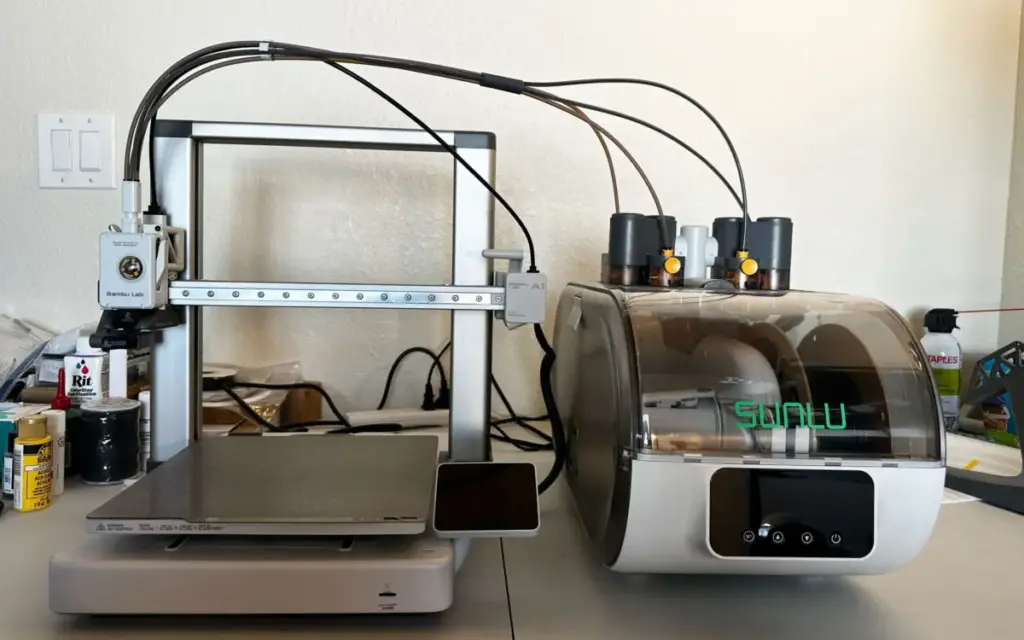
For many desktop 3D printing enthusiasts, moisture management is a background concern that only bubbles to the surface when prints begin to fail, showing telltale signs of stringing, bubbling, or weak layer adhesion. While the market is full of standalone heating cabinets and separate drying boxes designed to bake ambient water out of thermoplastic spools, integration has rarely crossed over directly into multi-material hardware. Enter the Sunlu AMS Lite Filament Heater, a $130 aftermarket expansion designed specifically to upgrade the Bambu Lab A1 and AMS Lite ecosystem by turning the multi-material unit into a combined storage, drying, and printing station.
The concept behind the accessory is straightforward. Rather than requiring users to pull spools out of a dedicated dry box, bake them for hours, and then transfer them over to the printer, the Sunlu unit physically integrates with the Bambu Lab AMS Lite. This allows the system to keep multiple rolls of filament completely dry both before and during active print jobs. For users operating in humid climates, this active-duty drying approach offers a continuous line of defense against moisture-absorbing polymers, though the practicalities of installation and everyday use reveal a few distinct design trade-offs.
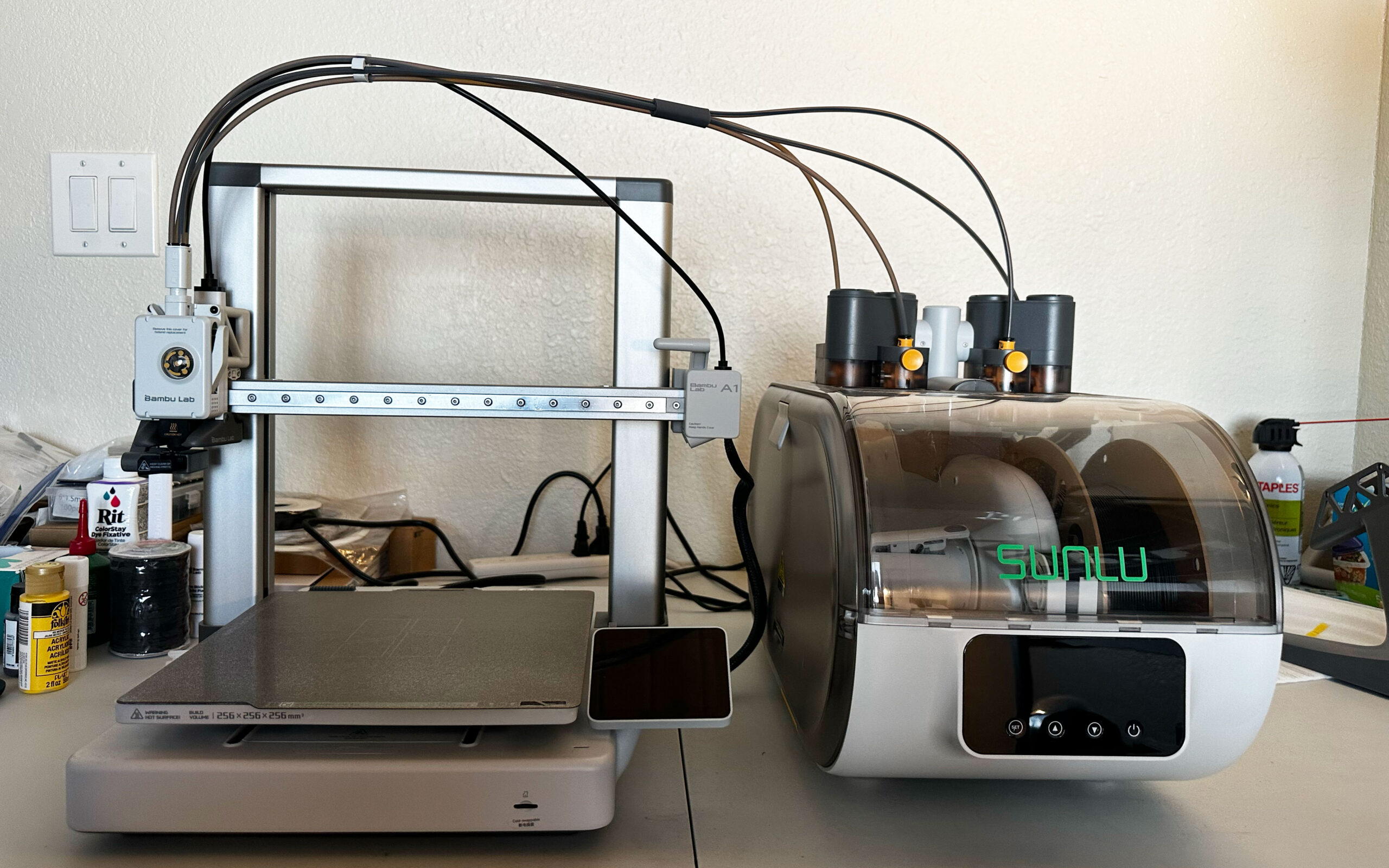
When unboxing the $130 device from manufacturer Sunlu, the assembly process can initially appear somewhat daunting. Unlike drop-in accessories, upgrading the system requires essentially splitting the original Bambu Lab AMS Lite apart and sandwiching the Sunlu heating chassis right into the middle of the assembly. Despite the intimidating prospect of taking apart factory hardware, the physical transformation is surprisingly manageable in practice. It boils down to swapping out a few specific screws, routing a couple of internal wires, and securing the modified framework.
The integration maintains clever ties to the host machine. The modified AMS remains powered directly through the printer itself, allowing users the flexibility to run print jobs without engaging the heating elements, or alternatively, to run the drying heater while the primary printer is powered down entirely. While the assembly is generally smooth, users may encounter minor tolerances issues, such as a couple of screw holes that do not line up with absolute perfection or a fussy plastic cover that demands patience to snap back into place. Once successfully integrated, however, the result is a remarkably cohesive setup that replaces the stock configuration without expanding the overall desk footprint.
Operationally, the Sunlu unit offers a comprehensive suite of environmental controls tailored to the diverse needs of modern 3D printing materials. The device features six built-in preset temperature and humidity configurations optimized for common and engineering-grade polymers, including PLA, PETG, TPU, ABS, PA (Nylon), and PC (Polycarbonate). Beyond these factory presets, users retain full manual control, allowing them to dial in custom temperatures ranging from 35 degrees Celsius up to 70 degrees Celsius, alongside target humidity levels adjustable between 25 percent and 50 percent.

The onboard timing mechanism defaults to a six-hour heating cycle. Once that initial timer expires, the unit transitions into an intelligent maintenance mode, automatically switching back on whenever ambient humidity rises above the target value to continuously draw moisture out of the enclosed environment. Throughout active operation, the chassis remains warm to the touch, but not to a degree that poses a burn risk or radiates unwanted heat into a home office environment. Furthermore, the internal fans and heating elements operate at a notably quiet volume, blending easily into the background noise of a typical workspace.
Evaluating the tangible print quality improvements delivered by the hardware depends heavily on geographic location and baseline environmental humidity. For users operating in relatively dry environments, such as the San Francisco Bay Area, the visual or structural improvements on standard prints may be subtle or virtually unnoticeable during routine tasks. However, makers located in humid coastal or tropical regions are likely to reap significantly greater rewards, particularly given the unit’s ability to combat ambient moisture absorption in real-time while the print head is actively laying down plastic.
Despite its clever engineering, the integration introduces a few physical and mechanical considerations regarding daily workflow. Because the filament spools are housed in a tightly enclosed, heated chamber, users must be mindful of how they load mixed material types. Different polymers require vastly different thermal thresholds. For instance, maintaining a spool of PETG at its required elevated drying temperature could easily spell disaster for a neighboring spool of standard PLA loaded into the same array, potentially causing the lower-temperature filament to soften, melt, and fuse into a solid, unusable mass.

Accessing individual spools also requires careful spatial planning around the desk layout. The integrated heater doors swing downward to allow access for loading and unloading material. Because the factory-supplied PTFE tubes running from the AMS Lite to the printer are relatively short, accessing the specific doors facing directly toward the printer can become cumbersome. Users often find themselves needing to physically rotate the entire machine on their desk to reach the interior side safely without straining the delicate tubing.
Ultimately, the Sunlu AMS Lite Filament Heater stands out as a clever, purpose-built hardware modification. For Bambu Lab A1 owners heavily invested in the AMS Lite ecosystem who routinely battle moisture-sensitive engineering filaments, it provides an organized, desktop-friendly solution that keeps material dry at the point of delivery without claiming any additional real estate on the workbench.