
The Love Hypothesis streams exclusively on Prime Video starting September 23.
Sometimes a romantic comedy is much more than just a standard rom-com. Such is the case with The Love Hypothesis, a feature film adaptation of author Ali Hazelwood’s 2021 New York Times bestselling novel. In most cases, translating a hit book to the screen is a straightforward process. However, Hazelwood’s novel evolved out of the author’s profound frustration with how the Star Wars sequel trilogy concluded. Like many fans, she was deeply dissatisfied with how the characters of Rey and Kylo Ren/Ben Solo were handled in Star Wars: The Rise of Skywalker, prompting her to "fix" their outcomes through a creative outpouring of fan fiction. One of those pieces was eventually rewritten into The Love Hypothesis and published, turning it into an international BookTok phenomenon and, ultimately, a major motion picture.
This unique creative history means The Love Hypothesis operates through a decidedly modern lens, depending on the audience watching it. For viewers who simply enjoy an entertaining romantic comedy or loved the original book, the film is an accessible, charming watch driven by the warm chemistry of the entire cast, particularly leads Lili Reinhart and Tom Bateman. For anyone coming to the project from the Star Wars fandom who has followed the journey of Hazelwood and her story to this moment, the movie functions as a meta wink filled with Easter eggs tailored specifically for them.
The basic narrative structure remains faithful to the page. The story follows Olive Smith (Reinhart), a third-year Stanford University PhD student who is overworked, exhausted, and navigating the traditionally male-dominated world of academic science on a tight budget. Her lifeline through the pressure is her best friend Anh (Rachel Marsh), a fellow PhD student who has helped pull Olive out of her shell, introduced her to other friends like Malcolm (Jaboukie Young-White), and become her ride-or-die found family.
Complications arise when Jeremy (Nicholas Duvernay), a man Olive once harbored a crush on, shows interest in Anh. True to their strict adherence to "girl code," Anh refuses to act on her mutual attraction because of Jeremy’s past connection to Olive. Desperate to convince Anh to pursue Jeremy without hesitation, Olive lies and claims she has a brand-new boyfriend.
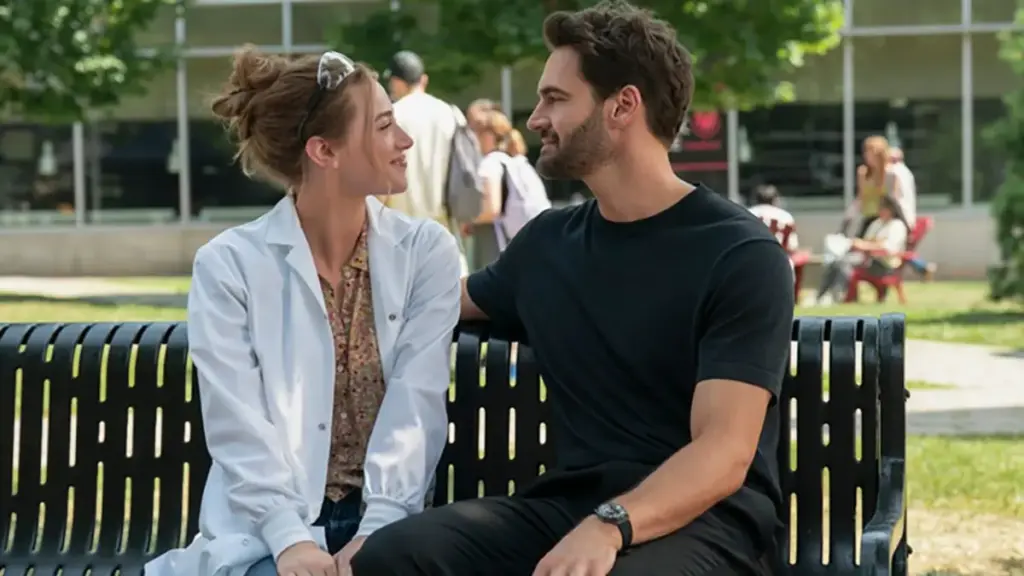
The white lie quickly backfires when Anh demands in-person details about Olive’s mysterious "date." Panicked and cornered, Olive grabs the first man she sees to use as cover—the department’s notorious curmudgeon and academic powerhouse, Dr. Adam Carlsen (Bateman), frequently referred to by students as the resident Kylo Ren. What begins as a horribly awkward, impulsive moment soon transforms into a mutually agreed-upon ruse between Olive and Adam.
Adam reveals that his grant money is currently under threat of being withheld because Stanford administrators worry he is a flight risk who might soon jump ship to another research institution. Realizing a fake girlfriend would prove he has established roots and no plans of exiting anytime soon, Adam agrees to the scheme, setting the stage for a classic fake-dating arrangement.
For both audiences, the public relationship-proving moments quickly escalate into wonderfully awkward expressions of enforced intimacy. These include moments like applying suntan lotion in public and awkwardly recounting their fictional "meet-cute" to Adam’s skeptical university colleagues.
Director Claire Scanlon, previously known for The People We Hate at the Wedding, wisely allows these comedic sequences to breathe. This pacing heightens their comedic potential and gives the supporting ensemble plenty of room to deliver laughs, of which there are many. Marsh and Young-White are particularly effective, delivering pitch-perfect reactions and sharp zingers that lean into the inherent silliness of the fake-dating scenario while establishing a believable ecosystem of friendship that validates why Olive goes to such lengths in the first place.
Reinhart and Bateman also completely sell the gradual thawing between two socially awkward academics into a genuine romance. While both actors are undeniably too conventionally attractive to truly fit the "awkward dork" mold in reality, as Olive and Adam, they successfully convey why two people who usually hold the world at arm’s length would lower their defenses for one another. Comedically, they are top-tier, and the moments where they share genuine honesty and mutual loneliness blossom into a heartfelt friendship and bubbling romantic attraction—the essential, do-or-die element of any great rom-com.
Certain STEM-centric aspects of the story are naturally watered down in screenwriter Sarah Rothschild’s script, though a vibrant homage sequence to Martha Coolidge’s 1985 science comedy Real Genius succeeds by adding rich color and context to Olive’s academic world. Less successful is the film’s science villain, who receives significantly more narrative real estate to unfurl his machinations in the source novel. In the film, he is not given enough screen time to emerge as a truly potent adversary or to rise above a one-note character with cliché intentions.
Fortunately, Rothschild’s screenplay redirects that screen time toward more consequential scenes for Olive and Anh, which serve as the emotional bedrock for the entire fake-dating operation. Portraying the unwavering strength of their bond proves far more worthwhile, successfully underpinning the central romantic plot with a deeper, resonant story about female friendship and sisterhood.
At its heart, The Love Hypothesis functions as both a gentle satire of classic romance tropes—particularly enemies-to-lovers—and a genuine celebration of female friendship. Both concepts could easily feel hokey in lesser hands, but the creative team understands precisely what made Hazelwood’s book a viral hit and how to translate those elements effectively to the screen. They maintain a tone that is earnest yet firmly tongue-in-cheek, allowing their cast to weave their magic and give rom-com lovers the exact kind of undeniable on-screen chemistry that makes the genre work.
For the longtime fans tracking the story all the way back to its Star Wars origins, the film offers a wealth of hidden Easter eggs to discover and appreciate. These range from pointed needle drops and specific Laura Karpman-inspired musical character themes to clever red-and-blue color cameos. The production clearly recognizes its core audience and approaches the original fandom with a palpable sense of humor and respect.
Verdict
The Love Hypothesis successfully adapts its viral page-turner origins into a funny, engaging, and genuinely charming romantic comedy for the screen. Lili Reinhart and Tom Bateman bring both humor and heat to Olive and Adam, while Rachel Marsh and Jaboukie Young-White deliver fantastic support as part of a winning ensemble cast.