


At first glance, the new Sony FE 400mm f/4.5 GM OSS and FE 600mm f/6.3 GM OSS lenses are clearly distinct pieces of professional gear designed to serve different specialized needs in the field. But look a little closer at the engineering and specifications, and you realize they are not nearly as different as one might reasonably assume. Behind the sleek G Master exterior, some seriously efficient optical engineering is going on, revealing a masterclass in modern lens design and manufacturing strategy.
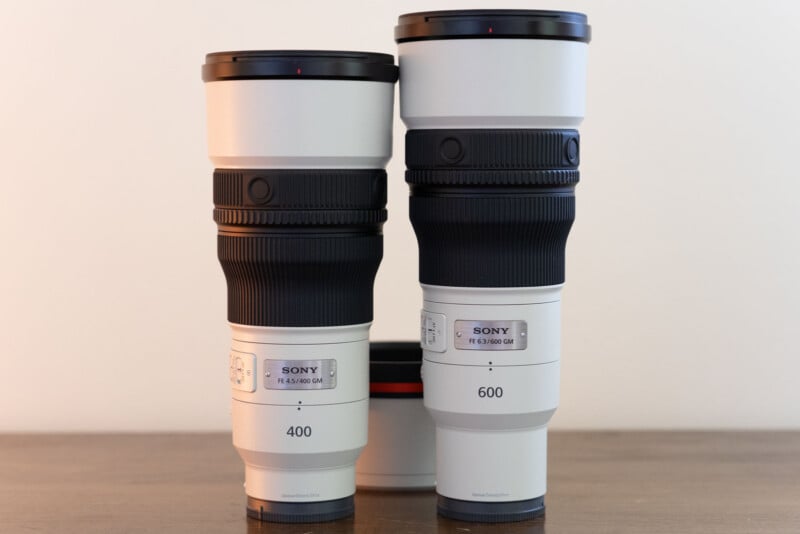
As detailed in initial industry coverage and dedicated reviews of the Sony FE 400mm f/4.5 GM OSS and the Sony FE 600mm f/6.3 GM OSS, the two flagship telephoto primes are remarkably alike. Beyond the obvious visual similarities that run through Sony’s high-end white-lens lineup, the physical weights of these two optics are separated by a mere single gram. That is the equivalent weight of a standard paper clip, a crisp dollar bill, or a light pinch of salt. Meanwhile, the longer 600mm f/6.3 GM OSS is physically longer by less than an inch, a negligible difference when dealing with long-range super-telephoto glass.

Looking at their performance and external features, the similarities continue to stack up. Both new telephoto prime lenses feature the exact same advanced autofocus system, identical minimum focusing distances for close-up framing, the same comprehensive layout of on-barrel controls, the same robust weather resistance, and, for all intents and purposes, the same exceptional image quality. Both optics deliver stunning sharpness from corner to corner, making them formidable tools for wildlife, sports, and aviation photographers.
For the vast majority of working photographers, this is all they really need to know. The lenses look good, handle brilliantly in challenging outdoor environments, and perform at the absolute highest level. But if you look beneath the surface, peering directly inside the optical barrels, something genuinely interesting is happening that highlights how modern lens manufacturers maximize their research and development investments.
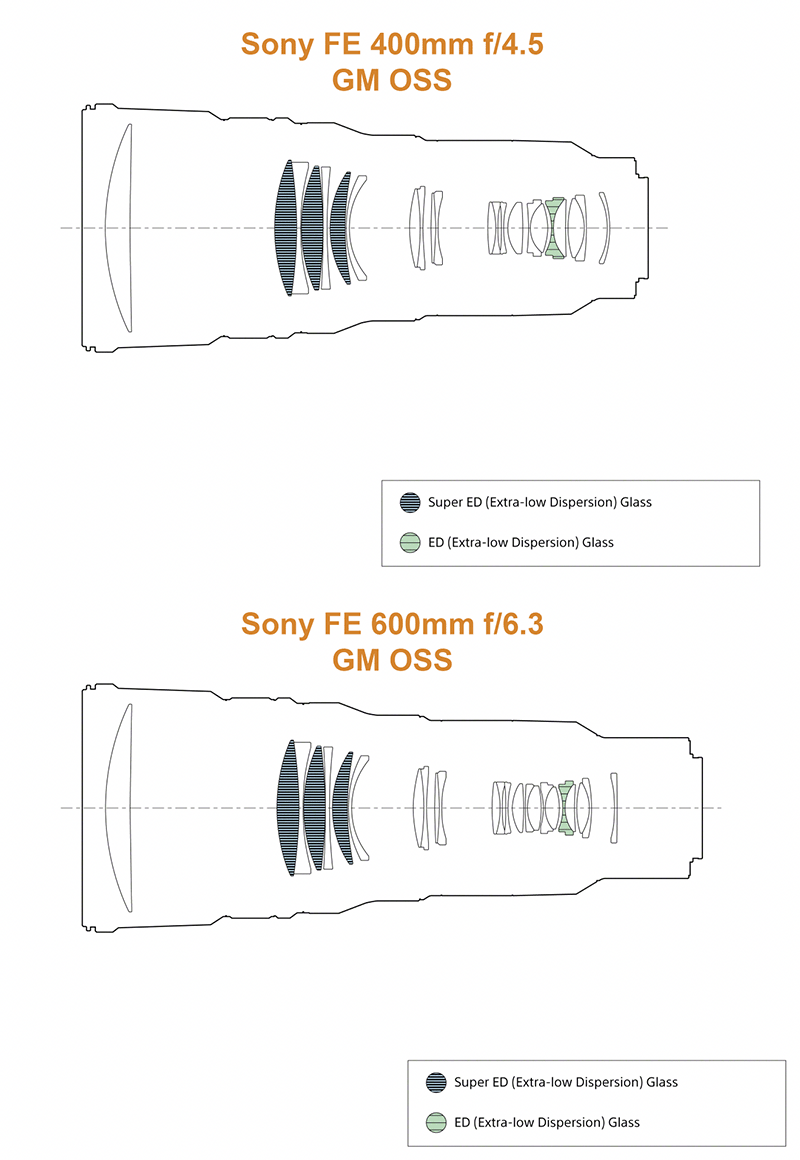
Half of the optical design of both lenses is identical. That does not mean merely similar; it means completely identical. From the single large front element to the internal focusing group positioned near the middle of the lens barrel, the 400mm and 600mm lenses are optical twins—specifically, fraternal twins sharing a massive portion of their genetic blueprint. This shared architecture includes the critical optical group housing all the Super ED (Extra-low Dispersion) glass elements that live up to their promise of delivering pristine contrast, brilliant color fidelity, and razor-sharp image quality.
Continuing further back toward the camera mount, the two telephoto lenses still share a striking family resemblance, though you do start to notice measurable shifts in element positioning and overall barrel dimensions to accommodate the differing focal lengths. To achieve its extra reach, the FE 600mm f/6.3 GM OSS adds two additional elements housed within a single extra group, bringing its total configuration to 24 elements arranged in 17 groups. You have to achieve that extra magnification somehow, after all, and physics demands certain structural accommodations.

Naturally, the slightly slower maximum aperture of the 600mm model is a direct result of keeping the physical front entrance pupil size consistent while stretching the focal length. That is simply the math of optical physics. Without significantly increasing the physical size of the entrance pupil, the relative aperture must decrease as the focal length increases.
This approach represents a remarkably clever piece of industrial engineering by Sony. Developing an entirely new high-end super-telephoto lens requires significant research, complex optical simulation, and substantial engineering efforts, not to mention the heavy capital costs of tooling up factory lines for actual manufacturing. By designing these two lenses to share such a vast majority of their internal components and optical architecture, Sony has demonstrated that creating two distinct products does not have to mean doubling the work from scratch. The company has effectively leveraged its extensive research, development, and parts inventory across two separate commercial offerings.

Of course, camera manufacturers constantly build upon their prior technological foundations when developing new lenses. They do not reinvent the optical wheel every time a new product is conceptualized. Nonetheless, this level of platform sharing in ultra-specialized glass is a brilliant business strategy, and the real-world results speak for themselves through the performance of the lenses in the field.
This strategy brings to mind previous industry maneuvers, such as when Fujifilm developed its specialized 500mm f/5.6 R LM OIS WR lens for the medium-format GFX system and subsequently adapted the concept to its smaller sensor lineup, bringing portable super-telephoto capabilities to the X Series. Arguably, what Sony has accomplished with the 400mm f/4.5 and 600mm f/6.3 duo is an even more impressive commercial feat, delivering two distinct prime lenses for something relatively close to the development and manufacturing cost of one. It is difficult not to respect that level of operational efficiency.
For photographers evaluating the ecosystem, there is virtually no downside to this engineering approach. Neither lens suffers from compromises in build quality or optical performance, and shooters who invest in either system are bound to be deeply satisfied with their results in the field. For those who decide to purchase both lenses to cover a wider range of sports or wildlife scenarios, it is worth keeping in mind that you are essentially acquiring most of the same optical system twice, with the longer variant commanding an extra thousand-dollar premium for its additional reach and minor structural adjustments. Of course, retail pricing depends on a multitude of market factors beyond the baseline production cost of a specific lens barrel, reflecting the specialized nature of high-end telephoto glass.