



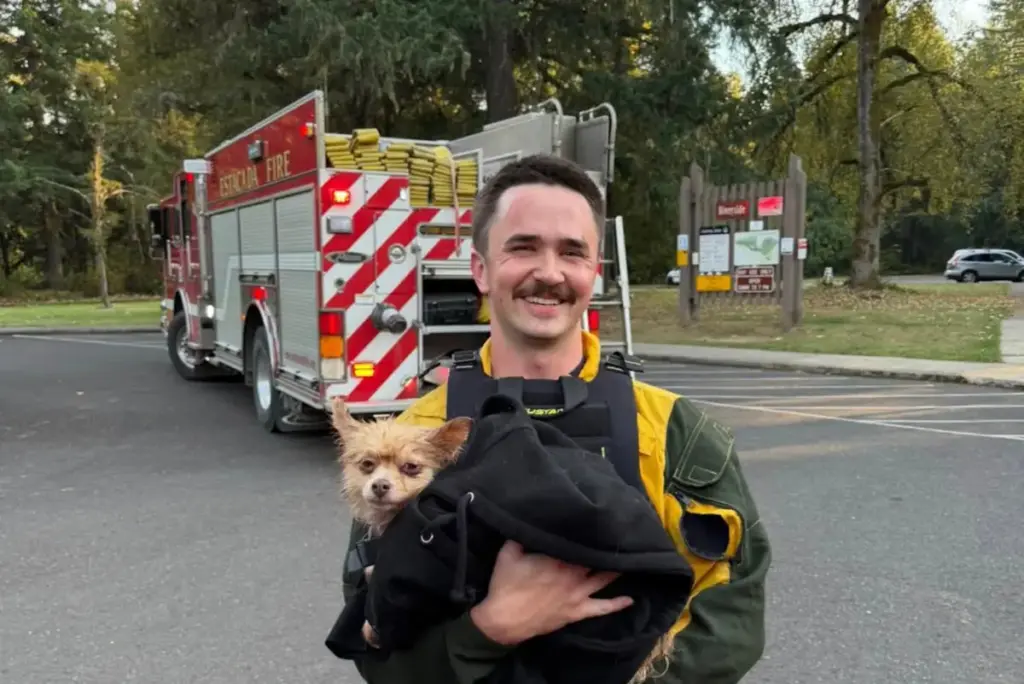
ESTACADA, Oregon — A routine autumn kayaking excursion turned into a chilly emergency on October 16, when an unnamed woman and her small dog, Gizmo, were plunged into the fast-moving currents of Oregon’s Clackamas River. The incident, which unfolded roughly 30 miles southeast of Portland near Milo McIver State Park, highlights the hidden dangers of deceptively warm fall weather colliding with freezing mountain-fed waterways. While both escaped without physical injury, emergency responders credit a well-fitted canine life jacket with preventing a potential tragedy.
According to the Estacada Fire District (EFD), the woman launched her watercraft near the popular recreation area, which is known for its scenic trails, campgrounds, and river access points. Almost immediately after entering the water, she found herself struggling to maintain control of the kayak. Within sight of the boat ramp, the vessel flipped, leaving her standing waist-deep in the cold river alongside a waterlogged kayak and her loyal companion, Gizmo.
While the dog was securely outfitted in a canine life jacket complete with a rescue handle, his owner was not wearing hers.
Unable to perform a self-rescue due to the current and the weight of the waterlogged boat, the woman managed to use her mobile phone to contact her mother. Her mother swiftly alerted emergency services, while the woman’s father rushed to the scene to meet arriving firefighters, directing them along a trail that led straight to the stranded pair.
Matt Aalto, a division chief with the Estacada Fire District who oversaw the operation, noted how fortunate the family was regarding the geography of the rescue. The trail opened up directly to the exact spot where the woman and her dog were standing, allowing crews to execute a rapid response.
Inside the Rescue
Firefighters arrived and quickly formulated a plan to secure the area, positioning downstream rescue personnel equipped with safety ropes in case the strong current swept the stranded pair further down the river. Rescuers then waded into the waist-deep water to execute the extraction.
In a delicate operation that took approximately ten minutes from start to finish, firefighters first retrieved Gizmo, followed by his owner and the flooded kayak.
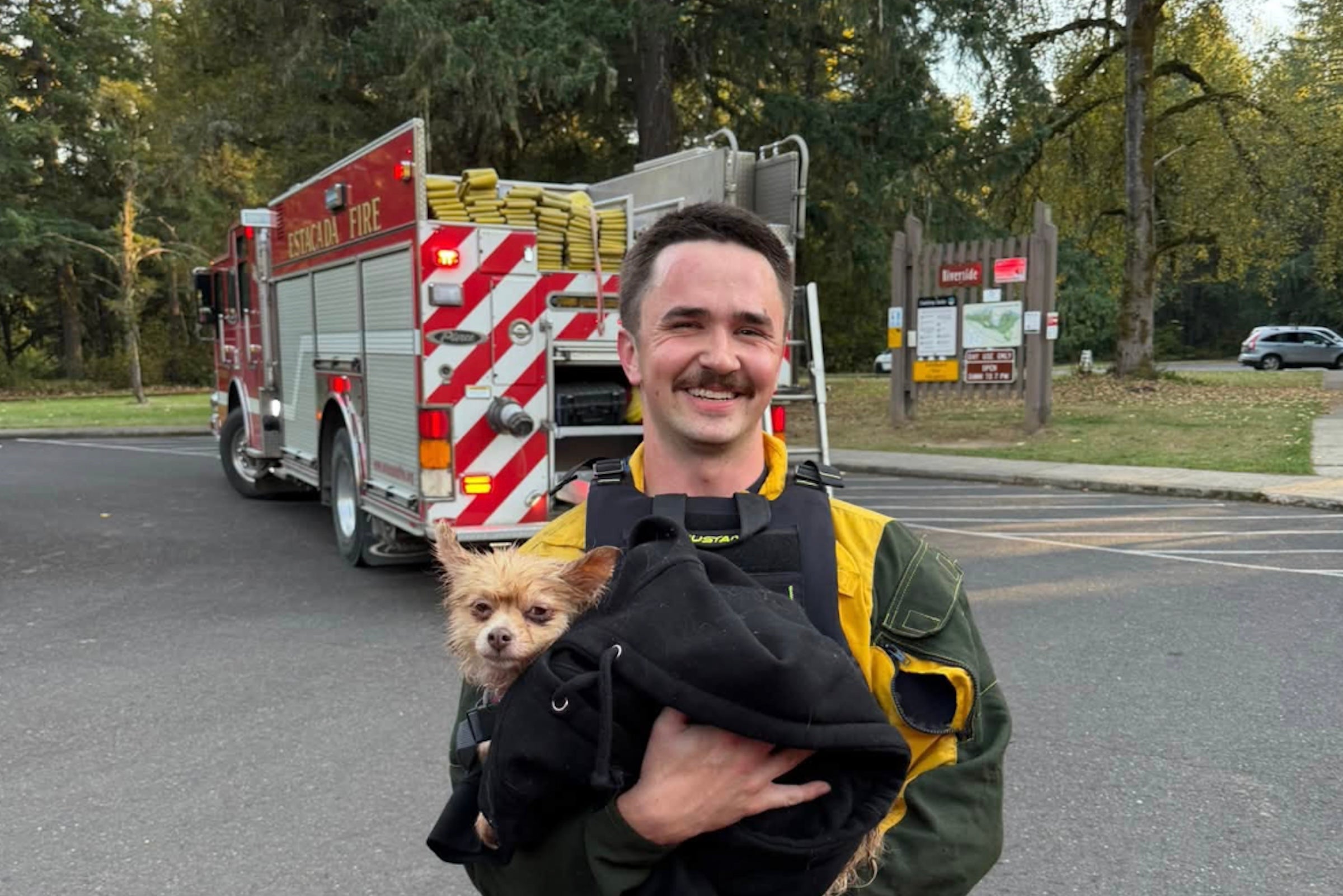
When Gizmo was brought to the shore, he was wide-eyed, shivering, and visibly cold, but otherwise unharmed. Aalto recalled that despite being cold and shaken, the small, scruffy dog remained exceptionally gentle, allowing the firefighter to offer a comforting hand.
Chief Aalto emphasized that Gizmo’s flotation device was the definitive factor in the dog’s survival. Without it, the small animal would likely have been swept down the river by the relentless current, where his chances of recovery in the cold water would have been deeply uncertain. Firefighters subsequently guided the woman safely back to land, where medical evaluations determined she did not require professional medical treatment.
Why Cold Water Can Be Dangerous Within Minutes
The Clackamas River is fed by rain and snowmelt cascading from the Cascade Mountains, meaning its waters remain dangerously cold even during mild autumn afternoons. On the day of the incident, the contrast between the air and water temperatures created a classic environmental hazard for unseasonably warm weather. While air temperatures in nearby Portland climbed to a warm 78 degrees Fahrenheit that afternoon, a U.S. Geological Survey monitoring station recorded the Clackamas River at a chilly 53.6 degrees that morning.
Some outdoor recreationists look to the Rule of 120, a traditional guideline that adds together the air and water temperatures to evaluate cold-water risks. The readings on October 16 totaled roughly 132 degrees, sitting just above the safety threshold. However, authorities stress that water in the low 50s is still cold enough to trigger immediate physiological dangers, specifically cold-water shock.
According to the National Weather Service, sudden immersion in cold water can provoke an involuntary gasp and rapid breathing. If an individual is submerged or has their head underwater during this initial phase, the risk of inhaling water and drowning increases dramatically. Furthermore, continuous exposure quickly impairs muscle control in the extremities, making it difficult to perform basic survival tasks like gripping an overturned boat or swimming to safety. These debilitating effects can manifest within minutes, long before full-scale hypothermia sets in.
Under Oregon law, adult kayakers are required to carry a properly fitting, readily accessible Coast Guard-approved life jacket on board. However, wearing the device is only legally mandated in more turbulent waters featuring moderate to difficult rapids, specifically Class III and above. Despite the legal minimums, the Oregon State Marine Board strongly encourages paddlers to wear their flotation devices at all times, regardless of the perceived calmness of the water.
What Kayakers Should Know About Keeping Dogs Safe
Taking pets onto the water introduces unique variables that require preparation and specialized gear. Major organizations, including the American Kennel Club, advise that dogs should wear dedicated life jackets while boating or kayaking, even if they are confident swimmers. Moving water can easily exhaust or disorient a dog, and a proper flotation device ensures they remain buoyant and visible.
Unlike human life jackets, canine flotation gear does not carry an official U.S. Coast Guard approval standard. Safety advocates, such as the BoatUS Foundation, recommend that pet owners look for jackets equipped with sturdy rescue handles, wide padded belly straps, and an ergonomic fit that allows the animal to move and paddle naturally without restriction.
Experts also caution against tying dogs to watercraft using leashes or tethers. If a kayak capsizes, a tethered dog can easily become trapped beneath the boat or entangled in the rigging, creating a life-threatening situation.
Chief Aalto noted that successfully bringing a pet onto the water relies heavily on the animal’s obedience and responsiveness to voice commands, as well as choosing equipment scaled appropriately to the dog’s size and the environmental conditions. Ultimately, however, keeping a canine companion safe on moving water relies on the human paddler remaining upright, vigilant, and afloat.
Reflecting on the near-miss along the Clackamas River, Aalto praised the woman for handling a stressful situation well, noting that she had taken many proper precautions for her pet while overlooking her own personal safety equipment.
"In this case, this person did a wonderful job," Aalto said. "She just forgot her own."