The market for pet CBD has expanded rapidly, making these products incredibly easy for dog owners to find. However, determining what to buy, understanding what scientific evidence actually supports, and deciding whether CBD is appropriate for an individual dog’s specific health needs remains a significant challenge. For responsible pet owners, the most effective starting point is a collaborative conversation with a veterinarian focused on a specific health goal, followed by a rigorous examination of the product’s ingredients, concentration, and third-party laboratory reports.
While research suggests that certain cannabidiol (CBD) formulations may help manage specific measures of discomfort or stress, these findings do not mean all oils, treats, and chews are created equal. There is currently no universally established CBD dosage that applies to every dog, and the U.S. Food and Drug Administration (FDA) has not approved cannabis products for use in animals. By examining veterinary university guidance and published clinical research, pet owners can learn to evaluate their options objectively without mistaking a product label for an established veterinary treatment plan.
Defining CBD and the Canine Endocannabinoid System
CBD, short for cannabidiol, is a naturally occurring active compound found in the cannabis plant. To manufacture pet products, companies typically extract hemp-derived compounds and suspend them in carrier oils, bake them into soft chews, or formulate them into other easily administered formats. It is critical to distinguish CBD from tetrahydrocannabinol (THC), the primary cannabis compound associated with psychoactive effects and intoxication. Because a product labeled as containing CBD can still contain trace amounts of other cannabinoids, simply seeing the words "hemp" or "CBD" on a package does not reveal the complete chemical makeup of the formula.
Like humans and other mammals, dogs possess an endocannabinoid system (ECS). This complex biological receptor network is involved in regulating several normal bodily functions, including sleep, appetite, pain transmission, and immune responses. This biological connection explains why veterinary researchers are highly interested in studying cannabinoids. However, the mere existence of the endocannabinoid system does not prove that any individual commercial product will improve a dog’s health. When evaluating the potential benefits of CBD, the most relevant scientific questions are highly specific: What exact formulation was studied, which specific dogs were enrolled in the trial, what doses did they receive, and which clinical outcomes actually changed?
Deciphering the Spectrum: Full-Spectrum, Broad-Spectrum, and Isolates
When shopping for pet CBD, consumers will frequently encounter terms describing how an extract is manufactured and which plant compounds it is designed to retain. These terms help categorize different products, but they are not guarantees of potency. To verify the actual cannabinoid profile of a product, pet owners must consult its specific laboratory report. A full-spectrum CBD oil for dogs is not automatically stronger or more effective than a broad-spectrum oil with the exact same labeled concentration of CBD.
To understand these categories, it helps to break down what the manufacturing descriptions generally mean and what details owners should verify:
- Full-Spectrum Extracts: These formulations are designed to retain CBD alongside a wide array of other naturally occurring plant compounds, which may include trace amounts of THC. When considering a full-spectrum product, owners should look at the matching laboratory report to verify the exact levels of both CBD and THC.
- Broad-Spectrum Extracts: These products aim to deliver multiple beneficial plant compounds but undergo additional processing to remove THC. When reviewing these, it is important to check whether the laboratory tested for THC and to note the lab’s specific detection threshold.
- CBD Isolates: These formulas contain CBD that has been chemically separated from almost all other plant compounds, resulting in a highly purified product. For isolates, owners should pay close attention to the overall CBD concentration, any added inactive ingredients, and the quality testing performed on the finished product.
A product’s spectrum classification is only one variable in the selection process. The choice of carrier oil, the presence of added functional ingredients, the recommended serving size, and the manufacturer’s batch-to-batch consistency all influence which option is most practical and safe for a dog. Furthermore, "hemp oil" can refer to vastly different products in everyday retail language. Hemp seed oil, for example, is highly nutritious but contains virtually no CBD. Consequently, consumers should always look for a clear, declared measurement of CBD on the label before assuming a hemp-based product is equivalent to a active CBD formula.

It is also important to separate the decision to use a product from the theories of why it might work. While some researchers study the "entourage effect"—the hypothesis that various plant compounds can interact synergistically—this remains an ongoing scientific question. It should not be used as a marketing-based reason to assume that a multi-ingredient formula will automatically outperform a pure isolate. For a pet owner, the most practical step is simply identifying exactly what ingredients they are giving their dog and how they will measure the results.
What the Clinical Research Actually Shows
To make informed care decisions, pet owners must separate the clinical findings of independent scientific studies from the marketing claims of retail brands. For instance, a small 2018 randomized crossover study of dogs diagnosed with osteoarthritis found that a specific CBD-based oil was associated with significant improvements in owner-reported pain levels and overall activity measures. While these findings are highly promising, they do not serve as scientific evidence that every retail CBD oil on the market is an effective treatment for canine arthritis.
Similarly, a 2023 controlled study focusing on separation anxiety and car travel observed improvements in some physiological and behavioral measures of stress after dogs received a single dose of CBD. However, the dogs, the experimental stressors, and the specific formulation used were highly specialized to that particular clinical trial. These results do not guarantee that a retail product will calm a dog during a chaotic fireworks display, nor do they establish CBD as a stand-alone treatment for a diagnosed canine anxiety disorder.
When reviewing scientific studies or marketing claims, analytical pet owners should ask several key questions:
- Did the study evaluate the exact product being sold, or did it use an unrelated, highly standardized pharmaceutical-grade extract?
- How many dogs participated in the trial, and were the conditions controlled using a placebo?
- Were the observed improvements based on objective veterinary measurements, or were they based entirely on subjective owner surveys?
- What side effects, such as elevated liver enzymes or gastrointestinal distress, were documented during the study?
A bold sales claim does not equate to strong scientific evidence. A truly transparent and helpful product guide should be able to explain both what clinical trials have demonstrated and what questions remain unanswered by modern veterinary science.
A blinded crossover study published in 2025 added crucial detail to the growing body of evidence surrounding canine stress. In this trial, 54 dogs received either a placebo or different CBD-containing treats before embarking on a short car journey. The researchers evaluated a specific blend containing CBD, L-tryptophan, and alpha-casozepine. While the active blend successfully reduced the dogs’ cortisol (stress hormone) spike compared to the placebo group, other evaluated behavioral treatment effects were not statistically significant. This outcome highlights the importance of continued research into specific compound combinations, rather than assuming all calming blends will yield the same clinical results.
For pet owners, the real-world value of this clinical evidence is that it facilitates much better conversations with veterinarians. Telling a vet, "My dog takes several attempts to rise from his bed in the morning," provides a highly specific, observable behavior for a clinician to evaluate. Conversely, stating, "I want to improve my dog’s overall wellness," is incredibly difficult to measure. A structured, useful home trial of CBD requires a clear baseline observation and a scheduled follow-up date, allowing owners to compare actual behavioral changes against how the dog was behaving before starting the product.
It is also vital to keep a record of everyday changes in a dog’s environment. A dog may walk more comfortably because they have recently lost weight, adapted to using a new ramp, or recovered from a minor muscle strain. Similarly, a dog might remain calmer during a car ride simply because the trip was shorter or traffic was quieter. These improvements are highly positive, even if their exact cause is difficult to isolate. By keeping a simple, daily journal, pet owners can track what is helping their dog without automatically attributing every positive behavioral shift to a single supplement.
Evaluating Safety, Side Effects, and Regulatory Realities
Determining whether CBD is safe for a dog depends heavily on the individual animal and the exact formulation of the product. CBD is a biologically active compound that requires the same level of cautious consideration as any other supplement or medication. A dog’s age, complete medical history, current prescription medications, and the product’s inactive ingredients must all be factored into the decision. Cornell University’s veterinary guidance strongly recommends discussing CBD use with a veterinarian beforehand, emphasizing the critical importance of product quality control and consistent patient monitoring.
Potential adverse effects of CBD in dogs include gastrointestinal upset, mild diarrhea, and temporary changes in alertness or activity levels. Additionally, several canine clinical studies have documented elevations in liver enzyme levels, specifically alkaline phosphatase (ALP), following CBD administration. While an elevated liver enzyme level does not automatically indicate liver failure, it is a significant clinical finding. It highlights the need for a veterinarian to monitor blood work in context, rather than having an owner attempt to diagnose or dismiss these changes at home.
Before introducing any CBD product, pet owners should thoroughly review:
- The complete list of active and inactive ingredients to rule out potential allergens or compounds that are contraindicated for their dog’s specific health profile.
- The manufacturer’s published third-party laboratory reports to verify the exact cannabinoid concentration and ensure the batch is free from contaminants.
- The dog’s existing prescription medications and supplements to identify potential drug-herb interactions.
- The manufacturer’s contact information and quality assurance certifications to ensure accountability.
The FDA’s official guidance regarding animal-use cannabis products maintains that these substances have not been approved for veterinary use. Marketing terms like "vet-formulated" indicate that a veterinarian may have been involved in product development, but they do not carry the weight of FDA approval, do not imply endorsement by an owner’s personal veterinarian, and do not serve as clinical proof of safety or efficacy.
While some veterinarians may incorporate CBD into a comprehensive, multi-modal care plan, "veterinarian-recommended CBD" is not a standardized, regulated product category. If a product carries this label, owners should ask what the recommendation is based on: Is it supported by peer-reviewed ingredient evidence, the manufacturer’s specific quality-control standards, or clinical experience with a particular condition? Understanding these distinctions makes follow-up care far more effective.
To maintain safety at home, pet owners should organize their management routine around three practical scenarios:
- Routine daily administration: Clearly document who administers the dose, the exact time it is given, and the specific amount given to prevent accidental double-dosing in multi-person households.
- Occasional or situational use: Note the specific trigger (such as travel or thunderstorms), the exact time the CBD was administered, and the dog’s subsequent behavioral response.
- Unplanned or accidental exposure: Establish a clear protocol for contacting emergency veterinary services or an animal poison control center if a dog accesses a large quantity of CBD or human cannabis products.
This structured approach is particularly helpful in busy households. Writing down the administration details in a shared location prevents situations where one family member administers a liquid dropper of CBD oil and another offers a soft chew later, unaware that both products contain active cannabinoids.
Can CBD Intoxicate a Dog?
Because CBD is structurally distinct from THC, it does not produce the classic intoxicating "high" associated with cannabis. However, a retail CBD label alone is not definitive proof that a product is entirely free of THC or other potentially harmful compounds. While terms like full-spectrum, broad-spectrum, and isolate categorize how an extract was processed, a batch’s specific third-party laboratory analysis is always more reliable than marketing terminology.
If a dog exhibits signs of toxicity—such as an unusually wobbly gait (ataxia), profound lethargy, muscle tremors, urinary incontinence, or other sudden changes in health—after consuming a cannabis-derived product, owners should contact a veterinarian or an animal poison hotline immediately. It is vital to bring the product packaging to the clinic, as this helps the veterinary team determine exactly what was consumed, how much may be missing, and when the exposure occurred. Owners should never assume a reaction is harmless simply because the label mentions CBD, and they should never attempt to induce vomiting at home unless explicitly instructed to do so by a licensed veterinary professional.
Dosing Dynamics: Milligrams versus Milliliters
There is no single, standardized CBD dosage for dogs that applies across all products, body weights, and medical conditions. A dose used in a controlled clinical study should not be treated as a direct recommendation for home use, and another pet owner’s anecdotal success is not a safe dosing guide. Only a veterinarian can properly evaluate whether CBD is appropriate for a dog’s health plan and calculate a safe starting dose based on the specific concentration of the chosen product.
The most critical mathematical skill for an owner to master is distinguishing between milligrams (mg) of active CBD and milliliters (mL) of total liquid volume. A bottle’s total CBD content is distributed throughout the entire volume of liquid. Consequently, a large number printed on the front of a bottle often reflects the total milligrams of CBD in the entire container, whereas the suggested-use instructions refer to a much smaller fraction of that volume. Furthermore, dropper sizes vary significantly across brands, meaning "one dropperful" is not a standard unit of measurement.
When comparing product labels, owners should locate and verify:
- The total amount of active CBD in the entire package.
- The concentration of CBD per milliliter of liquid or per individual chew.
- The exact size of the container or the total number of chews included.
- A clear distinction between active cannabinoids and inactive carrier ingredients.
- The manufacturer’s batch or lot number for quality tracking.
While a dog’s body weight is a key factor in calculating a starting serving, it is only one part of the clinical picture. A senior, small-breed dog taking multiple prescription medications requires a fundamentally different medical approach than a young, large-breed dog with no underlying health issues. Owners should never increase a CBD dose simply because a dog continues to show signs of fear, pain, or restlessness. Ongoing symptoms indicate that the dog needs a professional veterinary re-evaluation or a different therapeutic intervention altogether.
Understanding Concentrations: A Real-World Label Example
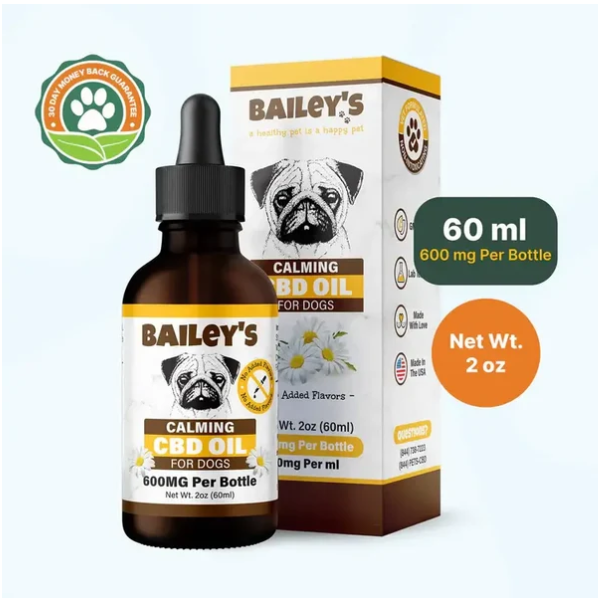
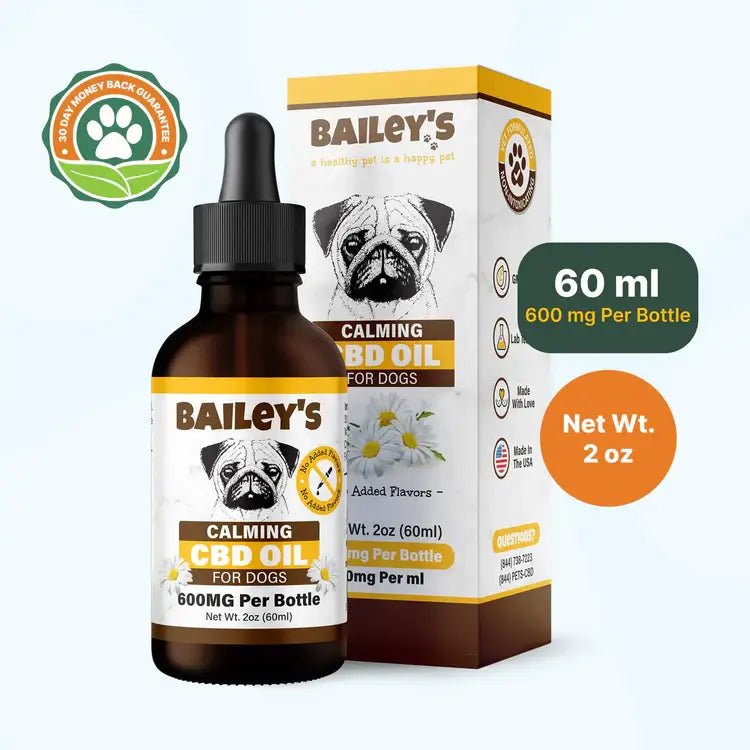
To illustrate the mathematical relationship between active ingredients and total volume, consider the product line from Bailey’s CBD. Their Calming CBD Oil is offered in two sizes: a 30-milliliter bottle containing a total of 300 milligrams of CBD, and a 60-milliliter bottle containing 600 milligrams of CBD.
Mathematically, both bottles have the exact same concentration: 10 milligrams of CBD per milliliter of liquid. The larger bottle simply contains twice the volume of liquid and twice the total amount of CBD, while the strength of the liquid itself remains unchanged.
To apply this practically:
- If a veterinarian recommends a specific starting dose of active CBD, the owner must calculate how many milliliters of liquid are required to deliver that exact milligram amount based on the product’s concentration.
- Owners should always use the graduated, marked measurements on the syringe or dropper provided with the product, rather than trying to count individual drops or assuming a full dropper equals a specific dose.
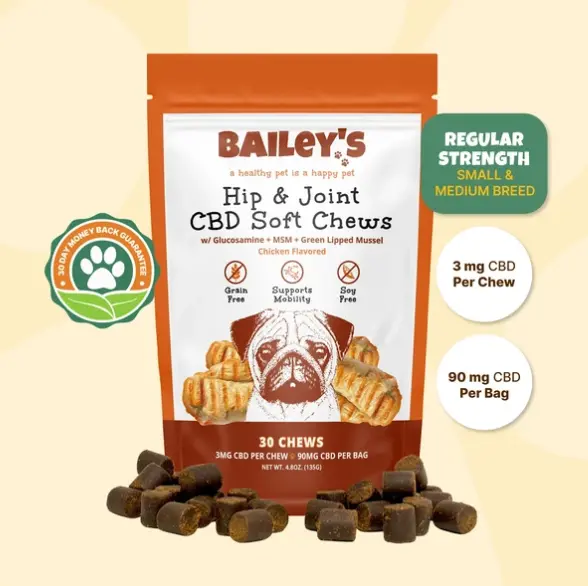
- When using soft chews, owners must check the specific milligrams of CBD contained in each individual chew, as regular-strength and extra-strength packages can look remarkably similar while containing vastly different amounts of the active ingredient.
Once a veterinarian has specified a starting serving size, owners should ensure they fully understand the measurement units. It can be incredibly helpful to ask the vet to write down both the target milligram amount of CBD and the corresponding liquid volume in milliliters to prevent math errors at home. Additionally, pet products should always be kept in their original, labeled packaging so that the safety information and batch details remain easily accessible to anyone caring for the dog.
If there is any uncertainty about how much CBD a dog actually consumed—for example, if a dog spits out a chew, leaves half their medicated food uneaten, or drools out a liquid dose—owners should always consult their veterinary team before administering more. Guessing or repeating a full dose is not a safe way to handle an incomplete serving.
Understanding Onset and Duration
There is no reliable, universal timeline for how quickly CBD will take effect in a dog’s body. The rate of absorption depends heavily on the specific formulation, whether the product is given with food or on an empty stomach, and individual metabolic differences. The rapid absorption times observed in highly controlled laboratory studies do not always translate to a commercial chew or oil administered at home.
Pet owners should establish a clear observation window in consultation with their veterinarian. During this period, it is helpful to record the exact time of administration, the precise amount given, and the specific behaviors or mobility changes being evaluated. If no noticeable changes occur, owners should resist the urge to give additional doses in an attempt to force an immediate behavioral change, as this complicates both clinical evaluation and safety monitoring.
Comparing Delivery Formats: CBD Oils versus Soft Chews
Neither liquid oils nor soft chews are inherently superior; rather, each format offers distinct practical advantages depending on the dog’s temperament and the owner’s lifestyle. Liquid oils or tinctures are often ideal for owners who require precise, incremental dosing adjustments, while soft chews are highly convenient for dogs that readily accept treats.
An oil formulation may be the most practical choice when:
- A veterinarian recommends highly precise, incremental dose adjustments that cannot be easily achieved by cutting a solid chew.
- The dog has dental issues or dietary restrictions that make solid treats difficult to chew or digest.
- The owner prefers to mix the supplement directly into a small, controlled portion of wet food or administer it directly into the mouth.
Conversely, soft chews may be the most practical option when:
- The dog is highly food-motivated and views the chew as a reward, minimizing the stress of administration.
- The product needs to be administered on the go, during travel, or by a pet sitter who requires a simple, pre-measured format.
- The dog’s calculated dose aligns perfectly with the pre-measured cannabinoid content of a single chew.
Mixing liquid oil into a large bowl of dry kibble is rarely successful if the dog leaves a portion of the meal behind. Similarly, attempting to split a small, soft chew by hand does not guarantee an even distribution of the active ingredient. Owners should always follow the manufacturer’s specific guidelines and ask their veterinarian how to handle missed doses or product refusal.
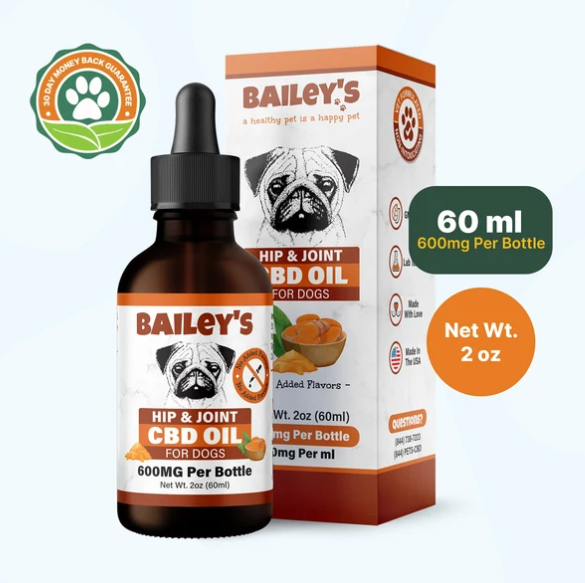
For a direct comparison of formats, Bailey’s CBD for Dogs collection includes both liquid oils and soft chews. When evaluating these options, owners must look past the brand’s main landing pages and scrutinize the exact ingredient panels and laboratory certificates of analysis for each specific product.
Within this product line, the differences in formulation are clear:
- Calming CBD Oil: This liquid formula combines hemp-derived CBD with added chamomile extract and L-theanine, suspended in an organic medium-chain triglyceride (MCT) carrier oil. It is designed for owners who prefer to measure precise liquid volumes.
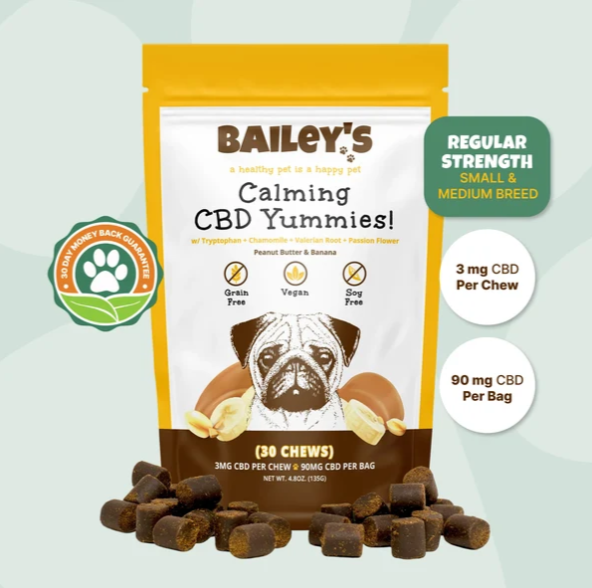
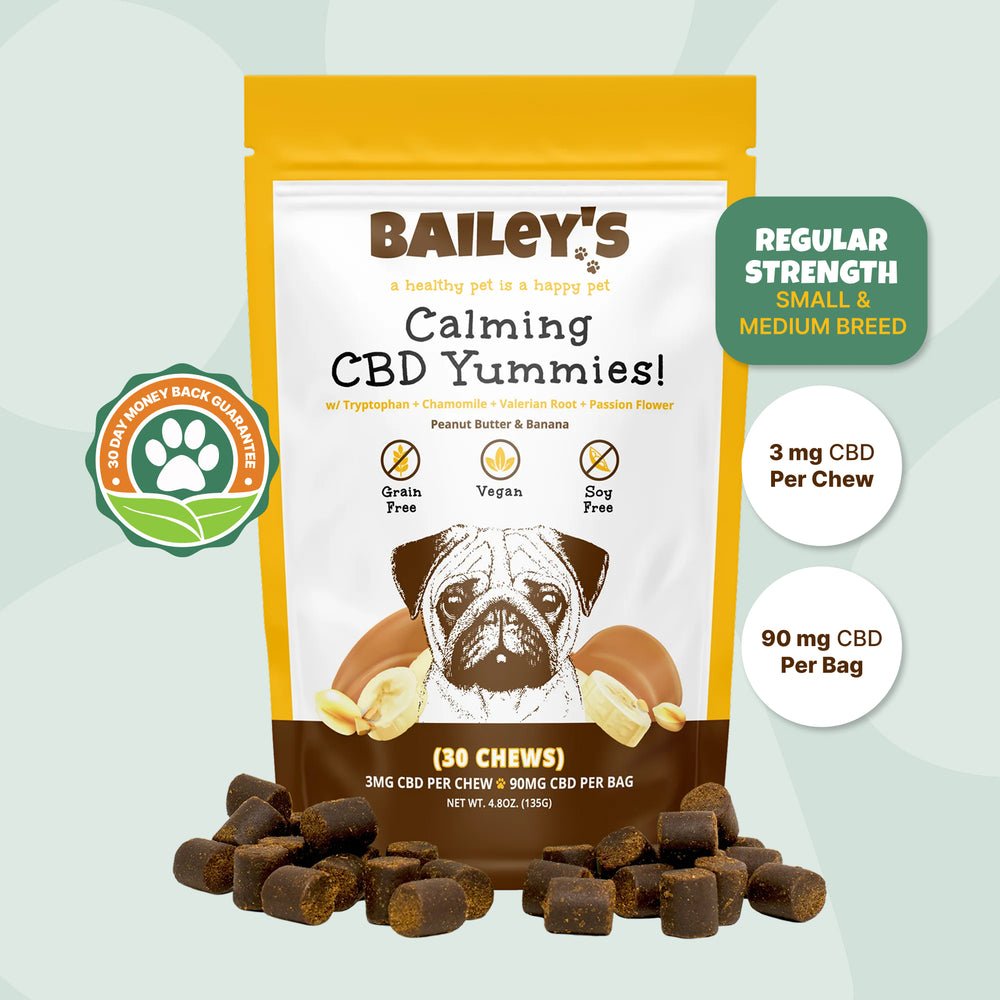
- Calming CBD Yummies: These soft chews contain a pre-measured, strength-specific amount of CBD alongside functional calming ingredients. They are formulated for dogs that prefer a soft, chewable treat format.
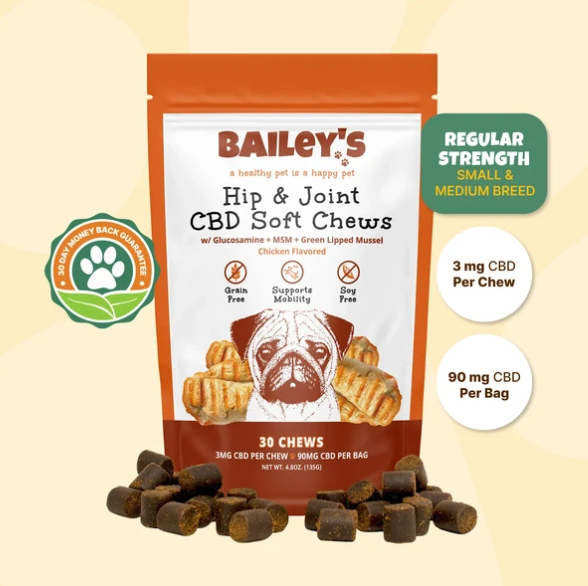
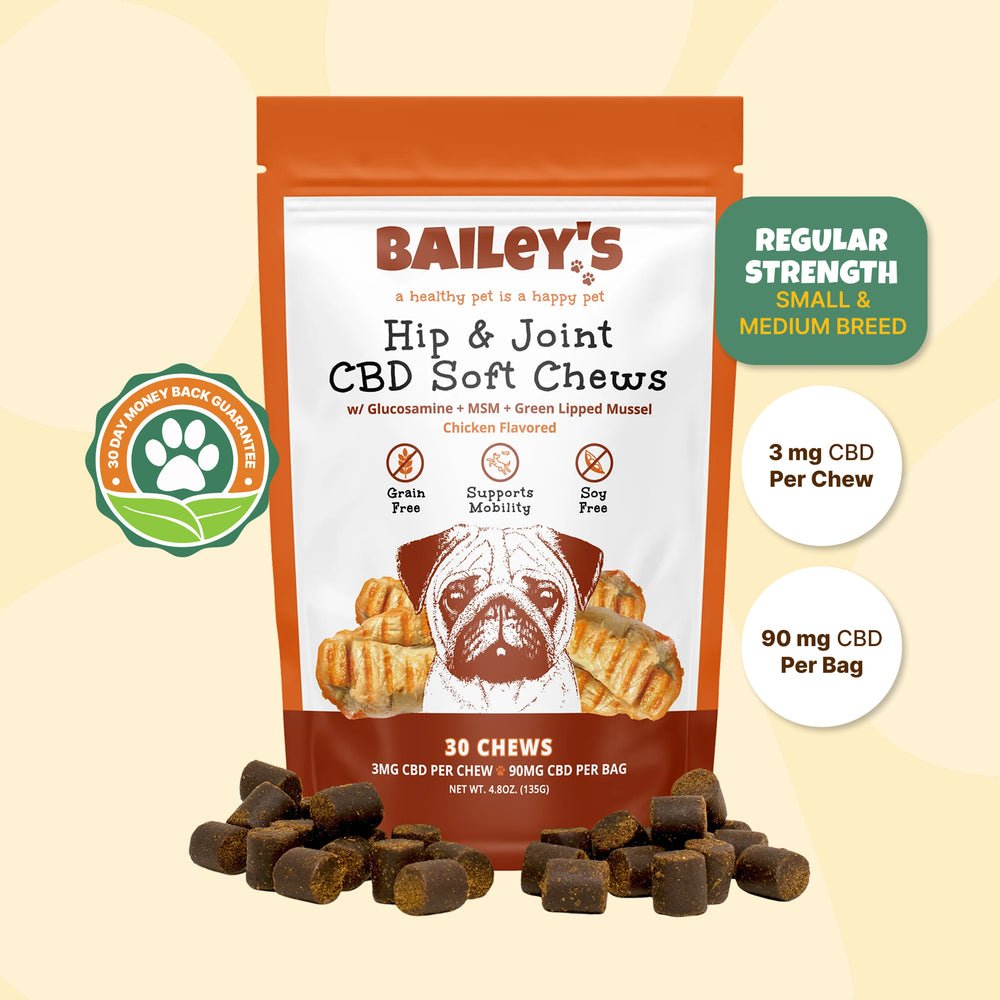
- Hip & Joint CBD Soft Chews: These soft chews combine CBD with established joint-support ingredients, including glucosamine, methylsulfonylmethane (MSM), and green-lipped mussel. This formula is designed for owners looking to integrate CBD alongside a dog’s existing mobility support regimen.
Comparing these products side-by-side helps owners narrow down their options based on their dog’s specific needs, rather than assuming a calming product and a joint-support product perform the same function.
Daily household routines should also guide the choice of format. If multiple family members, pet sitters, or boarding kennel staff are involved in a dog’s daily care, an easy-to-explain, pre-measured chew can significantly reduce the risk of dosing errors. Regardless of the format chosen, written instructions should always be kept alongside the original packaging.
Proper storage is another simple but vital safety consideration. Owners should follow the label’s storage instructions, keep containers tightly sealed, and store all products completely out of the dog’s reach. Highly flavored chews can be so appealing to a dog that they may attempt to chew through the packaging to consume the entire contents. Human-strength cannabis products must be stored in an entirely separate, secure location to prevent accidental ingestion by pets.
How to Select a High-Quality CBD Product
When evaluating pet CBD brands, owners should use a rigorous, verifiable checklist rather than relying on attractive packaging or vague quality claims. The best CBD product for a dog is one whose ingredients, active concentration, and third-party testing directly align with the dog’s unique health profile.
A comprehensive product evaluation should follow these steps:
- Consult your veterinarian: Discuss your specific health goals, review your dog’s current medications, and confirm that CBD is a safe option.
- Verify the active CBD content: Ensure the label clearly states the exact milligrams of active CBD per serving, rather than just listing "total hemp extract."
- Request the Certificate of Analysis (COA): Verify that the manufacturer provides up-to-date, batch-specific laboratory reports from an accredited, independent testing facility.
- Review the inactive ingredients: Check for any artificial preservatives, common allergens, or additives that could cause digestive upset.
- Confirm the THC levels: Ensure the product’s THC content falls within safe, legal limits (less than 0.3% for hemp-derived products) or is completely non-detectable, depending on your veterinarian’s recommendation.
To facilitate this verification process, Bailey’s provides a public online laboratory results directory. This resource allows consumers to match the batch number printed on their specific product packaging directly to its corresponding third-party lab analysis. Access to these reports provides essential transparency, though the owner and their veterinarian must still evaluate the actual data within the report to confirm its relevance.
How to Properly Read a Certificate of Analysis (COA)
A Certificate of Analysis (COA) is a formal document issued by an independent laboratory that details the exact chemical composition of a tested sample. To read a COA effectively, owners should start at the very top of the document to identify the product name, the specific batch or lot number, the date of the test, and the credentials of the testing laboratory. Next, compare the cannabinoid units reported by the lab with the claims printed on the product label. It is important to note that percentages, milligrams per gram (mg/g), and milligrams per serving are distinct mathematical units and cannot be used interchangeably.
The term "not detected" (ND) on a laboratory report indicates that the target compound was not present at a concentration above the laboratory’s specific reporting threshold. It does not necessarily mean the compound is completely absent at an absolute chemical level. Furthermore, owners must distinguish between a basic cannabinoid potency test and a comprehensive contaminant screen. A laboratory report that only measures CBD and THC levels does not prove that the product has been tested for, or is free of, harmful pesticides, heavy metals, residual solvents, or microbial contaminants.
Ultimately, a COA can confirm what a specific batch of product contained at the time of testing. It cannot, however, predict whether the product will be effective for an individual dog, nor can it determine a safe, appropriate dose alongside other medications.
A Practical Example of Matching a Batch Report
To understand how to navigate a public laboratory directory, consider an example from Bailey’s database. In the section for their 600-milligram Calming CBD Oil, the directory lists a specific tested sample: batch number BCL-250311-073, with a sample date of March 2025 and a best-by date of March 2027. This entry serves as a clear example of how quality-control records are organized. It does not, however, mean that every bottle currently available on retail shelves belongs to this specific batch.
When verifying a product at home, owners should follow this verification sequence:
- Locate the physical batch, lot, or tracking number printed directly on the bottle or box in their possession.
- Access the manufacturer’s online laboratory directory and locate the specific product format and strength.
- Find the PDF report that matches the exact batch number identified on the packaging.
- Verify that the laboratory’s measured active CBD concentration matches the strength declared on the product label.
- Confirm that the sample passed all relevant safety screens for contaminants and that the testing dates align with the product’s shelf life.
This systematic process allows pet owners to move past broad, unverified marketing claims and confirm exactly what they are introducing into their dog’s care routine. A well-organized database is invaluable because it separates testing records by specific formats and strengths. Specific batch documents provide the verifiable data needed for an informed decision.
Furthermore, keeping questions specific when contacting a manufacturer—such as asking, "Which specific laboratory report corresponds to lot number BCL-250311-073?"—yields far more useful information than asking general questions like, "Is your CBD high quality?" Similarly, a veterinarian can provide much better guidance when presented with a specific product label and its matching laboratory report, rather than a generic marketing brochure. The ultimate goal is to make a traceable, evidence-based care decision that everyone involved in the dog’s daily routine can easily understand and follow.
Preparing for Your Vet Visit: A Five-Question Checklist
When discussing CBD with a veterinarian, pet owners should bring the physical product container, the complete product label, and the matching third-party laboratory report. Writing down the specific batch number and taking a clear photo of the suggested-use panel can also be incredibly helpful. Providing these specific details is far more useful to a veterinary professional than asking a general question about "CBD," as formulations and concentrations vary dramatically across the market.
Pet owners can use this structured checklist to guide their veterinary consultation:
- Target Goals: Based on my dog’s current health status and physical exam, what specific, observable behaviors or mobility measures are we hoping to improve?
- Medication Safety: Do the active cannabinoids or inactive ingredients in this specific product present any potential risks or interactions with my dog’s current prescription medications or supplements?
- Starting Plan: What is a safe, conservative starting dose in milligrams of active CBD for this specific formulation, and how does that translate to milliliters of liquid or a fraction of a chew?
- Monitoring Protocol: What specific signs of improvement should I look for, what potential side effects (such as digestive changes or lethargy) require us to stop administration, and should we schedule follow-up blood tests to monitor liver enzymes?
- Evaluation Timeline: How long should we maintain this starting dose before we meet again to evaluate my dog’s progress and decide whether to adjust the plan?
To ensure a successful trial, keep your home observations as simple and objective as possible. If the primary goal is improving mobility, focus on tracking a single, consistent daily activity, such as how easily the dog stands up from their bed after a long nap. If the goal is managing situational stress, record the specific trigger, the duration of the behavior, and how long it takes the dog to settle, rather than simply noting whether the dog appeared sleepy. It is important to remember that a sedated or inactive dog is not necessarily a comfortable or stress-free dog.
Frequently Asked Questions
Does CBD really help dogs?
Clinical research suggests that CBD may provide meaningful support for dogs in specific health scenarios. Some controlled veterinary studies have documented positive outcomes, such as improvements in specific osteoarthritis pain scales and reduced physiological stress markers during controlled travel tests. However, these clinical results depend heavily on the exact formulation, dose, and specific patient population studied. CBD should always be evaluated as a targeted option for a defined health goal under veterinary supervision, rather than treated as a broad cure-all for every symptom.
What is the best CBD product to give my dog?
There is no single "best" CBD product that works for every dog. Owners should prioritize pet-specific formulations that feature clear ingredient lists, a declared concentration of active CBD, and an easily accessible, batch-specific third-party laboratory report. Once a product meets these quality standards, owners should consult their veterinarian to confirm the formula is safe and appropriate for their dog’s unique health profile and medication history. Selecting a preferred flavor or convenient delivery format should only occur after these safety steps are complete.
Is it safe to give my dog CBD on a daily basis?
Administering