


Four years ago, while browsing a local Goodwill in Wheaton, Illinois, college student Terrell Brown spotted an unusual, oversized ashtray. Priced at just $10, the ceramic piece featured a cartoon-like illustration of a fierce-looking young girl smoking a cigarette, accompanied by the stark, provocative words “Too Young to Die.” Although Brown recognized the distinct imagery, he was entirely unfamiliar with the artist behind it. Seeking answers, he snapped a quick photograph and shared it on Reddit. Within moments, a user chimed in: “Yoshitomo Nara is a really cool and famous artist, this is an amazing find!”

Today, Brown is a vintage reseller boasting a massive following of nearly 360,000 on TikTok. Capitalizing on his thrift store discovery, he resold the ashtray—which remarkably remained preserved in its original packaging—on eBay for an impressive $2,860. This lucky transaction illustrates far more than a simple online flip; it underscores the powerful cultural attraction and the sprawling, multidimensional afterlife of Yoshitomo Nara’s signature aesthetic.
The Japanese artist’s core creations—deceptively simple, round-headed children with enormous eyes whose expressions oscillate wildly between mischief, defiance, and profound melancholy—have become ubiquitous. Often accompanied by punchy, countercultural slogans like “No nukes” and “Rock ’n’ roll is not dead,” Nara’s figures manage to bridge the gap between high-end international contemporary art and widely circulated pop culture icons.

This dual reality is vividly on display as powerhouse art dealer David Zwirner unveils a major solo exhibition of Nara’s work in New York. Marking his first major solo showing in the city in over a decade and his inaugural exhibition with Zwirner after parting ways with Pace last year, the highly anticipated event is a museum-quality affair. Curated entirely by Nara, the exhibition spans the gallery’s two Chelsea locations, showcasing a comprehensive collection of paintings, drawings, and sculptures. Yet, true to the artist’s unique phenomenon, the gallery is expected to draw not only elite contemporary art collectors and museum curators, but also a broader public of devoted fans who know and love Nara’s imagery from a completely different cultural territory—one closer to the realm of Hello Kitty or Miffy.
Now in his 60s and working out of his studio in Tochigi Prefecture, located about 100 miles north of Tokyo, Nara first emerged on the international contemporary art scene during the 1990s. The unique affect of his creations—simultaneously innocent and deeply world-weary—remains central to their widespread appeal. Takako Nagasawa, deputy chairwoman at Phillips auction house, notes the complex psychological pull of the artwork. The characters “look cute on the surface,” she observes, “but if you read into them, they’re not cute, like the girl who has a knife hidden behind her back.”

Noting that many collectors choose to display Nara’s work prominently in their children’s bedrooms, Nagasawa points to this psychological duality as the driving force behind his lasting popularity. “I think that two-sidedness is the attraction, and very relevant now. We want to talk about what’s going on around the world, but we also don’t want to talk about it,” she explains.
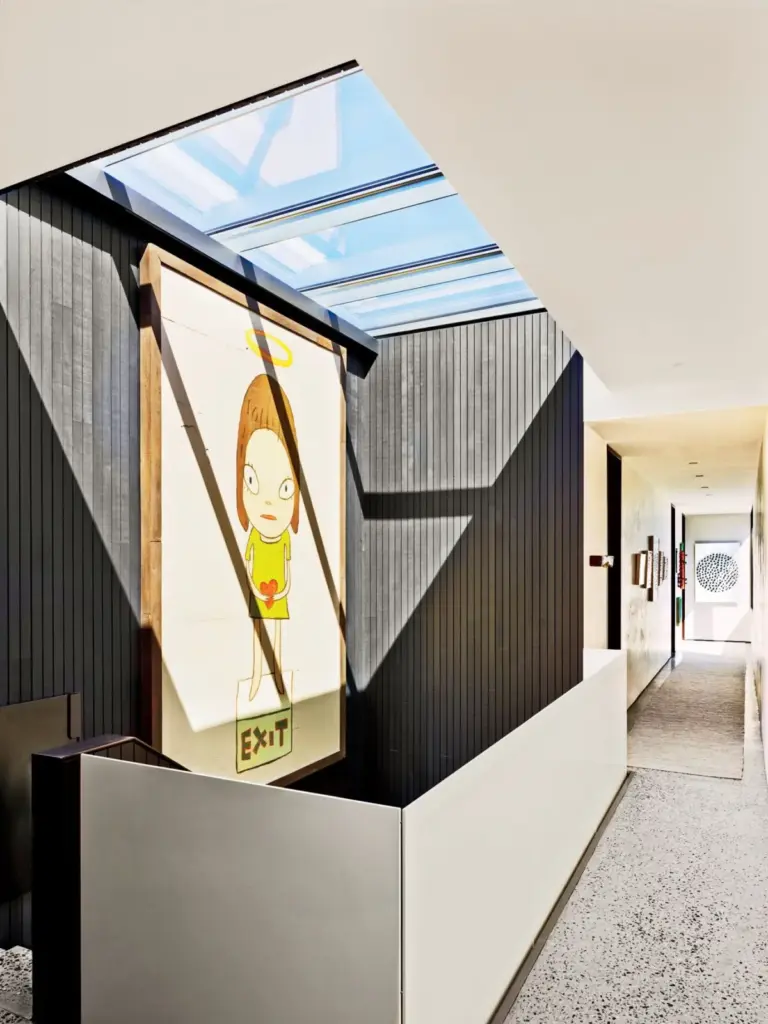
This broad, cross-generational appeal has landed Nara’s work in some of the most exclusive and talked-about spaces in the world. His fans include ultra-high-net-worth figures like Salesforce founder Marc Benioff, a dedicated, longtime collector who actively supported a major retrospective of Nara’s work last year at London’s Hayward Gallery, an exhibition co-organized by the Guggenheim Museum Bilbao and Museum Frieder Burda in Baden-Baden. Furthermore, Nara’s work has become a recurring fixture in high-end residential interior design, frequently featured in publications like Architectural Design. From a striking Nara sculpture positioned in Usher’s Atlanta backyard and multiple artworks decorating his daughter’s bedroom to a painting hanging proudly in Kris Jenner’s Hidden Hills dining room, the artist’s footprint in luxury spaces is undeniable.

Simultaneously, Nara enjoys a kind of cult currency among younger generations, circulating organically through college dorm rooms, online marketplaces, thrift stores, and social media platforms. His characters have become so deeply embedded in the cultural ether that they frequently feel as though they belong to everyone.
Unlike many fine artists who strictly guard the boundaries of high art, Nara actively prizes accessibility and has consistently embraced the extension of his imagery into everyday consumer products. While other prominent contemporary artists have successfully introduced signature characters into commercial merchandise—such as Kaws’s Companion and Jeff Koons’s balloon dog—none have endured and proliferated quite like Nara’s creations, which retain an underlying rebelliousness capable of speaking directly to disaffected youth across successive generations.

This spirit of collaboration extends across various creative industries. Yoshiki, the frontman of the legendary Japanese rock band X Japan, partnered with Nara to design the packaging for his Napa Valley wine label, Y by Yoshiki, which features the artist’s iconic figures. Similarly, fashion designer Stella McCartney, a close friend of Nara, has collaborated with him on multiple limited-edition collections. The resulting merchandise ranges widely in price and scope, from $100 shoelaces and $12 band-aids to $7,900 knit sweaters and heavy winter garments. Furthermore, institutions like the MoMA Design Store offer an array of Nara-designed consumer goods, including $85 snow globes, $1,200 table lamps, and alarm clocks. According to Chay Costello, associate director of merchandising and product development at MoMA, Nara consistently ranks as one of the most searched artists on the museum’s website.
For everyday admirers, these accessible consumer items provide a tangible connection to an artist whose primary-market fine art remains entirely out of reach. Content creator Nick Lowry, who purchased a Nara ashtray on eBay two decades ago for $250, recently documented his decision to move the object from a casual spot on his coffee table to a prominent position on his wall. The original acrylic painting that inspired the ashtray currently resides in the permanent collection of the Rubell Museum in Miami. “Objects like this are one of the only ways to own work by a living artist whose paintings now sell for more than I could ever afford,” Lowry shared in a viral TikTok video, adding that the piece “deserved a better spot.”

Marc Benioff shares a similar sentiment, describing Nara as “one of the most important artists of our time.” Benioff’s own journey into collecting began on eBay, where he initially purchased artist-designed journals and small books touching upon the Zen Buddhist concept of Shoshin, widely translated as “beginner’s mind.” Having since formed a personal friendship with Nara through Yoshiki, Benioff has built a substantial collection of the artist’s works. His holdings include a drawing of a grimacing girl bearing the text “I’m just alright,” a totemic fiberglass sculpture depicting two heads resting in a bowl, and a monumental bronze head. Reflecting on the competitive nature of the contemporary art market, Benioff notes the difficulty of securing works today. “It’s great that I picked them up early,” he says. “It’s really almost impossible to get anything [on the primary market]. The best pieces all go to the museums.”
The opening of Zwirner’s New York exhibition has naturally coincided with a flurry of high-profile activity across the global auction market. Nara currently holds an auction record of $25 million, achieved when his massive, seven-and-a-half-foot canvas Knife Behind Back sold at Sotheby’s Hong Kong in 2019. Additional monumental works continue to command staggering sums. His eight-and-a-half-foot painting Milky Lake / Thinking One, which depicts a young girl with downcast eyes, is slated for sale through the online auction platform Fair Warning with an estimated value of $10 million.

Meanwhile, Christie’s is offering an eight-foot-tall bronze sculpture of Nara’s character Miss Forest with an estimate of $1 million during its upcoming 21st Century Evening Sale. At Sotheby’s, collectors are eyeing Candy Blue Night, a 2001 painting estimated at $5 million, alongside a set of fiberglass sculptures titled The Little Pilgrims (Night Walking) from a 1999 edition, which carries an estimate of $1.2 million. The current consignors, Theodore and Ruth Baum, originally acquired the set at auction two decades ago for a mere $360,000.
For the David Zwirner exhibition, Nara has carefully curated a dialogue between historical and contemporary pieces, pairing works from his formative student days in Düsseldorf during the 1980s and 1990s with his most recent output. This pairing highlights how drawing has remained a foundational element throughout his career. Additionally, the exhibition features 13 oversized bronze heads, which were enlarged from palm-sized clay models inspired by the winter snow “monsters” of the artist’s childhood in rural northern Japan. This sculptural presentation follows closely on the heels of the recent reopening of the Hirshhorn Sculpture Garden in Washington, D.C., following a four-year renovation, where three larger aluminum iterations of the bronze heads are currently installed on the grounds.

For most contemporary artists, the vast financial and cultural distance separating multi-million-dollar museum masterpieces from mass-produced consumer trinkets would be virtually impossible to bridge. Yet, in the case of Yoshitomo Nara, this very duality serves as the anchor of his enduring legacy. His work exists comfortably simultaneously as an elite, million-dollar auction trophy and as an accessible token for a teenager. While high-powered collectors, curators, and celebrities gather in Chelsea for his latest gallery opening, a new generation of fans continues to discover his iconic, defiant figures somewhere entirely different—scrolling through TikTok, browsing Instagram feeds, or unboxing a gift shop find.