

Humanity’s demand on the natural world has hit a grim milestone, with Earth Overshoot Day for 2025 falling on July 24. Announced by the Global Footprint Network, this year’s date marks the earliest point in the calendar year that the event has occurred since calculations first began in 2006, underscoring a rapidly accelerating consumption rate that continues to outpace the planet’s biological capacity to regenerate.
Earth Overshoot Day designates the precise point in the year when humanity’s demand for ecological resources and services—such as food, fiber, timber, freshwater, and carbon absorption—exceeds what Earth’s ecosystems can naturally renew over the course of an entire year. The remaining months of the year represent a state of permanent ecological deficit, sustained by drawing down the planet’s vital natural capital and accumulating carbon emissions in the atmosphere faster than forests and oceans can absorb them.
First launched in 2006 by author, political economist, and campaigner Andrew Simms in collaboration with the Global Footprint Network, the tracking of Earth Overshoot Day has become a cornerstone metric for measuring global sustainability and human pressure on the biosphere. Over nearly two decades of tracking, the date has consistently crept earlier into the calendar, signaling how rapidly global consumption habits are expanding and depleting the planet’s finite resources.
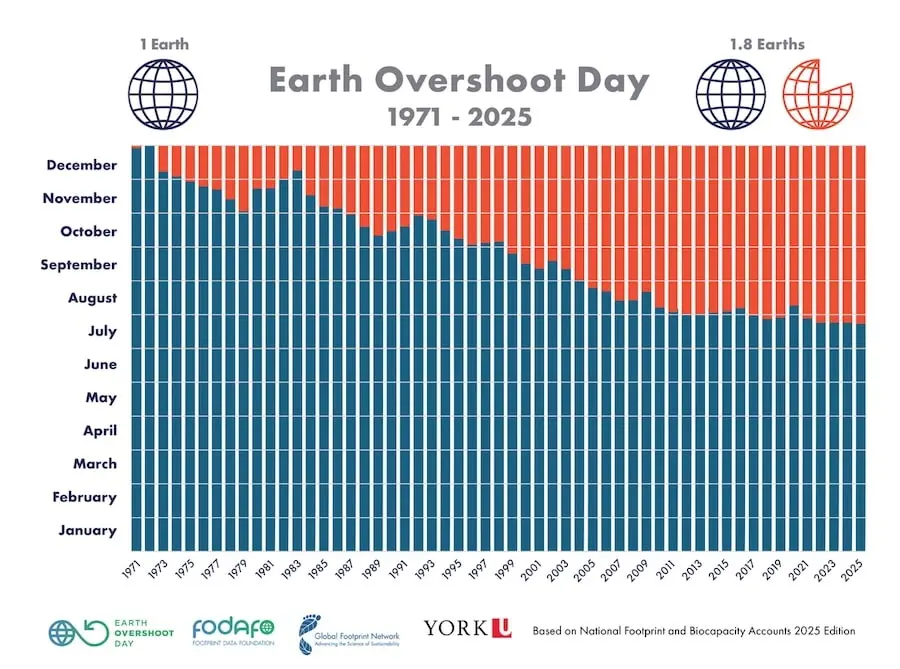
To ensure the utmost accuracy and provide a clearer historical trajectory, the Global Footprint Network recalculated previous Earth Overshoot Days, extending their analytical models even prior to 2006. These refined retrospective calculations reveal a startling long-term acceleration of resource extraction. According to the updated data, Earth Overshoot Day fell as late as December 31 in 1972, meaning humanity lived essentially within the planet’s ecological budget for nearly the entire year. By 1979, however, the date had crept up to November 3.

While the date briefly retreated into early December during the early 1980s amid economic shifts, the temporary reprieve was short-lived. By 1989, the date had advanced to October 12, where it remained relatively stable throughout the decade, hovering in October before reaching September 25 in 1999. When the formal announcement of Earth Overshoot Day was first established in 2006, the revised calculations placed that year’s marker on August 22.
The relentless downward trend continued into the 21st century, breaching the threshold into July for the very first time in 2018. Although global lockdowns and economic contractions briefly pushed the date back to August in 2020, consumption quickly rebounded, and the marker has remained firmly planted in July ever since. Prior to the 2025 calculation, the earliest recorded dates had been July 25, which occurred in both 2022 and 2023. Reaching an even earlier date in 2025 highlights the stark reality that humanity’s demands are intensifying at a pace that nature simply cannot sustain.
Global Footprint Network estimates indicate that humanity is currently operating at a deficit of 1.8, meaning people are using nature 1.8 times faster than Earth’s ecosystems can regenerate. Essential renewable resources—including freshwater reserves, timber supplies, and global seafood populations—are being harvested and consumed at rates that prevent adequate replenishment. Compounding this ecological strain is the unrelenting volume of greenhouse gas emissions, which far exceeds the capacity of natural carbon sinks to sequester.
Experts warn that this systemic overconsumption carries a severe cumulative toll. Even if the calendar date of Overshoot Day were to stabilize in future years, the ongoing deficit creates immense underlying pressure on Earth’s life-support systems. This systemic stress has already pushed humanity dangerously close to breaching critical thresholds, with scientists noting that human activity has nearly exceeded seven of the nine scientifically defined planetary boundaries that maintain a stable and habitable Earth system.
The sheer scale of this ecological debt has sparked urgent warnings from environmental scientists and institutional leaders alike. Lewis Akenji, a board member of the Global Footprint Network, emphasized the magnitude of the crisis in a statement accompanying the 2025 announcement. He noted that humanity is currently stretching the absolute limits of ecological damage and pointed out that a quarter of the way through the 21st century, the global community owes the planet decades of ecological regeneration, even if all harmful extraction were to halt immediately. Akenji added that preserving the planet as a viable home for future generations requires an unprecedented level of ambition in climate adaptation and mitigation, dwarfing any historical investments made to date.

Despite the sobering statistics, researchers stress that it is not too late to alter course and steer global society back toward ecological balance. The Global Footprint Network has outlined a series of systemic transformations through a campaign known as the "Power of Possibility," demonstrating that meaningful structural shifts can significantly move the date of Earth Overshoot Day backward in the calendar.
Among the most impactful interventions is the reduction of global carbon emissions. According to the organization’s models, cutting global carbon emissions by 50% would single-handedly shift the Earth Overshoot Date farther into the year by three months, providing immense relief to the atmosphere and global ecosystems.
Additional systemic adjustments offer substantial gains. Reducing global food waste by half would push the date back by 13 days, alleviating the immense agricultural footprint required to produce uneaten food. Transitioning power grids so that at least 75% of global electricity is generated from renewable sources would push the date forward by 26 days. Furthermore, implementing a comprehensive Green New Deal at a global scale could shift the marker by an impressive 42 days, illustrating the profound impact that coordinated international policy and green infrastructure investments could achieve.
Mathis Wackernagel, co-founder and board member of the Global Footprint Network, underscored the absolute necessity of proactive change. He noted that due to the immutable laws of physics, ecological overshoot cannot continue indefinitely and will inevitably conclude either through deliberate human design or through severe, disruptive ecological disasters. Emphasizing the availability of viable solutions, Wackernagel pointed out that choosing a sustainable path by design should remain the clear and preferable option for a society equipped with the knowledge and tools to enact change.