
A single word on a pet food label can completely transform what a dog is actually eating. When a product prominently features the words "Beef Dog Food," regulatory standards dictate that beef must comprise almost the entire weight of the product before water is added. However, adding simple descriptors such as "dinner," "with," or "flavor" dramatically lowers the legally required amount of that named protein—shifting the minimum requirement from 95 percent down to 25 percent, 3 percent, or no minimum percentage whatsoever.
Understanding these distinctions requires navigating the model pet food regulations established by the Association of American Feed Control Officials (AAFCO) and enforced through state agriculture departments and the U.S. Food and Drug Administration (FDA). Beneath the front-of-package marketing lies a precise regulatory system designed to ensure ingredient transparency.
Disclosure: This article is sponsored by Get Real, Chewy’s gently cooked fresh dog food line. Vetstreet may earn a commission if you purchase through links in this article.
What Is the 95% Rule in Dog Food?
The 95% rule applies to product names built entirely around an ingredient without modifying descriptors, such as "Beef Dog Food" or "Chicken and Rice Dog Food." According to official AAFCO label guidelines, named ingredients in these products must account for at least 95 percent of the total product weight excluding added water. When added water is factored back into the total weight, the named ingredients must still represent at least 70 percent of the complete product. The remaining 5 percent consists primarily of essential vitamins, minerals, and minor formulation ingredients required to make the diet nutritionally balanced.
AAFCO rules also explicitly protect the integrity of the product name. A food labeled "Beef Dog Food" must consist primarily of actual beef meat rather than beef meal or beef byproducts. Furthermore, creative or phonetic spellings do not allow manufacturers to bypass the rule; a name like "Chik’n Dog Food" is legally held to the exact same 95 percent requirement as standard chicken.
This dual-percentage calculation is especially critical for canned, wet, and fresh pet foods, where water is intentionally introduced during processing. While dry kibble also utilizes water during mixing, most of that moisture is driven off during the drying and extrusion process. Because high-moisture foods retain significant water content, the regulatory framework relies on two target numbers: one accounting for the recipe without added water, and one assessing the food in its final, hydrated state.
The pet food regulatory structure establishes a clear hierarchy of naming rules, each defined by specific trigger words and minimum percentage thresholds:
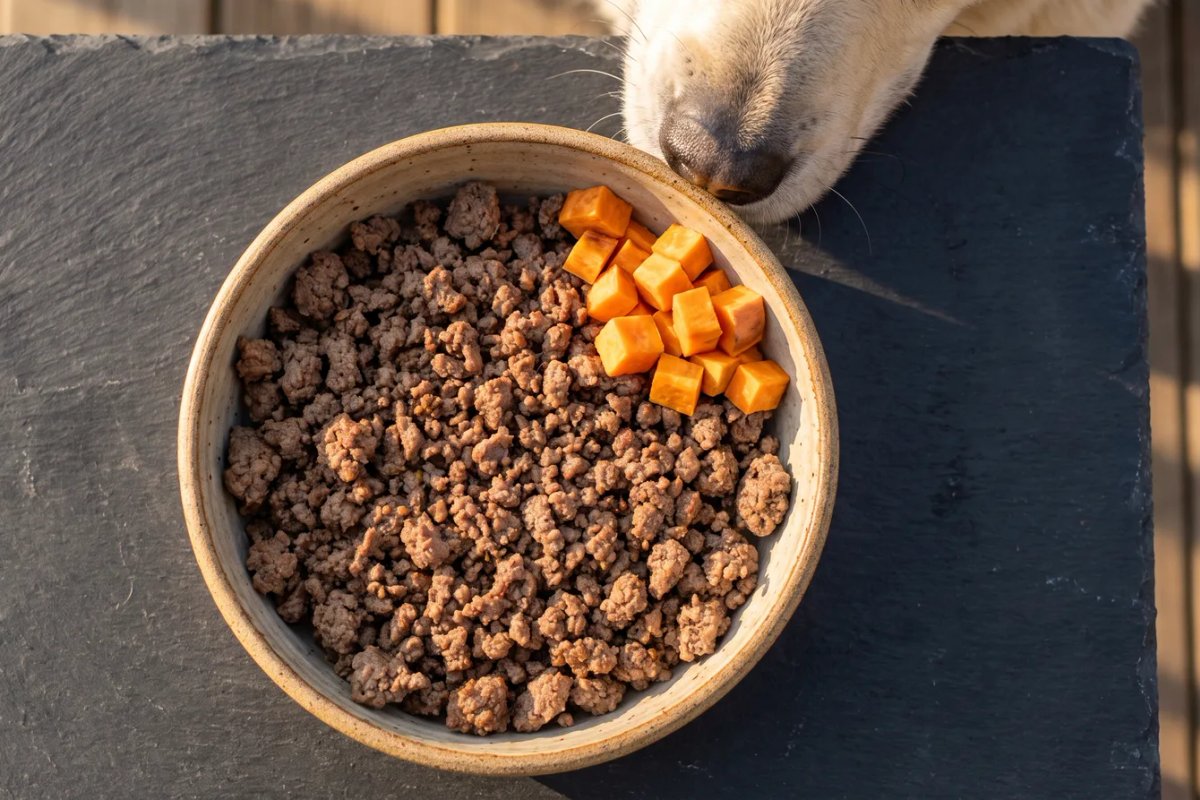
Under the top tier—the 95% rule—an ingredient named alone on the front display panel (such as "Beef Dog Food") must meet the 95 percent threshold excluding added water and 70 percent of the total weight overall.
The second tier is the 25% rule, which is triggered by descriptor terms such as "dinner," "entree," "platter," "formula," or "nuggets." A product labeled "Beef Dinner for Dogs" requires the named ingredient to make up at least 25 percent of the product weight excluding added water, and at least 10 percent of the total product weight when water is included.
The third tier is the 3% rule, triggered by the simple prenominal word "with." A product titled "Dog Food with Beef" must contain a minimum of 3 percent beef based on total product weight.
The final tier is the flavor rule. Products labeled as "Beef Flavor Dog Food" have no fixed minimum percentage of meat required. Instead, the recipe must simply contain a listed ingredient that imparts a detectable flavor—such as beef fat or beef broth—and the word "flavor" must appear on the package in the same type size and style as the named protein.
When comparing products on store shelves, reading the exact terminology in the product title is essential. The distinction between "Beef Dog Food" and "Dog Food with Beef" appears subtle at first glance, but under state and federal feed controls, the former must contain at least 95 percent beef by dry weight, while the latter requires only 3 percent overall.
The 25% Rule: Dinner, Entree, Platter, and Descriptors
The 25 percent rule comes into play when a product name pairs a primary ingredient with a qualifying descriptor word. AAFCO’s Model Regulations for Pet Food (specifically regulation PF3) outline an extensive list of recognized descriptors, including "dinner," "entree," "platter," "formula," "nuggets," and similar terms.
Under this rule, the named ingredient must account for at least 25 percent of the formula by weight, excluding added water, and at least 10 percent of the total product weight once added water is counted. This represents a significant decrease from the stringent 95 percent standard. A package labeled "Beef Dinner for Dogs" legally requires far less beef than one labeled simply "Beef Dog Food."
AAFCO compares this labeling mechanism to ordering a dinner at a restaurant: a sirloin dinner plate arrives accompanied by vegetables, starches, and sides, rather than consisting entirely of steak. The descriptor signals to the consumer that while the named protein is a significant component of the diet, the complete recipe relies on additional proteins, grains, or vegetables to round out the meal.
When a 25 percent descriptor product lists multiple ingredients in its title—such as a "Lamb and Rice Platter"—additional regulatory conditions apply:
- The named ingredients combined must meet the total 25 percent threshold (excluding added water) and the 10 percent total product floor.
- No individual ingredient named in the title can account for less than 3 percent of the total product weight.
- The ingredients must appear in the product title in order of their relative weight, meaning a "Lamb and Rice Platter" must contain more lamb by weight than rice.
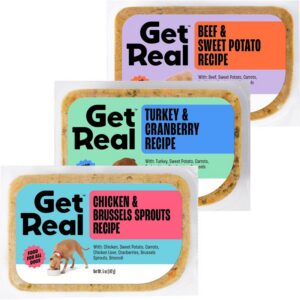
A product operating under the 25 percent rule is not inherently inferior in quality. Many complete and balanced pet diets deliberately pair high-quality animal proteins with vegetables, fruits, or healthy grains, and descriptor names accurately reflect those multi-ingredient formulas. For pet owners evaluating multi-protein or produce-inclusive options, product lines like the Get Real Sampler Pack offer gently cooked fresh recipes—including beef, chicken, and turkey formulas—that showcase how proteins and whole-food ingredients are blended under these guidelines.
The 3% "With" Rule
The 3 percent "with" rule provides manufacturers with a flexible method for highlighting secondary ingredients without claiming them as primary protein bases. Under AAFCO standards, inserting the word "with" before an ingredient allows that component to be named on the front label provided it makes up at least 3 percent of the total product by weight.
For example, a product named "Dog Food with Chicken" must contain at least 3 percent chicken. Similarly, a cat food labeled "with Tuna and Rice" must contain at least 3 percent tuna and at least 3 percent rice.
Consumer confusion frequently arises with this rule because the phrasing in "Dog Food with Beef" contains the exact same primary words as "Beef Dog Food." On commercial packaging, the word "with" is often rendered in smaller typography, leading buyers to assume the named meat is the dominant component. In reality, a "with" designation offers very little insight into the primary protein foundation of the food. To identify the primary components of such a diet, consumers must review the ingredient panel on the back of the package, where ingredients are listed in descending order of predominance by weight.
The Flavor Rule
The flavor rule establishes the lowest quantitative threshold among pet food naming standards, imposing no minimum numerical percentage. Under AAFCO guidance, a flavor designation may be used in a product title as long as a designated ingredient in the recipe provides the specified flavor, and the word "flavor" is displayed just as conspicuously and in the same font size as the flavor name itself.
Consequently, a product sold as "Beef Flavor Dog Food" is not required to contain actual beef muscle meat. The flavor profile can be derived from alternate listed components such as beef fat, beef stock, or hydrolyzed animal tissues that impart a recognizable taste. For instance, in a chicken-flavored product, chicken fat or chicken digest listed on the panel satisfies the regulatory requirement, provided the typography on the front display matches across both words.
Flavor designations are common in dry kibble, budget-tier pet foods, and dog treats, allowing products to deliver a consistent, appealing taste profile without altering the core underlying matrix of the recipe.
How Added Water and Combination Names Change the Math
The inclusion of added processing water complicates label calculations under both the 95% and 25% rules. Regulators resolve this by establishing two distinct quantitative hurdles that a recipe must clear simultaneously:
- The named ingredient must reach its high threshold (95% or 25%) when added water is completely excluded from the equation.
- The named ingredient must hit a secondary, minimum floor (70% or 10%) when total weight—including added water—is calculated.
To illustrate how this moisture math operates in practice, consider a hypothetical 100-pound batch of canned food intended to be labeled "Beef Dog Food":
-
Formula A: A 100-pound batch consists of 72 pounds of beef, 25 pounds of added water, and 3 pounds of vitamin and mineral premix.
- Test 1 (Excluding Water): Without the 25 pounds of water, the dry batch weighs 75 pounds. The 72 pounds of beef accounts for 96 percent of that dry weight ($72 div 75$), successfully passing the 95 percent dry requirement.
- Test 2 (Including Water): Out of the total 100-pound wet batch, the 72 pounds of beef represents 72 percent of the overall weight, passing the 70 percent wet floor. Because Formula A clears both tests, it can legally be titled "Beef Dog Food."
-
Formula B: The batch is adjusted to 65 pounds of beef, 30 pounds of added water, and 5 pounds of essential supplements.
- Test 1 (Excluding Water): Excluding water, the dry batch weighs 70 pounds. The 65 pounds of beef makes up 92.8 percent of that dry weight ($65 div 70$). Because this falls below the 95 percent threshold, the product cannot legally be called "Beef Dog Food."
- Adjustment: However, because the beef content exceeds 25 percent of the dry weight and easily surpasses 10 percent of the total wet batch ($65 div 100 = 65%$), the manufacturer can legally market this formula under the 25 percent rule as "Beef Dinner for Dogs."
Moisture content also explains why fresh, gently cooked foods and canned diets feature guaranteed analysis panels that look dramatically different from dry kibble. Fresh diets typically contain around 75 percent moisture, causing their raw protein and fat percentages to appear lower on the package label until converted to a dry matter basis.
Where Naming Rules Come From: AAFCO and the FDA
Pet food regulatory oversight in the United States relies on a dual system involving both state feed officials and federal authorities.
AAFCO itself is not a government regulatory agency, nor does it have independent enforcement authority. Instead, it is a voluntary association of state and federal feed control officials, veterinarians, and researchers who establish uniform model pet food regulations and nutritional profiles. State legislatures and state departments of agriculture routinely adopt AAFCO model regulations into state feed laws, making them legally binding at the local level.
At the federal level, the FDA Center for Veterinary Medicine (CVM) regulates pet food under the Federal Food, Drug, and Cosmetic Act. FDA requirements mandate that pet foods sold in interstate commerce must be safe, produced under sanitary conditions, truthfully labeled, and formatted with basic required elements—including clear product identification, net quantity statements, the manufacturer’s name and address, and an accurate ingredient list arranged by weight.
The regulatory framework functions through defined roles:
- FDA Center for Veterinary Medicine: Enforces federal safety standards, sanitary production compliance, truthful labeling, and basic panel formatting across state lines.
- AAFCO Model Regulations: Defines standard naming percentage rules, terms, definitions, guaranteed analysis standards, and nutritional adequacy profiles.
- State Feed Control Officials: Enact and enforce feed laws based on AAFCO models, inspect manufacturing facilities, pull market samples, and audit retail product labels.
A common area of consumer confusion is the phrase "AAFCO approved." AAFCO does not approve, test, certify, or endorse commercial pet foods. When a product label references AAFCO, it signifies that the manufacturer formulated the product to meet established AAFCO Nutrient Profiles or validated the diet through standard AAFCO feeding protocols.
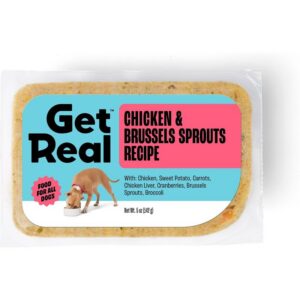
Because these labeling regulations apply universally across product categories, consumers can evaluate fresh, frozen, canned, and dry kibble products using the exact same analytical checklist. For instance, gently cooked options like the Get Real Chicken & Brussels Sprouts Recipe follow these identical labeling guidelines while maintaining formulation targets for all life stages, including large breed growth.
What Naming Rules Do Not Tell You
While product naming rules establish precise requirements for ingredient quantity, they leave several critical dietary factors unaddressed. A front-of-package product title does not reveal ingredient quality, overall digestibility, calorie density, or nutritional balance. A diet meeting the 95% rule could theoretically lack necessary trace minerals if unsupplemented, while a product operating under the 25 percent descriptor rule may provide a fully balanced profile for long-term health.
Evaluating a pet food requires reviewing three additional elements on the packaging:
- Nutritional Adequacy Statement: This statement confirms whether the food provides complete and balanced nutrition. It states whether the diet was formulated to meet AAFCO Nutrient Profiles or successfully passed standardized AAFCO feeding trials for specific life stages (such as adult maintenance, growth, or all life stages).
- Guaranteed Analysis: State laws require labels to display guaranteed minimum percentages for crude protein and crude fat, along with maximum percentages for crude fiber and moisture. The term "crude" refers to the analytical laboratory testing methods used to quantify the nutrients, not the intrinsic quality of the ingredients.
- Calorie Statement: Expressed as kilocalories per kilogram and kilocalories per standard feeding unit (such as a cup, pouch, or can), this data allows pet owners to calculate accurate daily intake based on their dog’s body condition.
Independent third-party certifications represent a separate layer of evaluation. Organizations like the Clean Label Project conduct independent laboratory testing to screen pet foods for environmental contaminants, heavy metals, or pesticide residues. These certifications are strictly voluntary and operate independently of AAFCO naming standards; a clean label seal does not indicate compliance with the 95% rule, just as meeting the 95% rule does not imply third-party contaminant screening.
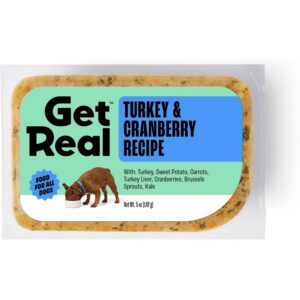
For pet owners selecting between different protein sources within a fresh format, products such as the Get Real Turkey & Cranberry Recipe demonstrate how alternative poultry formulas utilize simple ingredient lists while satisfying established complete-and-balanced life stage requirements.
Reading a Fresh Dog Food Label: A Worked Example
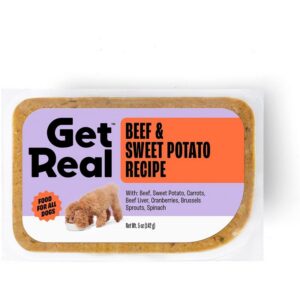
To understand how naming rules and label requirements operate in practice, consider a step-by-step examination of a fresh pet food label: the Get Real Beef & Sweet Potato Recipe.
1. Front Display Panel and Naming Rule
The title "Beef & Sweet Potato Recipe" combines two named ingredients with the descriptor word "Recipe." Because it uses a descriptor word, it falls under the 25 percent rule framework rather than the 95% rule. Consequently, the relative proportion of ingredients is verified by reviewing the ingredient list on the back panel.
2. Ingredient List Analysis
Under federal regulations, ingredients must be listed in descending order of weight prior to cooking. The published ingredient deck for this formula reads in sequence:
- Beef (Primary protein source)
- Sweet Potato (Primary carbohydrate and fiber source)
- Water (Processing moisture)
- Beef Liver (Organ protein providing essential vitamins and minerals)
- Spinach (Secondary produce component)
Following the primary whole foods, the panel lists precise nutrient supplements: dicalcium phosphate, canola oil, potassium chloride, calcium carbonate, salt, fish oil, choline chloride, magnesium sulfate, trace mineral complexes, mixed tocopherols, and vitamin supplements. This formulation adheres to a limited-ingredient structure containing ten primary whole food items or fewer alongside essential vitamin and mineral premixes.
3. Guaranteed Analysis & Calorie Content
The product’s panel guarantees:
- Crude Protein: Minimum 9.0%
- Crude Fat: Minimum 7.0%
- Crude Fiber: Maximum 1.5%
- Moisture: Maximum 75.0%
The product page specifies an energy density of 451 kilocalories per 12-ounce pack. The label’s nutritional adequacy statement confirms the diet is formulated to meet AAFCO Nutrient Profiles for all life stages, including the growth of large-size dogs (70 pounds or more as an adult).
By combining the front-panel naming rules with the back-panel ingredient order, guaranteed analysis, and adequacy statement, consumers gain a complete, accurate understanding of what the food delivers. The same methodology applies to other formulas across the product line, such as the Chicken & Brussels Sprouts or Turkey & Cranberry recipes, providing a standard framework for comparing pet food options regardless of brand or format.
Frequently Asked Questions
How do you calculate the dry matter fat percentage in dog food?
To convert guaranteed fat to a dry matter basis, subtract the listed moisture percentage from 100 to determine the total dry matter percentage. Then, divide the guaranteed fat percentage by the dry matter percentage and multiply by 100.
For example, a fresh food listing 7 percent fat and 75 percent maximum moisture has 25 percent dry matter ($100 – 75 = 25$). Dividing 7 by 25 and multiplying by 100 yields approximately 28 percent fat on a dry matter basis. Conversely, a dry kibble guaranteeing 15 percent fat and 10 percent moisture has 90 percent dry matter ($100 – 10 = 90$), yielding about 16.7 percent fat on a dry matter basis ($15 div 90 times 100$). Because guaranteed analyses list minimums and maximums rather than exact lab values, this calculation serves as an estimate for comparison rather than an absolute figure.
What is the 80/20 rule for dog food?
The 80/20 rule is an informal ratio used in raw feeding frameworks, typically suggesting a raw diet consist of 80 percent muscle meat, 10 percent bone, and 10 percent organ meats. It is not an AAFCO labeling rule and carries no legal definition in commercial pet food regulation. Diets prepared solely to meet an 80/20 ratio are not guaranteed to be complete and balanced, and home-prepared raw diets should be reviewed with a veterinary nutritionist.
Is there such a thing as "AAFCO-approved" dog food?
No. AAFCO does not test, approve, register, or certify commercial pet food products. Labels referencing AAFCO indicate that the manufacturer formulated the product to meet AAFCO Nutrient Profiles or validated the diet through standard AAFCO feeding trial protocols.

What are the main AAFCO dog food guidelines?
The primary guidelines consist of the AAFCO Model Pet Food Regulations and the AAFCO Dog Food Nutrient Profiles. The model regulations govern labeling requirements—including product naming percentage rules, ingredient definitions, guaranteed analysis standards, and nutritional adequacy statements—while the nutrient profiles establish minimum and maximum nutrient levels required for adult maintenance and growth.
What is the Clean Label Project for dog food?
The Clean Label Project is an independent non-profit organization that evaluates consumer products for environmental contaminants, heavy metals, pesticide residues, and plasticizers. Their certification is voluntary, fee-based, and separate from government oversight. A Clean Label seal does not indicate compliance with AAFCO naming rules or confirm whether a diet is nutritionally complete.
Who regulates pet food labels in the United States?
Pet food labels are regulated through a combination of federal and state oversight. The FDA Center for Veterinary Medicine enforces federal standards ensuring pet foods are safe, truthfully labeled, and manufactured under sanitary conditions. State feed control officials enforce state agricultural laws, which largely adopt AAFCO model regulations to oversee product registration, naming accuracy, and label compliance.
What does "flavor" mean on a dog food label?
Under AAFCO rules, a product labeled with the word "flavor" (such as "Beef Flavor Dog Food") is not required to contain a specific minimum percentage of meat. The recipe must simply contain an ingredient listed on the back panel that imparts the designated flavor—such as animal fat or digest—and the word "flavor" must appear on the package in the same size, style, and color as the named protein.