


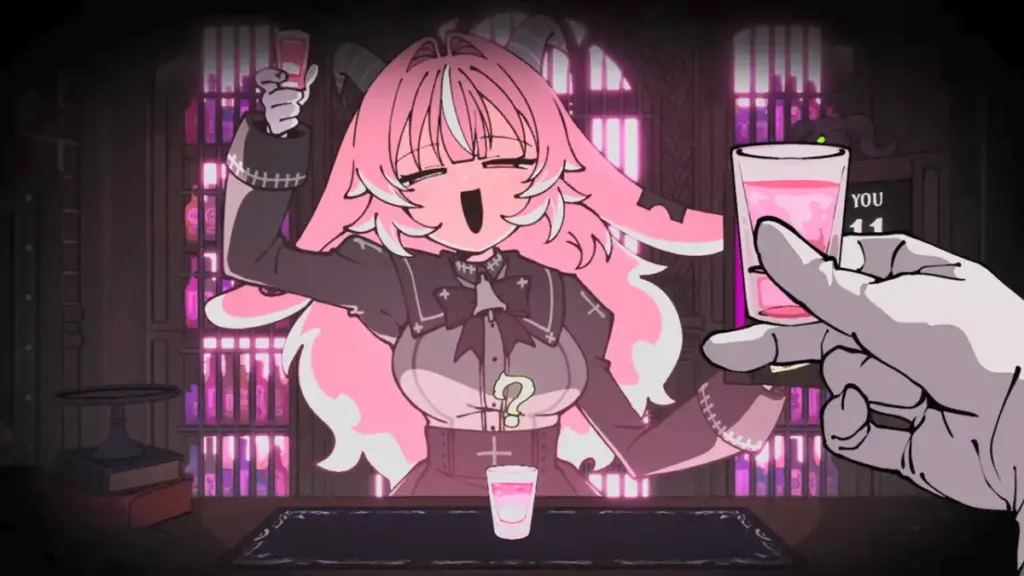
The developer behind the upcoming anime-inspired Russian roulette game Drunken Goddess Reflux has made the unexpected decision to cancel its planned public Steam demo, pointing to growing concerns over the rapid advancement of artificial intelligence and the threat of rapid-fire copycats.
Published by Alliance Arts and developed alongside Who You, Drunken Goddess Reflux had enjoyed a relatively smooth path to launch since its initial announcement back in April. The title immediately caught the attention of gamers with its striking aesthetic, characterized by ghostly pinks and purples, and a high-stakes gameplay premise that the team described as "shot glass Russian roulette with a demon who loves you enough to kill you." Momentum surrounding the project peaked recently when the developers proudly announced an official December launch window, giving fans a clear timeline for the game’s arrival.
As part of that release date announcement, Alliance Arts originally promised players a hands-on opportunity via a public demo slated to launch on October 19. However, in an official update post shared on Steam, the studio revealed that those plans have fundamentally changed. What was initially intended to be a wide, public release for the Drunken Goddess Reflux demo has now been entirely scrapped. In its place, the studio will host a "closed play session for a limited number of participants."
It is a drastic and last-minute pivot that Alliance Arts quickly apologized for in their community outreach, but the developers explained that their mounting concerns related to rapidly advancing AI technology were simply too significant to ignore. The decision highlights a growing anxiety among indie developers regarding how easily their creative works can be monitored, replicated, and commercialized by bad actors utilizing automated generation tools.
"We are concerned that, based on the content of the demo, works imitating or replicating this game’s presentation and gameplay could be quickly produced using AI or other tools and released ahead of the game’s launch," the developers explained in their detailed list of concerns published on Steam.
In practical terms, pushing a polished, accessible slice of the game out into the wild could inadvertently open the floodgates for nefarious individuals or opportunistic copycats. Armed with modern AI generation platforms and rapid prototyping software, these entities could potentially whip up a low-effort clone or mimicry experience to capitalize on the anticipation surrounding the original title. For an indie development team hoping for a clean, successful commercial launch in just a few months, a wave of cheap imitations stealing their thunder could introduce chaotic disruptions and financial risks that threaten the game’s viability.

Alliance Arts’ profound fears emerge during a turbulent era for the video game industry, a time when generative AI is seeping into digital spaces, creative pipelines, and community creations in ways that many developers and players never anticipated. The cultural footprint of generative tools has expanded rapidly across social media platforms. For instance, complex video game mods—including viral "vibe-coded" mashups that seamlessly splice together disparate franchises like Elden Ring and Super Mario 64, or Call of Duty: Modern Warfare 2 and Skate—have regularly captured the internet’s attention and gone viral on social media channels in recent weeks.
With generative and manipulative technology expanding in new, unforeseen, and often legally grey ways with each passing day, the studio decided that the risk of exposing their core assets prematurely was simply a gamble they were not willing to take.
Another critical bullet point listed in the developer’s message detailed the logistical and legal complications surrounding restrictions on posting and streaming gameplay videos. As the team candidly explained, they "are not currently in a position to properly handle and manage those restrictions" on a mass, public scale. Without the extensive resources or dedicated moderation infrastructure required to keep nearly unrestricted access and broadcasting of an open demo completely in check, Alliance Arts opted to scale down the scope of the preview entirely.
Rather than running the risk of unvetted distribution or unregulated content generation, Alliance Arts is pivoting to a tightly controlled environment. The developer confirmed that they will move forward with online play sessions housed within a closed ecosystem. This alternative approach ensures that the experience remains protected while still allowing community feedback.
"We will therefore hold online play sessions in a closed environment," the developer added, detailing that these sessions will be "open to those who have reviewed and agreed in advance to the participation requirements and the rules on posting and streaming gameplay videos."
For players who are still eager and genuinely interested in trying out the demonic drinking game ahead of its official release, the studio has provided a pathway for participation. Interested individuals have been encouraged to join the official Discord server linked directly within the recent Steam announcement post, where instructions and criteria for the closed play sessions will be managed.
Despite the sudden alteration to their pre-release schedule, the core rollout of the game remains firmly on track. Drunken Goddess Reflux is still officially scheduled to launch on PC via Steam on December 8, 2026.