


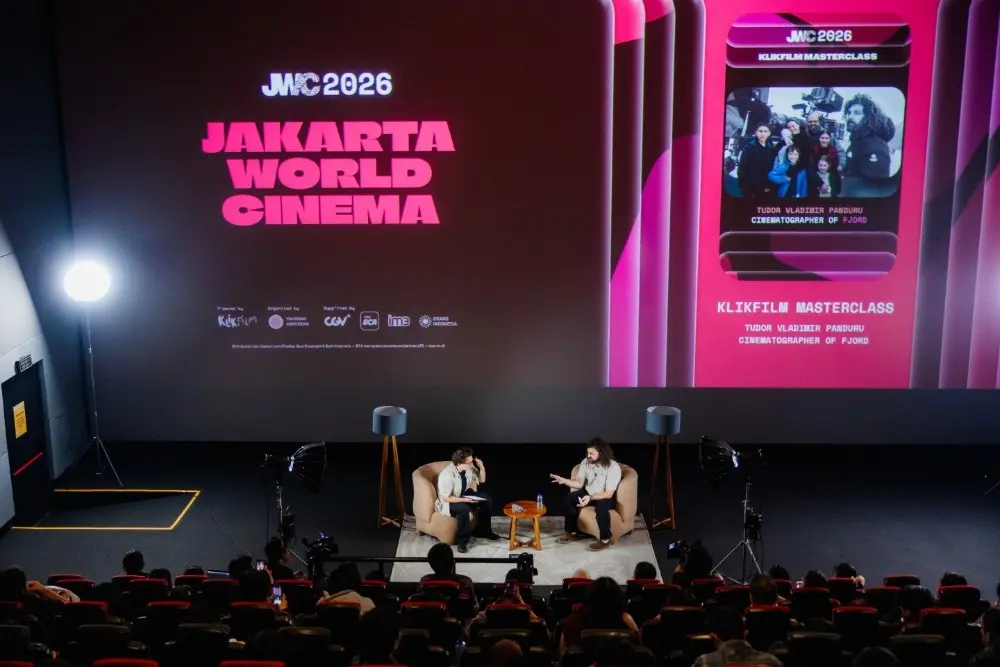
Acclaimed cinematographer Tudor Vladimir Panduru, best known for his close creative partnerships with prominent Romanian auteurs, recently took center stage at the Jakarta World Cinema event to offer an in-depth look into the rigorous and meticulous craft behind some of contemporary European cinema’s most striking visual storytelling. The masterclass traced Panduru’s professional evolution from a young trainee to an internationally recognized director of photography, examining his work across celebrated projects including Cristian Mungiu’s "Graduation," "R.M.N.," and "Fjord," alongside Iraqi director Hasan Hadi’s feature "The President’s Cake."
Guiding the conversation as moderator was Benh Zeitlin, the Oscar-nominated director renowned for "Beasts of the Southern Wild." Zeitlin opened the session by revealing his personal motivation for leading the discussion, candidly telling the audience that he was moderating because "we hope to work together someday." He went on to heap high praise upon Panduru, describing him as a rare breed of cinematographer capable of bringing a profound dimension to a director’s work that reaches "beyond your personal imagination."
The masterclass followed a chronological arc through Panduru’s career, beginning with a technical and artistic analysis of "Graduation," for which the screening room was shown one indoor and one outdoor scene. Panduru’s entry into the industry began under the mentorship of Oleg Mutu, Mungiu’s longtime cinematographer who lensed modern classics such as "4 Months, 3 Weeks and 2 Days." It was during this formative period as a trainee that Panduru was first introduced to Mungiu. Although "Graduation" served as only Panduru’s second feature film as a primary director of photography, it proved to be the breakthrough project that established his name on the international film scene.
Discussing his ongoing collaboration with Mungiu, Panduru explained that the camera in the Romanian auteur’s films is deliberately designed to remain low-profile. It avoids intrusive movements or manipulative angles meant to steer the audience toward specific conclusions, operating instead on the premise that viewers are intelligent enough to comprehend the narrative dynamics unfolding before them.
A defining characteristic of Mungiu’s directorial style is the heavy reliance on the plan-séquence—a method where entire scenes are captured in a single, uninterrupted shot without editorial cuts. For a cinematographer, Panduru noted, this presents immense technical challenges, as productions often require dozens of iterations to achieve the desired result. In this environment, actor performance reigns supreme as the most crucial element on set. Panduru revealed that the crew will frequently shoot anywhere from 20 to 40 takes to reach the optimal outcome.
While the grueling repetition of filming prolonged single takes might sound exhausting to outsiders, Panduru emphasized that the process rarely grows dreary. Mungiu possesses a unique ability to keep everyone on set mentally fresh and engaged throughout the long shooting days. At the same time, Panduru stressed that maintaining that vital energy is an individual responsibility, as the art of filmmaking ultimately boils down to living the authentic moment alongside every other cast and crew member.
This style of filmmaking relies heavily on an atmosphere of absolute trust, according to the cinematographer. When working within such an uncompromising framework, every contributor pours a piece of themselves into the creative process, eventually culminating in a powerful moment of synchronicity. Panduru clarified that shooting 30 or 40 takes is never a consequence of the earlier attempts being failures; rather, achieving perfection requires the delicate convergence of every moving element so that the final take captures the absolute best outcome of the collective effort.
Zeitlin observed that Mungiu’s films are anchored in themes of directness and truthfulness, while serving as a sharp critique of societal hypocrisy and dishonesty. Panduru concurred with this assessment, noting that Romanian cinema has historically maintained deep roots in pressing social issues, making Mungiu’s subject matter profoundly important. In his role, Panduru views himself simply as an enabler of that cinematic vision, stating that he is merely trying to help the director tell those essential stories.
When exploring how he selects his projects, Panduru advised that artists should always collaborate based on shared values. Reflecting on his own career, he noted his good fortune in being able to naturally gravitate toward subjects that deeply resonated with him. When asked about potential future genres, he firmly ruled out traditional action films, noting that he would only consider such a project if it carried an underlying social drama. Ultimately, he emphasized, every career choice relates back to personal affinities and creative alignment.
Throughout the masterclass, several defining scenes from Panduru’s filmography were screened, each immediately followed by a granular technical breakdown detailing how the shots were executed. These included a grueling 20-minute unbroken take featuring more than 100 people gathered tightly inside a town hall in "R.M.N.," a sweeping long shot tracking alongside a sailing boat gliding across the water in "The President’s Cake," and two distinct scenes drawn from Mungiu’s most recent feature, "Fjord."
The conversation surrounding "R.M.N." heavily focused on complex lighting choices. Panduru revealed the surprising technical reality behind a critical daytime scene, sharing that it was actually filmed entirely at night. He detailed the immense difficulty of the sequence, noting that focus pulling essentially served as the scene’s editing mechanism and reframing tool, eliminating any need for camera movement while keeping more than a hundred actors sharply in focus within a single, continuous frame.
Reflecting on the screening of the clip from "The President’s Cake," Zeitlin remarked that upon seeing the footage, he instantly realized it was shot by the same cinematographer behind the Mungiu films, prompting him to seek out a conversation despite the vastly different visual aesthetic. Panduru explained that because "The President’s Cake" is fundamentally a children’s fairytale, the material naturally demanded an entirely different visual language. The expansive natural landscape inspired him to approach scene construction with greater creative freedom, allowing him to employ running jib arms and specialized camera wheels—techniques he would later carry over into his work on "Fjord."
The discussion on "Fjord" began with a family gathering scene set during the fleeting, highly coveted "magic hour" just before sunset. Panduru walked the audience through the technical hurdles of the shoot, explaining how he systematically blocked the natural light coming from outside the location to artificially extend the available window for the actors’ performances.
The masterclass concluded with the screening of another demanding long take from "Fjord," which captures lead actor Renate Reinsve as she transitions from frantically searching the ground to executing a dramatic leap straight into the open sea.
Panduru emphasized that preserving the complete emotional arc and trajectory of the character made it imperative for Mungiu to avoid cutting away during the pivotal moment. Describing the physical reality of the shoot, the cinematographer recounted how he ultimately decided the most straightforward approach was to jump directly into the freezing sea alongside Reinsve. He noted that while matching the actor’s timing mid-jump was exceptionally difficult, an even greater anxiety loomed: the constant fear of losing control of the camera during the plunge itself, a remark that drew warm laughter from the audience. He was quick to credit the success of the ambitious shot to his exceptional team of grips, who expertly supported him both in the water and onshore.