

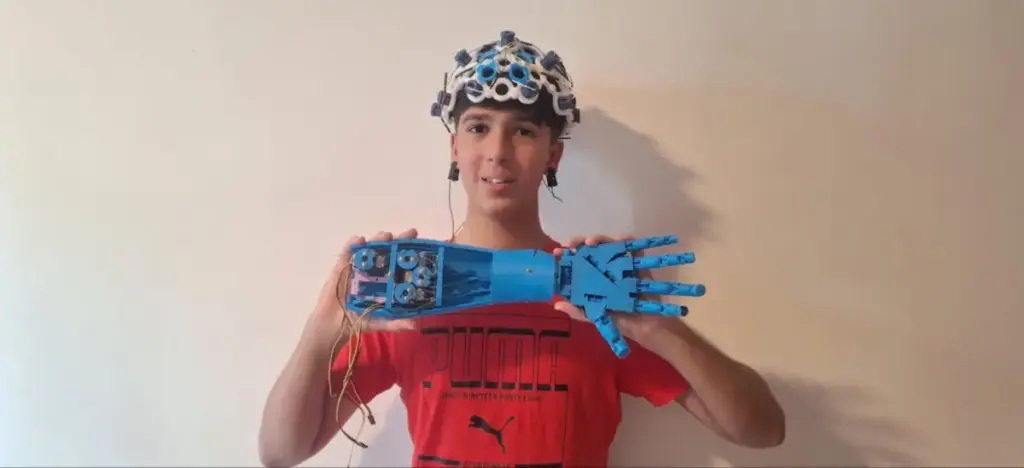
Aarav Sharma is still hard at work. If you follow the developments in the maker community, you might remember Sharma from earlier this year when he first caught widespread attention for building an innovative, 3D-printed, brain-controlled robot arm—a project he initially launched when he was just 14 years old. Since that early breakthrough, Sharma has shown no signs of slowing down. Instead, he has continued pushing the boundaries of what is possible in neurotechnology, expanding his focus beyond physical robotics into the realm of complex human communication systems.
Supported by a sponsorship from OpenBCI, Sharma has successfully engineered a sophisticated six-command Steady State Visually Evoked Potential system, commonly known as SSVEP. For those unfamiliar with the technology, SSVEP functions effectively as an internal form of eye tracking, relying on neural responses rather than physical camera tracking. As Sharma clearly explains, SSVEP operates as a specialized type of brain-computer interface where multiple visual targets flash on a screen at distinct, precise frequencies. When a user concentrates their gaze on a specific target, an EEG headset detects the corresponding neural response generated in the brain and seamlessly translates that specific frequency match into a functional digital command.

To further refine and accelerate the interaction speed of the interface, Sharma integrated intelligent word suggestions powered by an OpenAI language model. Despite the inclusion of advanced artificial intelligence, the design ensures that the human operator retains absolute control over the final output at all times. During rigorous preliminary testing, this thoughtful combination of neural sensing and predictive text allowed test users to formulate and transmit complete, full sentences in under five seconds.
The development process requires meticulous data collection and analysis. Describing his methodology for gathering and evaluating neural feedback, Sharma notes that for offline electroencephalography data collection, a user typically completes approximately 60 trials where the system explicitly instructs them on which of the six flashing visual targets to focus on. Following these sessions, Sharma carefully analyzes how overall system accuracy shifts when varying amounts of EEG data are utilized. He relies on time-frequency representation graphs to verify the successfully detected brain frequencies and employs confusion matrices to meticulously examine which specific targets are being mistakenly confused by the system during operation.

Looking toward the future of the project, Sharma has laid out ambitious plans to transition the user interface away from a traditional computer monitor. His ultimate goal is to port the entire system into augmented reality glasses, which would provide a significantly more portable, practical, and accessible everyday experience for potential end-users.
Those interested in following the ongoing evolution of Sharma’s brain-computer interface innovations can find further documentation and updates by visiting his project portfolio at aaravinnovate.com/bci-neurova.