



In the modern hospitality landscape, the traditional path to launching a restaurant or bar has undergone a seismic shift. Long gone are the days when a new establishment relied solely on a quiet, mysterious buildout behind paper-covered windows, followed by a sudden grand opening announcement in local print media. Today, founders across the globe are pulling back the curtain on the arduous, stressful, and deeply unglamorous reality of opening a food or beverage business, transforming construction zones and permitting nightmares into gripping, episodic digital entertainment.
This evolution in marketing represents the final installment of the series Getting on the Map, presented by Apple Maps, which explores how the most creative bars and restaurants are positioning themselves to stand out in an increasingly crowded market. At the forefront of this trend is a phenomenon where the creation of the venue becomes just as popular—and sometimes even more culturally resonant—than the venue itself.
Consider the opening of Susu’s, a new Brooklyn bar founded by Michael Bishop-Myers, a longtime New York City bartender. In an introductory video that immediately captured the internet’s attention, Bishop-Myers turns directly to the camera and offers a welcoming hook: "Hey, I’m Mike. I’ve been a bartender for a long time in New York City and I’m opening my very first bar. Let’s go inside."
Subsequent clips show Bishop-Myers sorting through menus, workers drilling into the in-progress bar counter, and team members meticulously adjusting wall frames. Earlier documentation of the space even focused on the technical minutiae of the venue’s sound system installation, highlighting 12 Klipsch speakers and one Powersoft amplifier. For a niche audience of hospitality nerds and neighborhood locals, this granular level of detail is irresistible. The first video alone accrued over 103,000 views on Instagram, accompanied by an influx of enthusiastic comments from prospective patrons eager to pull up a stool once the doors officially opened.
Across social media platforms, owners of bars, coffee shops, grocery stores, and restaurants are discovering that audiences have an insatiable appetite for behind-the-scenes content. This digital-first approach to construction and conceptualization has effectively turned ordinary buildouts into high-engagement video series.
The trend has deep roots in the recent past. Beginning in 2022, Chicago chef Jacob Potashnick utilized TikTok to meticulously chronicle the process of building his fine-dining establishment, Feld. When the restaurant finally opened in 2024, it arrived with a built-in community of digital followers. That foundational transparency paid off tremendously; Feld has since won a James Beard Award and earned a coveted Michelin star, milestones that now serve as the focal point for Potashnick’s ongoing social media content. Similarly, Vancouver’s Cowdog Coffee, launched by content creator Joe Lee, leaned heavily on social media to document its physical and operational genesis from the ground up.
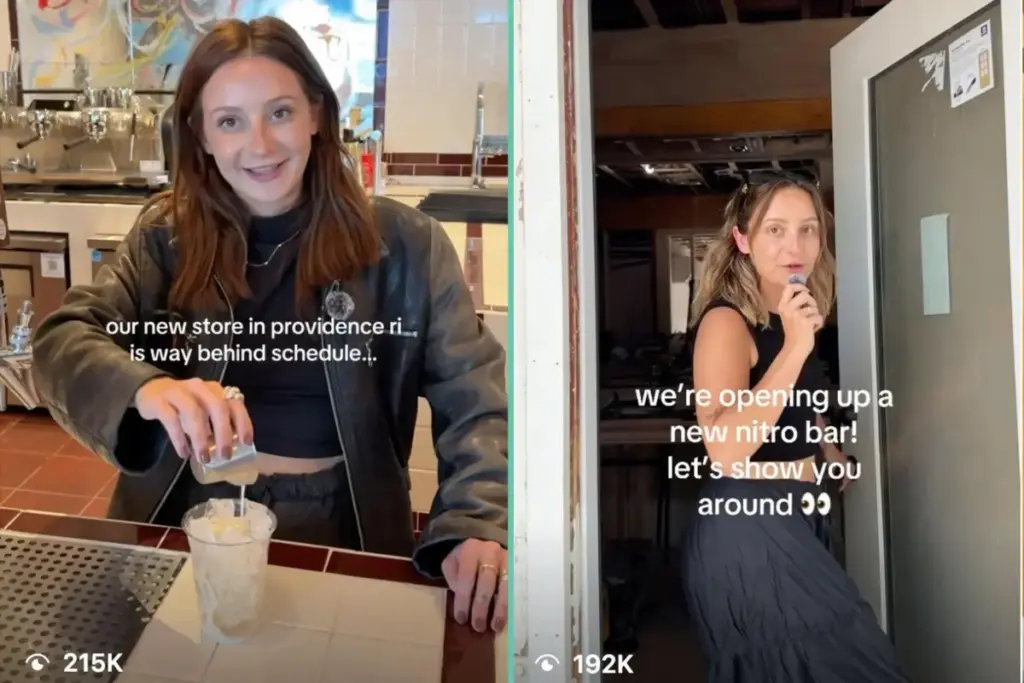
In Providence, Rhode Island, The Nitro Bar has long served as an innovator in digital hospitality marketing. Owner and prominent social media personality Audrey Finocchiaro has cultivated a massive following by blending authentic operational insights with lighthearted, sometimes absurd staff prompts. Finocchiaro, who frequently uses her personal accounts to pull back the curtain on the exhausting realities and absurdities of running a small-business coffee shop, has expanded this ethos into long-form YouTube content. Her series documenting the expansion of The Nitro Bar to New York City features everything from high-level interior design meetings to expansive tours of raw production spaces, drawing tens of thousands of views per installment.

Industry observers note that this strategy relies on a distinct psychological framework. As Rachel Karten of the social media-focused publication Link in Bio has explained regarding operations like The Nitro Bar, successful digital founders adopt a "my show is on" mentality. In this dynamic, the business functions as a set, the owner acts as the primary host, and the employees make up the supporting cast. Finocchiaro herself has often described her approach as treating the coffee shop as "its own person"—an entity that customers can actively befriend long before they ever step foot inside to order a beverage.
This cross-pollination of real estate development, design dilemmas, and hospitality has created a brand-new genre of entertainment. It is effectively HGTV fused with the Food Network, tailored specifically for consumers who prefer their lifestyle and consumption choices to be guided by parasocial relationships. Cookbook author and food personality Jake Cohen recently demonstrated this crossover appeal when he announced a series chronicling his DIY transformation of a Brooklyn warehouse into his dream event space and test kitchen. Standing in a raw, unfinished bathroom, Cohen posed design dilemmas directly to his followers: stainless countertops, stone, or butcher block? By inviting the audience into these micro-decisions, the business owner and the physical space itself transform into characters that viewers desperately want to support and see succeed.
Perhaps the most extreme and widely discussed example of this phenomenon is Sammy Nussdorf’s journey to open Meadow Lane, a high-end New York City grocery store. According to an analysis by Grub Street, Nussdorf documented the arduous path to opening over the course of more than 430 days, navigating multiple permitting snags and publishing nearly 700 TikTok posts along the way. By the time Meadow Lane finally opened its doors in late 2025, Nussdorf had transcended the traditional role of a retail founder to become as familiar and polarizing a figure as a reality television star. The confessional style of his videos, combined with the will-it-open-or-won’t-it-open narrative suspense, gave the grocery store buildout the cliffhanger appeal typically reserved for prestige television.
The marketing impact of this hyper-transparent approach was profound. Nussdorf told The New York Times that increased disclosure and unveiling the private machinery behind a business naturally drives public curiosity. That digital strategy translated directly into physical reality, resulting in massive lines wrapping down the block during the store’s opening week, with buzz spreading far beyond New York to regional shoppers nationwide.
This heightened level of disclosure is reshaping the broader restaurant and hospitality sector. As self-publishing platforms, newsletters, and short-form video networks empower creators to bypass traditional gatekeepers, founders are increasingly taking their narratives directly to the public. Stockholm-based chef Bill Allison has built a strong online presence by sharing the unvarnished, nuts-and-bolts realities of daily restaurant life. Meanwhile, new New York City restaurant Legion opted out of heavy social media short-form video entirely, instead publishing an in-depth Substack series titled The Opening Files in the weeks leading up to its debut.
Where prospective restaurateurs once depended exclusively on legacy food media to validate their concepts and generate early interest, contemporary operators can now test public appetite for the nitty-gritty logistics of restaurant design, menu development, and spatial layout in real time. Even legacy media outlets are leaning into the trend, as seen in a multi-part series published by Curbed following restaurateur and author Eddie Huang through the turbulent process of launching the new iteration of Baohaus, featuring candid disclosures regarding rent concessions, failed real estate deals, and the exact financial realities of the venture.
Ultimately, the driving force behind this cultural shift remains remarkably simple. In an era where consumers crave authenticity and connection, giving people a front-row seat to the chaos of creation satisfies a fundamental human curiosity, proving that when it comes to the hospitality industry, audiences will always lean in for a good story.