In the modern landscape of social media fitness trends, complex core-strengthening exercises frequently capture the collective attention of digital spaces. Yet, fitness experts often note that the most deceptively simple-looking movements are frequently the most difficult to execute. This reality sits at the core of the viral B.O.D.Y. balance challenge, a buzzing social media exercise that appears elegantly easy on a smartphone screen, but proves remarkably tough to pull off in a real-world gym setting.
While the name might imply a comprehensive acronym, the movement is a hyper-advanced stabilization exercise that tests the absolute limits of unilateral balance, core endurance, and mental focus. As outdoor athletes and everyday fitness enthusiasts attempt to replicate the posture seen across fitness feeds, trainers are weighing in on the biomechanics behind the challenge, why it leaves even seasoned movers wobbling, and what value—if any—it holds for those who spend their weekends hiking, running, or backpacking.
Reporting on the biomechanics behind the trend, Jenny McCoy, a National Academy of Sports Medicine (NASM)-certified personal trainer, explains why the exercise specifically targets the core and stabilization muscles that can make athletes stronger when they head out into the natural world. But before anyone can reap those theoretical athletic benefits, they first have to manage the intricate positioning required just to hold the pose.
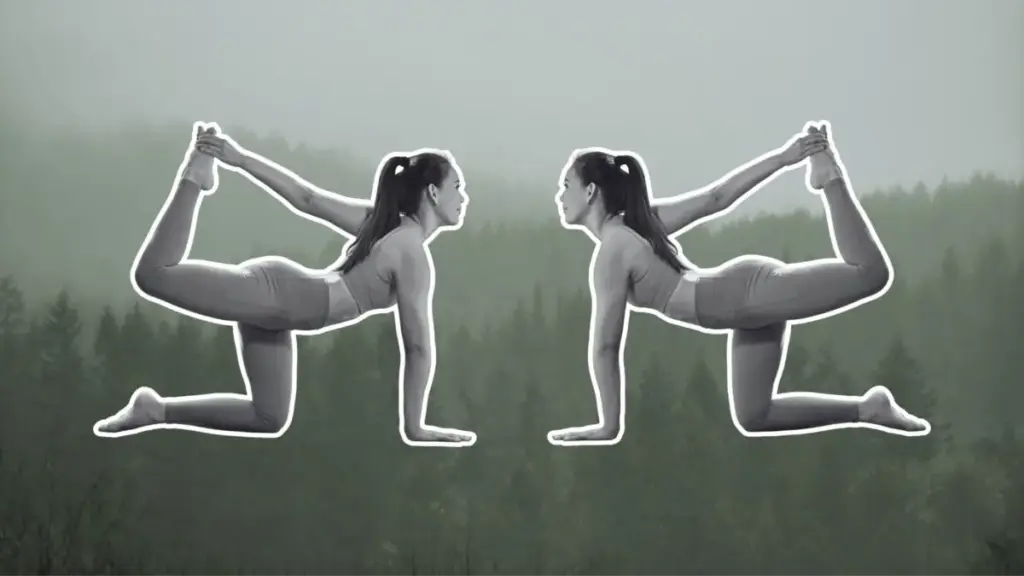
The physical execution of the challenge demands a precise sequence of body placements starting from the ground up. The pose initiates on all fours, after which the practitioner places their right forearm flat on the ground. From there, the left leg is lifted into the air. Next, the left arm is raised and rested carefully against the IT band, the dense connective tissue that runs along the outside of the left thigh. The final puzzle piece involves placing the right foot on top of the left quad, all while keeping that left leg elevated and suspended in space. To complete the picture, the individual props their chin up using their right hand.
The end result of this intricate choreography is a posture where the person is balancing entirely on their right elbow and right knee, situated completely on one side of their body. The primary objective is to hold as completely still as possible in this precarious position for a designated period before switching sides to repeat the process on the opposite flank. Because these directional cues are, admittedly, a mouthful to process in text form, many wellness creators rely on visual demonstrations to show just how rapidly the posture can cause a loss of balance.
For certified personal trainers attempting the move for the first time, the reality is often humbling. Even professionals who spend their careers coaching complex movement patterns report wobbling all over the place when trying to stabilize on such a minimal base of support. However, fitness theory consistently shows that a strong core improves both balance and overall posture, which in turn can make demanding outdoor pursuits like hiking, backpacking, and trail running significantly more manageable.
What Makes The B.O.D.Y Balance Move So Hard?
To understand why this viral social media movement causes so many fitness enthusiasts to topple over, it helps to examine the underlying physics. The exercise is essentially a hyper-advanced variation of a standard plank, but it strips away the structural redundancy that usually keeps the human body stable.
The primary reason for the extreme difficulty lies in the contact points with the floor. Practitioners must maintain balance using only two points of contact: a single elbow and a single knee, both positioned on the exact same side of the body. This creates an asymmetrical load on the skeletal and muscular systems. By contrast, if the contact points involved an elbow and a knee from opposite sides of the body—such as a standard diagonal bear crawl position—the move would be considerably more approachable, because that diagonal line naturally creates a broader and more secure base of stability.
Without that opposite-side support, the human body’s natural biomechanical tendencies take over. The hips and spine immediately want to rotate toward the grounded side, fighting against gravity and the pull of the suspended limbs. To prevent a complete collapse, the individual has to intensely engage their core musculature, forcing the torso to remain level against an uneven load.
Beyond core strength, the movement demands exceptional shoulder stability from the arm that is propping the entire upper body up by the elbow alone. Simultaneously, it requires significant glute and hamstring strength from the leg that is lifted straight up into the air, keeping it elevated without external support. Then, layer on top of all these physical demands an immense level of mental focus. The pose requires an individual to be one hundred percent present and internally connected to their body; the moment the mind wanders or loses concentration, the delicate center of gravity shifts, and the person will likely topple over.
Because of the intense, concentrated pressure this exercise places on the joints, fitness professionals advise caution. The movement puts a substantial amount of localized force directly onto the knees and elbows. Trainers suggest placing a supportive foam pad, folded blanket, or a pillow underneath the grounded elbows and knees to cushion the joints and make the attempt more comfortable. Furthermore, individuals with a history of chronic pain, joint issues, or previous injuries in their knees or shoulders would be wise to steer clear of this particular move altogether. Instead, those populations can explore safer, more traditional plank variations that effectively challenge core stability and shoulder strength without the high risk of joint strain.
How This Move Is Relevant For Outdoor Athletes
Despite its viral nature and the acrobatic look of the posture, the skills trained by the B.O.D.Y. balance challenge do carry some genuine relevance for outdoor athletes who demand functional durability from their bodies. The core stability trained by asymmetrical holds helps protect the spine from absorbing excessive, jarring forces during long backpacking trips, technical rock climbs, endurance runs, and rugged ski descents.
Furthermore, the secondary recruitment of glutes and hamstrings required to keep the body stable can translate to improved muscular endurance, helping propel athletes on long trail runs and up steep, unforgiving hikes. Sharpened mental attention and proprioception—the internal sense of where the body is in space—can also help individuals stay mindful of their movements and immediate surroundings when navigating uneven terrain outdoors, which may ultimately reduce the chances of surprise trips, slips, and falls.
At the same time, exercise scientists and trainers note that the B.O.D.Y. balance challenge is not the most functional movement pattern available. In the context of kinesiology, "functional" refers to exercises that closely resemble the natural ways humans move in daily life and specific athletic disciplines. Balancing on a single elbow and knee on one side of the body does not mirror the dynamic, multi-planar movements of walking, running, or climbing a mountain. Therefore, while the exercise certainly possesses legitimate benefits for isolated stabilization, athletes do not need to incorporate it into every single workout routine to see performance gains.
Instead, fitness professionals view movements like this as an occasional test rather than a daily prescription. If an athlete manages to get the hang of the posture, trying it every now and then can serve as a fun, unconventional way to benchmark core stability and unilateral balance over time. And even for those who try the movement and find themselves unable to master it, fitness experts suggest there is still value in the attempt. In an era dominated by instant digital gratification and easily accomplished digital trends, there remains something genuinely grounding about earnestly trying a difficult physical feat—and learning from the inevitable failure that follows.