The stock market has once again proved its capacity to surprise, leaving investors grappling with a familiar mix of anxiety and exhilaration. As equity indexes climb toward historic valuations, driven largely by a frenzied boom in Artificial Intelligence, a recurring question grips the financial community: Is this towering surge simply a prelude to a catastrophic crash, and will it ultimately devastate retirement portfolios?

For those who have tuned out the daily financial drama, the modern AI phenomenon follows a rapid trajectory of massive capital investment, soaring tech valuations, and widespread speculation about its societal impact. Yet, beneath the current market euphoria lies a deeper concern. Investors worry that the mania surrounding artificial intelligence is moving too fast and too excessively, setting the stage for a modern, amplified version of the dot-com crash of the early 2000s.
That particular historical bust holds distinct resonance for early retirement advocates and internet financial commentators who lived through it. Two decades ago, the dot-com boom fueled early career trajectories before the subsequent crash nearly derailed personal financial stability and legal residency applications. As questions mount regarding the current investment cycle, veteran commentators are taking these discussions beyond digital forums and onto the live stage, addressing audiences at events like Camp FI Midwest and the upcoming Bogleheads conference to dissect the psychological and economic realities of market booms.

Will the AI Bubble Ruin Our Retirement?
Having crossed the milestone of two decades of retirement, financial veterans have grown comfortable with the concept of post-work life, yet they still encounter profound questions from peers. Friends and observers frequently ask how anyone can remain retired and sleep soundly given the state of global affairs. In an era dominated by news feeds flashing warnings about geopolitical conflict, inflation, national debt, and technological disruption, the impulse to worry feels almost mandatory.
Yet, this anxiety is hardly unprecedented. Looking back twenty years to the mid-2000s reveals a remarkably similar climate of existential and financial dread. During that era, the public wrestled with the specter of volatile political leaders, wars in the Middle East, soaring national debt, persistent inflation, and anxieties over a wildly overvalued housing market. Back then, instead of fearing that artificial intelligence would eliminate jobs, workers worried about widespread corporate outsourcing to overseas economies like India and China. There was even a prevailing panic regarding "Peak Oil," a widespread theory that global fossil fuel consumption would inevitably outstrip supply and plunge industrial civilization into crisis.

Despite those intense anxieties, the subsequent twenty years unfolded with surprising resilience. While the world did experience the Great Financial Crisis—a severe downturn sparked by irrational exuberance in housing prices and overly complex financial leverage—the broader economic trajectory continued upward. Historical market data demonstrates that long-term investments weathered even the most dramatic downturns, including the 2008 crash and the pandemic-induced market shock of 2020, to deliver substantial growth over the long haul.
Simultaneously, global living standards improved dramatically across several measurable metrics. The proportion of the global population living in extreme poverty dropped significantly over a twenty-year span, while infant mortality rates were cut in half. Clean energy adoption accelerated as solar panel manufacturing costs plummeted, allowing solar power to become a dominant source of new electricity generation worldwide. Meanwhile, electric vehicle adoption surged from near-zero to claim substantial market share across the globe.

These historical realities pose a fundamental question: Does human energy yield better results when focused on anxiety over an uncertain future, or through steady optimism? Observers inevitably ask whether current conditions are genuinely different this time around—whether the U.S. national debt has finally reached a tipping point, or if the artificial intelligence bubble possesses unprecedented destructive potential. Financial media outlets thrive on producing compelling, high-stakes narratives about impending doom, yet these pessimistic forecasts often overlook a foundational economic truth. At its core, human prosperity is not derived from abstract financial systems or the fluctuating numbers on a stock market screen; true prosperity stems fundamentally from productivity.
Prosperity, Productivity, and the Human Experience
The relationship between economic output and human well-being points to a simple reality: the capitalist marketplace is inherently volatile and prone to dramatic cyclical swings. Beneath the surface turbulence, however, real people continue to perform tangible labor, develop innovative tools, and drive practical inventions. Economic and financial systems are ultimately human constructs. If a system experiences a severe failure due to confidence loss or mathematical imbalances, society possesses the capacity to restructure the framework and resume productive work, a strategy successfully utilized during past crises.

Tools designed to boost productivity remain intact, and high productivity continues to underpin standard of living enhancements, economic growth, and the feasibility of early retirement. Beyond mere economic output, however, human happiness eventually reaches a plateau where additional material wealth yields diminishing returns. Advanced industrial nations surpassed basic survival requirements decades ago, prompting individuals to seek fulfillment through other dimensions of life.
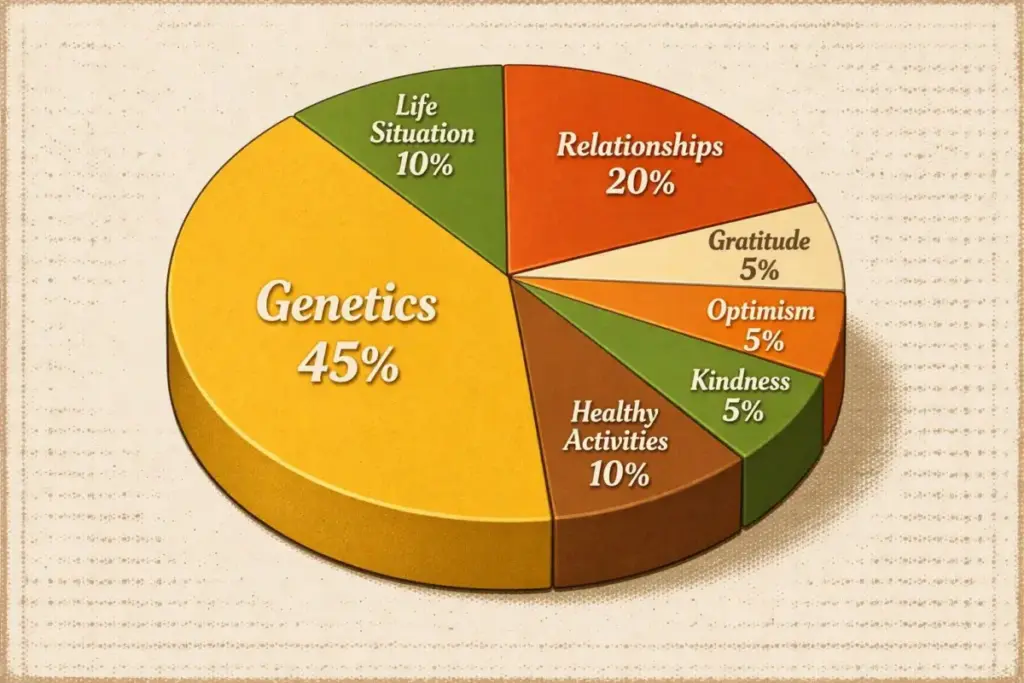
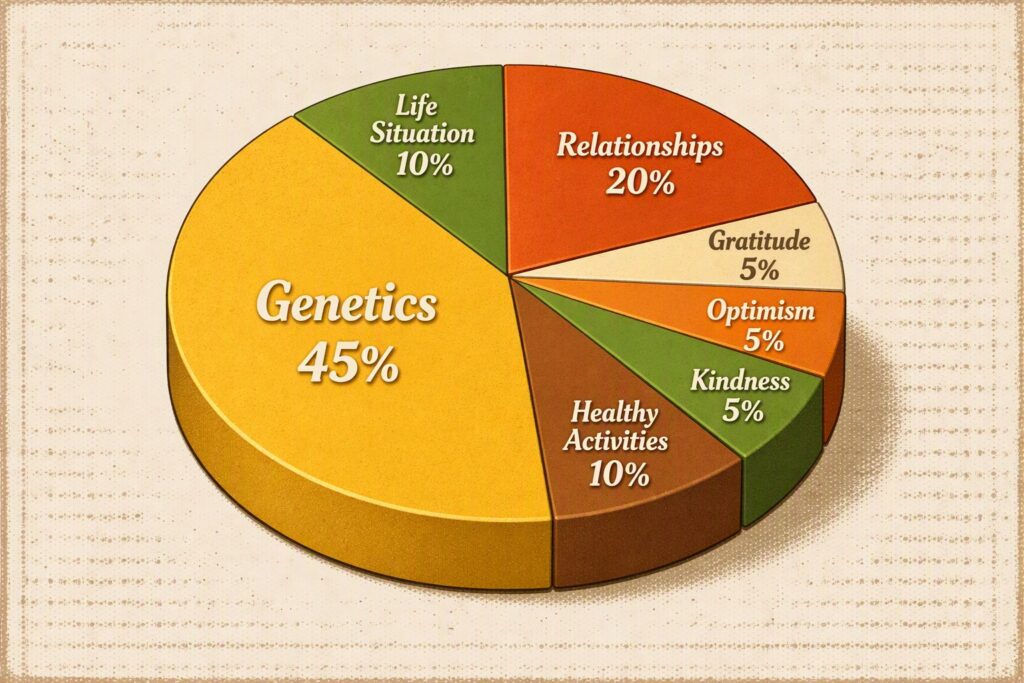
Psychological and lifestyle factors play a dominant role in overall human happiness. While genetic predisposition accounts for a significant portion of personal well-being, controllable choices remain vital. Cultivating close interpersonal relationships, practicing daily gratitude, maintaining an optimistic outlook, and engaging in regular outdoor physical activity consistently rank among the most powerful determinants of a satisfying life.

Despite these established insights, a pervasive undercurrent of fear persists even among financially secure individuals. This persistent anxiety often traces back to human evolutionary biology. As a species, humans evolved as highly sensitive danger-detection machines, utilizing background anxiety as a mechanism to evade environmental threats.
The complication arises when those tangible physical dangers recede. Rather than relaxing, human psychological machinery frequently continues scanning for new sources of worry, effectively shifting the goalposts of anxiety. Once physical safety and basic food security are achieved, worries migrate toward social acceptance, financial status, and resource scarcity. In more affluent populations, anxiety frequently manifests in hyper-specific concerns, ranging from neighborhood property rules and tax optimization strategies to government-mandated retirement account distributions.

Confronting Fear and Treating Everything as an Experiment
Combating this ingrained psychological fear requires intentional self-awareness and rational evaluation. Examining personal and familial history often reveals the roots of modern financial anxiety. Individuals raised in households marked by economic scarcity, or those who survived early-life trauma, frequently carry deep-seated survival anxieties into adulthood, projecting past scarcity onto present security.
Addressing these fears directly involves examining worst-case scenarios and recognizing their unlikeliness. Taking concrete action serves as a powerful antidote to anxiety, transforming the unfamiliar into the manageable and building personal resilience. Furthermore, curating one’s mental environment by reducing exposure to sensationalized news media allows individuals to replace passive consumption of fear with positive, constructive behaviors. Aligning daily habits with physical health—such as spending time outdoors, maintaining proper nutrition, and engaging in meaningful problem-solving—helps alleviate the existential distress generated by modern sedentary lifestyles.

This philosophy of proactive engagement extends naturally to emerging technological shifts, including the current revolution in artificial intelligence. Rather than viewing technological disruption solely through the lens of doom-scrolling and catastrophic risk, AI can be examined through the pragmatic framework of an ongoing experiment.
From a technological and economic perspective, artificial intelligence functions essentially as a sophisticated cognitive tool designed to supercharge human efficiency. Just like historical innovations that automated manual labor or streamlined communication, AI enhances productivity and generates broader economic prosperity, even as it simultaneously displaces specific job categories and reshapes entry-level white-collar professions. While the efficiency gains of such technologies historically concentrate rewards among asset owners and shareholders, they also lower costs and catalyze the creation of entirely new industries, much like the advent of the internet and mobile computing.
Ultimately, artificial intelligence represents another variable in the complex landscape of modern life—an opportunity to make deliberate choices rather than succumb to generalized panic. By acknowledging the evolutionary roots of fear, focusing on tangible productivity, and treating personal and professional transitions as manageable experiments, individuals can navigate market volatility and technological change with clarity, resilience, and purpose.