

Financial markets have a persistent habit of surprising investors. When stock indices crash, retirement portfolios shrink, prompting widespread anxiety. Yet even when the market surges to record highs and super-duper-crazy record valuations, it triggers an entirely different brand of worry. After all, soaring valuations often lead investors to fear an impending, catastrophic crash—particularly when the current market boom is fueled by the frenzied momentum of the artificial intelligence sector.
For those who have tuned out the daily financial drama to focus on everyday life, the disconnect is understandable. However, looking at the broader historical narrative provides crucial context. The central economic question weighing on investors today is whether the AI mania is moving too fast and too furiously, setting the stage for an amplified repeat of the dot-com crash of the early 2000s. That historical parallel carries personal significance for prominent financial commentators who watched the late-90s internet boom launch their own early careers, only to see the subsequent collapse threaten their livelihoods and stability.

As questions mount regarding this current investment cycle, long-time financial independence advocates have begun addressing the psychological and economic dimensions of the AI boom in public forums. A recent presentation at Camp FI Midwest, alongside upcoming discussions slated for national financial conferences, highlights a growing need to unpack the relationship between market volatility and human psychology. Rather than panicking over shifting technological landscapes, market observers are being urged to examine the underlying mechanics of productivity, wealth, and fear.
Will the AI Bubble Ruin Our Retirement?
Achieving long-term financial independence allows individuals to grow comfortable with market cycles, yet the overarching anxieties of the modern world frequently challenge that peace of mind. Observers frequently ask how retirees can sleep at night amidst a backdrop of global uncertainties. A glance at contemporary headlines reveals no shortage of alarming narratives, ranging from geopolitical tensions involving figures like Donald Trump and Vladimir Putin to persistent inflation, towering United States national debt, and international conflicts in Ukraine and the Middle East.

Yet, this brand of existential and financial worry is far from novel. A similar conversation between peers two decades ago—back in 2006—revealed a parallel set of anxieties. At that time, society fixated on different leaders, conflicts in Iraq, national debt, inflation, and an overvalued stock market driven by the housing bubble rather than artificial intelligence. Back then, job security concerns centered on the outsourcing of labor to India and China rather than automation, while widespread debates raged over "Peak Oil" and the impending depletion of fossil fuel reserves.
What actually transpired over the subsequent twenty years defied the most catastrophic predictions. Despite the arrival of the Great Financial Crisis—a historic market correction triggered by housing speculation and excessive financial leverage—the broader market maintained its long-term upward trajectory. Even after weathering major economic shocks, including the pandemic-induced market drop of 2020, historical data shows that patient, long-term capital investments continued to grow substantially over the two-decade span.

Simultaneously, the global standard of living improved across multiple measurable metrics. The proportion of the global population living in extreme poverty dropped significantly over a twenty-year period. Child mortality rates were cut in half, while clean energy adoption accelerated as solar technology became drastically cheaper. Solar power generation now accounts for the vast majority of newly added global energy capacity, while electric vehicle sales have expanded from a negligible fraction to a substantial share of the worldwide automotive market.
These historical realities raise a fundamental question regarding whether the future warrants perpetual anxiety or measured optimism. While skeptics argue that current conditions are fundamentally different—pointing to unprecedented national debt levels or the unprecedented nature of artificial intelligence—financial analysts note that true economic prosperity is rarely rooted in the arbitrary numbers flashing across financial systems and stock tickers.

Prosperity, Productivity, and the Roots of Human Happiness
At its core, genuine prosperity stems from productivity rather than financial market sentiment. The capitalist system is inherently volatile, subject to sudden swings and cyclical panics. Beneath those surface-level market waves, however, human beings continue to perform real work, invent practical tools, and drive technological advancement.
Economic systems and financial markets are fundamentally human constructs. If a financial system faces a severe correction because investors lose confidence in existing valuations, societies have repeatedly demonstrated the capacity to reset metrics and resume productive labor, as occurred following the 2008 financial crisis and prior historical downturns. The foundational tools that drive human productivity, standard of living, and economic growth remain intact regardless of short-term market fluctuations.

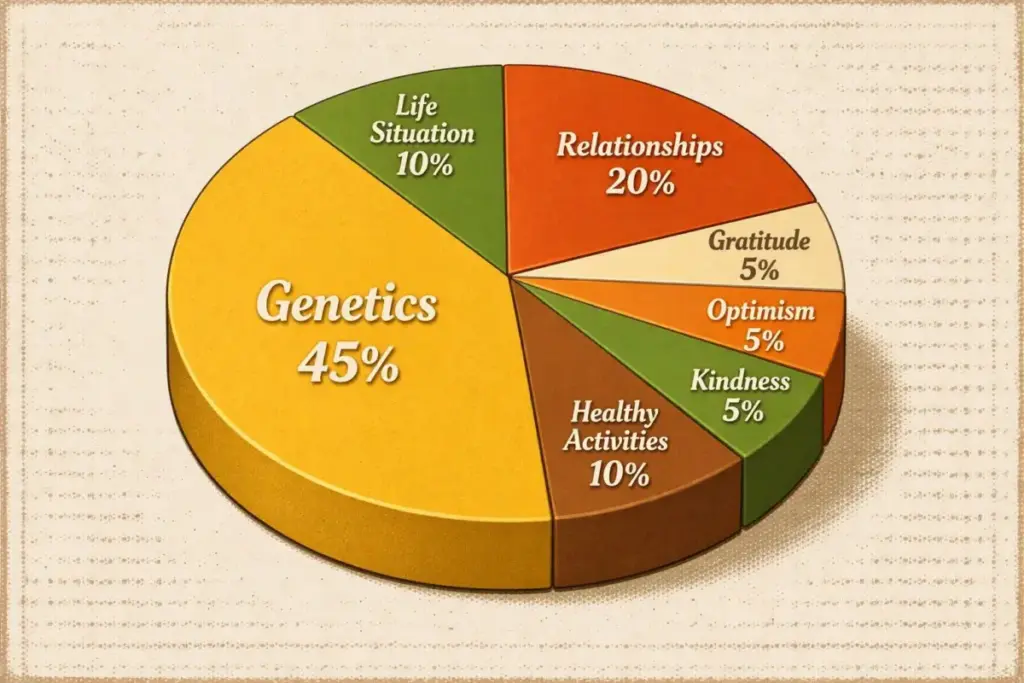
Beyond material prosperity, psychological research suggests that human happiness tends to plateau after a society achieves a baseline standard of living. Developed nations surpassed those minimum requirements decades ago, shifting the focus of human fulfillment toward non-financial factors. While psychological studies indicate that baseline temperament is heavily influenced by genetics, individuals maintain control over several critical aspects of their well-being.
Building strong interpersonal relationships, practicing gratitude, maintaining an optimistic outlook, and incorporating regular outdoor physical activity into daily routines play a far more significant role in long-term satisfaction than minor fluctuations in net worth. Despite the widespread dissemination of these principles within the financial independence community, a pervasive background fear persists among many individuals regarding an uncertain future.

Confronting Fear Itself and the AI Era
The root cause of this persistent anxiety is human evolutionary biology. As a species, human beings functioned historically as danger-detection machines, developing a baseline background fear to protect against environmental threats and physical scarcity. However, modern society has largely mitigated many of those foundational physical dangers, leaving the human brain to redirect its vigilance toward abstract concerns.
Once physical survival and basic resource needs are secured, anxiety often shifts toward social belonging, relative financial comparisons, tax strategies, and estate management. This continuous shifting of the psychological goalposts can trap individuals in cycles of unnecessary worry, even after achieving financial security. Overcoming this pattern requires self-awareness, an understanding of personal history, and an examination of how childhood experiences or past trauma contribute to a modern scarcity mindset.

Identifying specific fears by exploring worst-case scenarios often reveals that perceived catastrophes are manageable. Taking deliberate action against unfamiliar challenges transforms uncertainty into confidence and builds resilience—a trait that renders future obstacles less daunting. Furthermore, curating one’s daily mental diet by reducing exposure to sensationalized news media helps replace manufactured panic with constructive behaviors.
Applying this experimental mindset to the modern artificial intelligence boom reframes a perceived threat into an opportunity for observation and adaptation. Rather than succumbing to doom-scrolling and alarming headlines, technology analysts view artificial intelligence as a sophisticated cognitive tool designed to enhance human efficiency and productivity.

While technological revolutions historically displace certain categories of entry-level labor in fields like software, administration, and finance, they simultaneously lower service costs and catalyze entirely new industries, much like the rise of the internet and mobile computing. The concentration of financial rewards among enterprise owners and shareholders mirrors previous industrial shifts, underscoring that new technologies represent choices rather than predetermined disasters.
Ultimately, navigating both market bubbles and personal anxiety requires recognizing that fear is often an internal symptom rather than an objective reflection of reality. By focusing on productivity, personal resilience, and deliberate action, individuals can address the root causes of their concerns and approach the evolving technological landscape with informed curiosity.