

“Some partnerships don’t end.”
It is a line delivered by Ice-T’s iconic character, Detective Odafin “Fin” Tutuola, during the historic 600th episode of NBC’s “Law & Order: Special Victims Unit” on Thursday night. While the dialogue directly references the enduring, complicated bond between Captain Olivia Benson and Detective Elliot Stabler, it also serves as a powerful meta-commentary on the real-life relationships that have sustained the Universal Television procedural since its groundbreaking debut in 1999.
The sentiment applies just as accurately to the remarkable, quarter-century professional partnership between series star Mariska Hargitay and executive producer Dick Wolf. Together, they have steered the franchise through shifting television landscapes, changing network paradigms, and countless cultural milestones to reach a number that few scripted primetime dramas ever even approach.
“People throw around the word ‘family,’” Hargitay reflected on the deep bonds forged over decades of production. But for the cast and crew of “SVU”—many of whom have been with the series from its earliest days—the label carries literal truth. To like them, to love them, goes beyond professional courtesy. For Hargitay, arriving on set feels entirely genuine. Going to work on a Monday morning carries the warmth and anticipation of heading to a good dinner party hosted by people you cherish.
That metaphor became literal following the completion of the 600th episode’s production. Dick Wolf gathered the current cast, production crew, and key figures from the series’ history—including Wolf COO Peter Jankowski and former co-lead Christopher Meloni—for an exclusive celebration dinner. Standing before the assembled group at the beginning of the evening, Wolf delivered a brief, poignant speech that captured the rarity of the moment, telling the room plainly: “This has never happened, and it will never happen again.”
In an era of television where a series reaching a landmark 100 episodes is celebrated as a major corporate and creative achievement, Hargitay admitted that she never envisioned a world where the police procedural would stretch all the way to 600 installments. Wolf, however, possessed that rare long-term vision from the very beginning. Hargitay recounted that exact sentiment during an emotional speech she delivered to her extended “SVU” family that night.

“It really doesn’t feel totally real, which, in a way, is exactly how it should feel, because it’s as if we all get to live in this dream of what you thought might be possible someday,” Hargitay told Wolf and the assembled team during the celebration. “You’ve shown that it’s not only possible, but it’s so much better than anyone could have imagined.”
Reflecting on the psychological barrier of the number 600, Hargitay added with characteristic candor that if someone had told her about a television show maintaining an active run for that many episodes, her initial skepticism would have taken over. She noted she likely would have assumed the project must be tired, wheezing along, running purely on fumes, or catering to an uncritical audience tuning in out of sheer habit. Instead, she marveled at the reality of the production they have built and sustained.
“Here we are with a show that is healthy, that’s muscular, that’s fresh, smart, honest, and just so damn important,” she said. “And yes, people keep coming back, but not for some unknown reason. They keep coming back because you started something very special that we’ve all had the great privilege of carrying forward for all these years.”
For Hargitay, the milestone naturally brings a wave of strong emotion, rooted deeply in the mutual respect, affection, and artistic trust the ensemble has cultivated over the decades. That intentional culture extends directly to the revolving door of guest stars who cycle through Manhattan’s special victims unit episode after episode. According to Hargitay, guest actors consistently voice their appreciation for the set environment upon arrival and departure, recognizing a rare professional atmosphere.
“People are happy to be there. I love making a space that’s conducive to creating, and I love making a space where people feel safe enough to try, to risk, to play, and to hunker down, and know that we’re not playing around here,” Hargitay explained. “This is someone’s life. This is serious, and these are important stories. I’m so grateful.”
That seriousness and commitment to character depth were front and center in the 600th episode itself. Written by showrunner Michele Fazekas and directed by Brenna Malloy, the landmark installment tackles a haunting narrative challenge. The plot kicks into motion when jury consultant Gwen Sharpe, played by guest star J. Smith-Cameron, persuades Captain Benson to take a hard, second look at a long-buried cold case. The original investigation had wrongfully put a man behind bars for a brutal 1998 rape and murder.
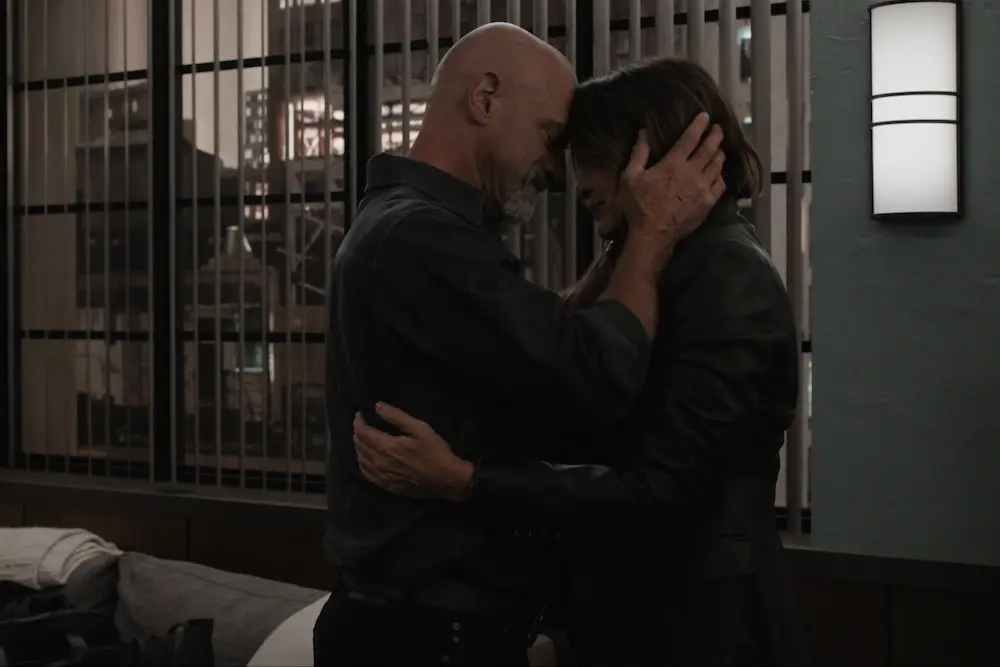
Upon pulling the old files, Benson experiences a jolt of history: she realizes she worked that very case alongside Detective Elliot Stabler during their earliest days on the force. Initial hesitation floods in. Stabler had notoriously failed to follow up on critical leads that could have uncovered the truth early on, freezing a young Benson out of the critical interrogation room. Despite those complicated echoes from the past, Stabler ultimately steps forward to reunite with Benson, eager to help correct a historical miscarriage of justice and put the actual perpetrator behind bars.

While the two have operated in separate professional spheres for years, the narrative forces them back onto the road together to dig deeper into the forgotten evidence. The dynamic immediately draws friction from within the current precinct. Captain Renee Curry steps in with a sharp reminder, telling Benson with professional respect that Stabler is no longer her partner and that she does not require his buy-in to move forward.
Yet, Fin’s pragmatic wisdom cuts through the departmental boundaries with a line that defines the thematic heart of the milestone hour: “It doesn’t matter. Some partnerships don’t end, even when they do.”
The unfolding storyline inevitably stirs up a storm of complicated, long-suppressed emotions for both Benson and Stabler. In a powerful narrative beat, Benson confronts her past choices, acknowledging to him directly that she allowed herself to be shut out, and that she must live with the painful realization of not trusting her own instincts because she was new and mistakenly assumed her senior partner inherently knew better.
For the first time in their shared history, Benson utilizes her voice with absolute clarity, recognizing just how fundamentally both characters have evolved away from the people they were when they patrolled New York City side by side. Yet, the friction ultimately validates a deeper truth: that kind of profound, foundational partnership transcends time, distance, and organizational charts.
Bringing such a massive narrative milestone to the screen required extraordinary effort behind the scenes, pushing the boundaries of traditional television production schedules. Hargitay revealed that the ambitious script ultimately ran nearly 12 minutes over standard broadcast time during initial cuts, requiring intensive refinement.
“This was a big one,” Hargitay said. “We were writing and rewriting and playing, and we had to shoot some scenes before we knew exactly what a scene was going to be, so there were a lot of different ways it could go. But it’s an embarrassment of riches.”