



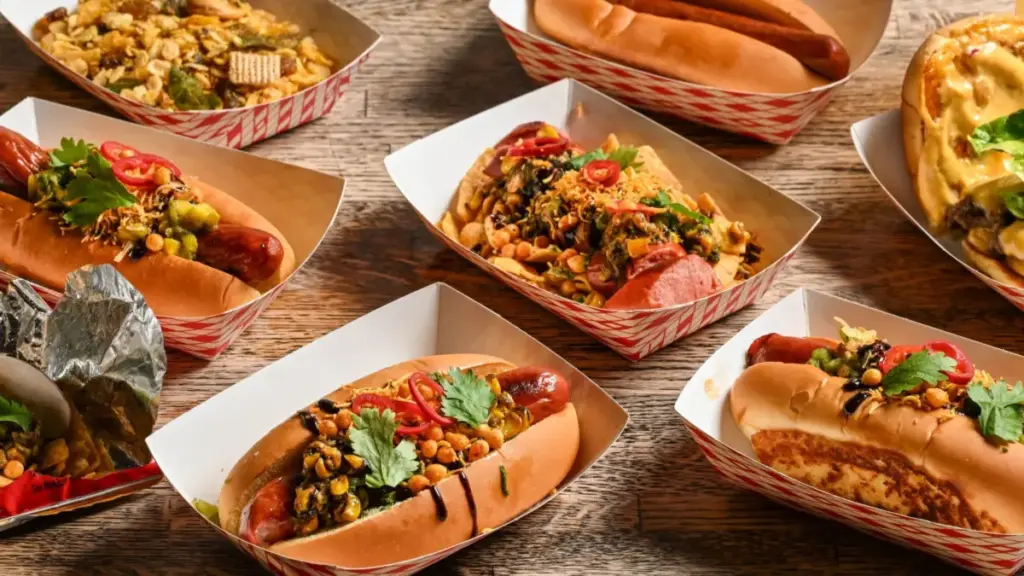
In the summer of 2017, journalist and chef Pervaiz Shallwani and his wife, Laena McCarthy, found themselves looking for a creative culinary contribution for a friend’s backyard hot dog cook-off. Their answer was an accidental masterpiece: a classic hot dog crowned with bhel puri, a popular South Asian street food snack composed of crispy puffed rice, diced red onions, and tomatoes, all tied together with a complex mix of tangy and spicy chutneys. The creation—representing a literal intersection where a Chicago hot dog meets Karachi street food—was more than just a hit at a birthday party. It was the spark for a much larger culinary evolution that would take years to fully unfold.
The broader historical context of this movement stretches back decades. Shallwani’s father was part of an early wave of Pakistani immigration that began arriving in the United States in increasing numbers by the 1970s, eventually settling around major urban centers such as New York City, Chicago, and Los Angeles, followed later by expanding communities in Washington, D.C., and Houston. During the 1980s, the small number of Pakistani restaurants that emerged in these immigrant hubs faced distinct commercial realities. To survive and attract a broader clientele, many chose to hide behind the generalized labels of "Indo-Pak" or "Indian"—categories that had already gained mainstream consumer acceptance through takeout staples like butter chicken and chana masala. Alternatively, these establishments catered almost exclusively to concentrated Pakistani immigrant enclaves, such as Hillcroft in Houston, Little Pakistan in Coney Island, and Devon Avenue in Chicago.

For generations, the Pakistani culinary footprint lived largely in the shadow of the vastly larger Indian-American community, which remains the second-largest immigrant group in the United States. However, the demographics have shifted dramatically over the years. From a modest diaspora population of just 32,600 in 1980, the Pakistani-American community has grown to nearly 680,000 today. With this substantial demographic growth, Pakistani restaurants are increasingly stepping out of the shadows and into the mainstream culinary spotlight.
While a few prominent exceptions have achieved massive commercial success—such as Aga’s in Houston, recently documented as the busiest single-location restaurant on Uber Eats, or the beloved, James Beard Award-nominated Zareen’s Kitchen in Palo Alto—they historically stood apart from the broader American dining mainstream. Much of the recent, widespread shift, however, has materialized in the years following the pandemic. The new wave of Pakistani-inspired concepts emerging across the country differs significantly from traditional fine-dining establishments or the regional food movements seen in previous decades, such as the West African food movement or the booming Filipino culinary scene of the 2010s. Instead, this new generation of chefs and entrepreneurs is taking a scrappier, fast-casual approach, introducing bold, authentic Pakistani flavors through distinctly familiar American formats.
This approach manifests in inventive menu items like hot dogs topped with spicy, tangy chaat, New York-style chopped cheese sandwiches made with spiced chapli kebab, and crispy, buttermilk-brined hot chicken seasoned with a complex medley of South Asian spices. Together, these innovations are cementing the arrival of the modern Pakistani-American kitchen.

In Fort Worth, Texas, pitmaster Zain Shafi found his entry point through the storied world of Texas barbecue. Growing up in Texas, Shafi had rarely eaten barbecue because finding reliable halal options was exceptionally difficult. But when he finally tasted it, the experience completely transformed his perspective. While actively supporting his family’s furniture business, Shafi dove headfirst into the craft of barbecue, eventually securing a spot working at the acclaimed Goldee’s. He later launched his own food truck venture called Sabar. From 2023 to 2025, Sabar served halal, Pakistani-inspired barbecue creations that reimagined classic smokehouse fare, including sausages seasoned with seekh kebab spices and smoked tandoori turkey, served alongside traditional accompaniments like tangy raita, lentils, and fresh naan. Reflecting on the reception in Texas, Shafi notes that food served as an effective bridge during times of localized Islamophobia, helping to break the ice and introduce community members to Pakistani flavors in an approachable way.
Remixing familiar American favorites has proven to be a vital strategy for breaking cultural barriers. Usman Chaudhry, an accountant by training who moved to the United States from Pakistan in the early 2000s alongside his parents and siblings, had long harbored ambitions of opening a restaurant. When a commercial space became available in Chatham, New Jersey, in the fall of 2020, he and his wife Amena seized the opportunity, partnering with his brother to launch Namkeen. Their primary objective was straightforward: to introduce high-quality halal hot chicken to the Tri-State area within a casual, vibrant space.
The tight, focused menu centered on creative variations of Nashville-style hot chicken. Offerings included the signature Clucking Waffle Sandwich, featuring hot fried chicken nestled between jalapeño-and-cheddar Belgian waffles; the Tikkaville Sandwich, comprising fried chicken layered with rich tikka sauce, coleslaw, pickled onions, and mint chutney on a brioche bun; and Chicken Tikka Mac & Cheese, which combined classic macaroni and cheese with crispy fried chicken and savory tikka sauce.

Launching a restaurant at the height of the COVID-19 pandemic might have appeared risky, but Namkeen quickly drew long, masked lines out the door. While its takeout- and delivery-friendly model suited the demands of the era, the operation’s tight, easily replicable menu also translated naturally into a scalable franchising framework. Namkeen has since expanded to 10 locations across three states as well as Canada, while the Chaudhry brothers have further diversified their culinary portfolio by launching a second concept, Ori’s Cheesesteaks, in Chatham, which specializes in premium halal ribeye cheesesteaks.
While Shafi utilized Texas-style barbecue and Chaudhry focused on Nashville hot chicken, Zeeshan Bakhrani chose a different American classic for his inspiration: the New York City bodega staple, the chopped cheese sandwich. Located in a tiny 600-square-foot storefront at 160 First Avenue in the East Village, Bakhrani’s restaurant, Nishaan, has quickly become one of the city’s most talked-about culinary openings. Nishaan’s signature dish is the Pakistani chopped cheese, featuring heavily seasoned chapli kebab chopped directly on a griddle alongside peppers and onions, then finished with a vibrant lime-cilantro sauce and tamarind chutney. The menu also features inventive items like bihari barbacoa tacos, Pakola soft-serve—a nostalgic nod to the iconic green soda beloved across Pakistan—and elote chaat, which draws direct inspiration from the Mexican flavors that surrounded Bakhrani during his childhood in Chicago.
Bakhrani’s path to establishing Nishaan was unconventional. After being laid off from his job in IT product management in 2024, he began creating food content and experimenting with unexpected mashups like mango lassi pie and elote chaat. He eventually secured a booth at Smorgasburg before earning a coveted spot on Season 18 of Food Network’s The Great Food Truck Race in 2025. Describing the television experience as an intense bootcamp, Bakhrani notes that roughly half of the menu items he currently sells were originally developed during the show. The Nishaan team ultimately won the $50,000 grand prize, making history as the show’s first all-halal food truck to take home the title. The competitive victory provided the crucial proof of concept Bakhrani needed to sign a lease for his first permanent brick-and-mortar location.

Since establishing his storefront, Bakhrani has emerged as a visible and energetic champion of Pakistani cuisine in New York City, which has solidified its position as a primary hub for the new generation of Pakistani restaurants reshaping the national culinary landscape. He has actively fostered community engagement through frequent chef collaborations, Pakistan Day block parties, and a dynamic menu dedicated to nostalgic, inventive takes on Pakistani flavors. When skeptics questioned whether centering his business around the explicit label of "Pakistani" would hinder his success during the television competition, his response was clear and pragmatic: it wouldn’t hurt him either.
Embracing the "Pakistani" label openly marks a dramatic departure from the cautious branding practices of previous generations. Saud Khan, the founder of Kaafi, a Pakistani chai café in Harlem, was raised within the restaurant industry. Born in Peshawar, Khan moved to the United States at the age of five and spent his youth assisting in his father’s restaurant in upstate New York. Though he initially had no intention of pursuing a career in hospitality, a quiet moment sitting in a café prompted him to wonder why similar community spaces centered on chai and Pakistani-inspired snacks did not exist. That inquiry ultimately inspired him to open two cafes in upstate New York before eventually relocating to New York City, where the metropolitan market felt primed for the concept.
Kaafi welcomed its first guests to its Harlem location in 2024, achieving immediate commercial success. Khan observes that the current climate offers unprecedented opportunities for South Asian restaurateurs in New York City, attributing part of this momentum to a broader wave of visible South Asian civic and cultural leadership within the city. Emphasizing the collective enthusiasm among modern operators, Khan notes that the community is experiencing a defining moment that calls for dedication and focus.

Long before the recent openings of Kaafi, Nishaan, and Namkeen in New York, Sibte Hassan founded BK Jani in Brooklyn in 2015, establishing an early indicator that New York City was poised to become the epicenter of this culinary movement. Armed with a background in the creative arts rather than professional hospitality, Hassan had relocated from Lahore—one of Pakistan’s premier culinary capitals—only to find himself deeply underwhelmed by the existing local options. Traditional Pakistani restaurants in the city were largely designed out of economic necessity to feed local cab drivers quickly and affordably for under $10, rather than focusing on sourcing premium ingredients.
Following a series of casual backyard grilling sessions where he cooked for friends, Hassan secured a former pizza parlor space in Bushwick. Learning the operational realities of restaurant ownership through trial and error, he developed BK Jani’s menu centered around premium halal burgers infused with authentic Lahori flavors. The initial reception was sparse; during the early months, Hassan frequently opened at noon and closed at 10 p.m. without welcoming a single customer. He was on the verge of accepting a commercial buyout offer when a review by Ligaya Mishan was published in The New York Times, dubbing Hassan the "Midas of Meat." Business shifted dramatically overnight, and the restaurant has remained busy ever since.
Like his contemporaries at Namkeen and Nishaan, Hassan deliberately selected a fast-casual format for its operational simplicity, ensuring that consumer attention remained firmly focused on the quality of the food. BK Jani was founded on a simple, enduring premise: sourcing premium halal ingredients and preparing them with uncompromising care.

Meanwhile, the accidental bhel puri hot dog that Pervaiz Shallwani and Laena McCarthy debuted at a friend’s backyard cook-off in 2017 has continued its upward trajectory. That spontaneous afternoon experiment served as the foundational concept for Chaat Dog, the hot dog pop-up Shallwani launched in 2022, blending his Chicago suburban upbringing in America’s self-proclaimed hot dog capital with his deep-rooted Pakistani heritage. Though he initially harbored doubts about how South Asian consumers would respond to traditional chaat served atop a hot dog, the overwhelmingly positive reception highlighted a powerful underlying sentiment among diners. As Shallwani notes, people simply felt seen. Chaat Dog has since expanded beyond pop-ups, opening its first permanent brick-and-mortar location inside Time Out Market in Brooklyn.
Reflecting on the broader phenomenon, Shallwani views the rise of Pakistani-American cuisine less as an isolated culinary fusion experiment and more as the continuation of a fundamental American tradition. The underlying process involves utilizing familiar ingredients, adapting to available resources, and evolving over time through cultural synthesis. Every immigrant group that has arrived in the United States over the centuries has integrated its culinary heritage into the broader fabric of American food, shaping what American cuisine ultimately represents. With this dynamic new wave of chefs and restaurateurs leading the charge, Pakistani flavors are now firmly and permanently part of that evolving culinary identity.