


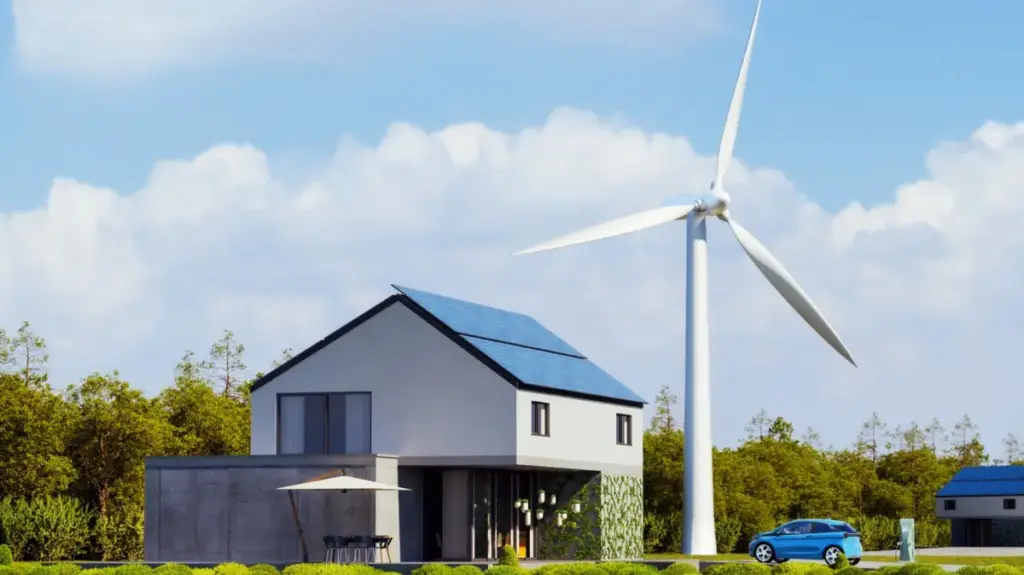
It all depends on the wind. While solar energy continues to cruise into record-breaking territory across the residential market, small-scale wind power for home use tends to get lost in the sun. Do home wind turbines actually work? The answer is a very reserved "yes."
There are several significant caveats, though wind power is not an altogether losing proposition. It really depends on the specific energy needs and the scale of use. Manufacturers even make compact turbines designed for powering recreational vehicles and remote camping setups, meaning the viability of wind energy often depends heavily on one’s definition of a "home."
It is important to understand that a 1-kilowatt turbine rating measures "peak" power output under ideal laboratory conditions, rather than what a user will consistently pull from the system day in and day out. A more useful metric for homeowners to examine is annual or monthly energy production, which is measured in kilowatt-hours. In a carefully chosen position with optimal environmental conditions, a 1-kW turbine could feasibly produce around 200 kilowatt-hours per month, or about 2,400 kilowatt-hours per year. That output works out to less than a quarter of the average United States household’s annual energy consumption.
None of this is to say that small wind turbines are weak power producers by design; rather, their performance relies entirely on atmospheric variables. If a resident lives in a geographic region with annual wind speeds averaging 14 miles per hour or higher, small-scale wind power is certainly something worth looking into. If not, or if genuinely windy days are sparse or merely average, the investment may not yield the desired return. A 1-kW system is entirely feasible from an engineering standpoint, but it is best evaluated in terms of supplemental power for an already energy-efficient home rather than a primary power source.

Placement Determines Whether It Works
A wind turbine intended for residential use practically requires a high average wind speed that remains consistent from month to month. Homes surrounded by dense stands of trees, packed tightly among other residential buildings, situated behind steep hills, or cluttered with large sheds need not apply. Not only do these physical obstacles block smooth airflow, but they also create significant turbulence. This turbulence drastically reduces power output and simultaneously accelerates mechanical wear and tear on the turbine’s moving parts.
The United States Department of Energy publishes clear small-wind guidance recommending that the bottom of the rotor blades be positioned at least 30 feet above any obstruction located within a 300-foot horizontal radius of the tower. That single recommendation dictates nearly all the practical limitations of placing a wind turbine in a typical suburban neighborhood. In most cases, a backyard installation will generate little more than interesting conversations among curious neighbors.
Worse yet, municipal zoning regulations in most residential areas strictly limit permanent structures to a maximum height of around 35 feet, whereas residential wind turbines often require considerably more vertical clearance to rise above nearby tree lines and rooftops. While a rooftop installation option sounds remarkably appealing on paper, it can easily transmit structural vibrations and low-frequency mechanical noise directly into the house—a less-than-ideal side effect for anyone trying to catch some sleep before the morning alarm goes off.
Property owners who remain sold on the potential of wind power must look far beyond their region’s generalized wind map. They must meticulously check local zoning laws and utility interconnection rules, and conduct a thorough, on-site assessment of local obstacles and prevailing wind directions. Consulting a professional installer to estimate overall production before spending hard-earned money remains a critical step in the evaluation process.

A Whole-House Turbine Needs Much More Capacity
If a dwelling happens to be a small, economical cabin or a permanently parked recreational vehicle, a 1-kW wind turbine is certainly a viable option. However, that capacity falls drastically short of what is required to power a typical American home. The average household consumes approximately 10,500 kilowatt-hours of electricity per year, translating to roughly 850 kilowatt-hours per month. To make a noticeable dent in that level of power consumption, a residential wind turbine in the 5-kW to 15-kW range is generally necessary.
Upfront cost serves as another major reason for consumers to proceed with a degree of caution. Installing a residential wind turbine can easily run the average consumer between $20,000 and $50,000 depending on the hardware, tower height, and local labor costs. By comparison, installing solar panels designed for a similar level of energy production typically ranges from $2,500 to $3,500, and those figures are calculated before factoring in various federal, state, and local clean energy incentives.
A grid-connected wind system typically requires an expensive inverter as well, allowing the system to offset utility use during periods when the wind is actively blowing. Off-grid systems face even higher infrastructure demands, requiring battery banks and charge controllers to safely store harvested power for later use. For the vast majority of suburban dwellers, improving home insulation and investing in ground-mounted or roof-mounted solar panels will provide much more dependable, solid results. For those determined to pursue the wind power route, the technology continues to make the most sense in open, rural environments featuring verified average wind speeds and ample acreage to safely erect a towering structure.