

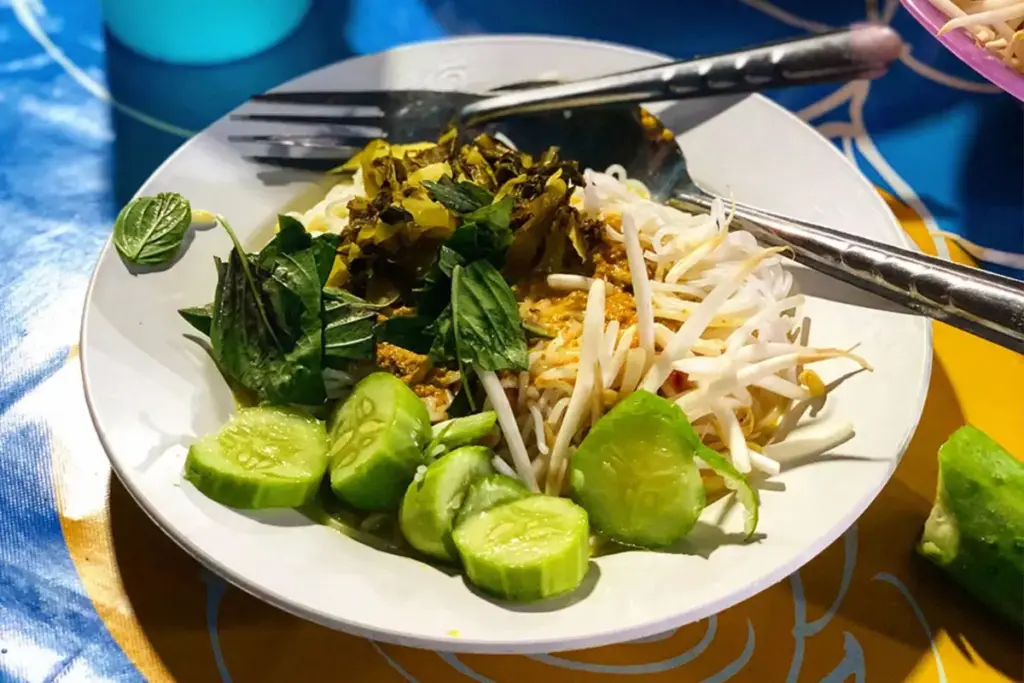
When chefs Justin Ahn and Alex McCoy first launched Alfie’s as a pop-up restaurant back in 2016, they anticipated a relatively straightforward path toward opening a permanent brick-and-mortar location. Instead, the temporary Washington, D.C., project—where the duo served northern Thai cuisine to a tight-knit community of hospitality workers and loyal regulars—lasted for just a few months before closing its doors. What followed was nearly a decade of roving residencies, international pop-ups, and culinary exploration across the globe. Now, after a nearly ten-year journey, Ahn and McCoy are finally returning to the District with a permanent venue nestled deep in a historic Georgetown alleyway.
The newly opened, 25-seat venue is tucked away in an alley just off M Street, offering an intimate dining experience that pairs regional Thai dishes with natural wines produced just across the Potomac River in Virginia. Despite finally settling down into a permanent home, the team has consciously retained the core elements that defined the original pop-up: a run-and-gun service style, an intensely personal touch from the founders, and a chalkboard menu that shifts dynamically based on what local purveyors have in season.
In a recent interview, McCoy reflected on the long, winding road from a temporary D.C. concept to a global nomadic brand, and finally, to a permanent neighborhood fixture in Georgetown.
Why Launch as a Pop-Up?
The genesis of Alfie’s was born out of convenience and timing rather than a calculated marketing strategy. At the time, Ahn and McCoy were already in the process of building out a permanent space for a brick-and-mortar restaurant in D.C.’s Petworth neighborhood. Concurrently, another restaurant space down the street was slated for demolition, prompting the chefs to approach the landlords to see if they could utilize the vacant building in the interim.
"They were like, ‘It’s yours until your space is ready or our project starts,’" McCoy recalled. The temporary space provided a valuable sandbox for the culinary team to train staff, test recipes, and refine menus while their primary location remained under construction.
Located in a relatively quiet part of town, the pop-up was initially conceived as a low-stakes environment for the team to have fun. However, it quickly exploded into a local and national culinary sensation. The tiny restaurant was booked out for months in advance, drawing glowing coverage from prominent lifestyle and food publications like Vogue and Bon Appétit, which named it one of the top new restaurants in America.
Yet, the whirlwind success was fleeting. The pop-up was open for only about six months total before closing its doors in 2017. Compounding the abrupt end, the planned Petworth space ultimately fell through, forcing Ahn and McCoy back to the drawing board to search for a new venue.
The Evolution on the Road
Faced with the setback in Petworth, the duo pivoted, taking the Alfie’s concept on the road. Over the following years, they operated pop-ups in major culinary hubs including New York City, Washington, D.C., and London. Their extended time overseas—particularly working alongside friends at Carousel in London—fundamentally reshaped the brand’s identity and long-term vision.
The culinary landscape shifted dramatically following the COVID-19 pandemic, with restaurant operators across the industry struggling to navigate rising labor and operational costs. Many establishments turned to streamlined service models, reducing front-of-house staff, eliminating traditional table service, and implementing QR-code ordering systems. To McCoy, the traditional American restaurant math simply stopped adding up.
Instead, McCoy looked toward Europe for inspiration, drawing from the intimate, neighborhood hole-in-the-wall spots common in cities like Paris and London. In those environments, chefs do not manage sprawling restaurant empires; rather, they are physically present in the kitchen alongside a minimal crew of one or two people. This intimate, hands-on approach mirrored the original heart and soul of Alfie’s, providing a clear blueprint for the brand’s future.
Following their final international pop-up in London, the team discovered the unconventional Georgetown space. To McCoy, the neighborhood possessed a distinctively European atmosphere unlike anywhere else in the District. Tucked away in an alley behind the bustling retail corridor of M Street, the 25-seat venue offered a raw, gritty charm. Visitors must step down into the alleyway and navigate around passing cars to enter the space, creating an immersive, character-rich environment that instantly resonated with the founders’ vision.

Maintaining the Pop-Up Ethos in a Permanent Space
Although Alfie’s now occupies a permanent address, the day-to-day operations continue to operate under a scrappy pop-up mindset. The kitchen staff is remarkably lean; Ahn, McCoy, and sous chef Ian constitute roughly 90 percent of the total restaurant staff.
Operating a 25-seat dining room allows the team to meticulously execute small batches of food. Rather than prepping massive quantities to service a sprawling dining room, the kitchen can focus deeply on individual dishes. For instance, when preparing a daily curry, the team might make only 30 orders. This micro-scale production enables the chefs to rewrite the menu daily, making adjustments in real time based on the exact ingredients delivered by local purveyors.
If a local fishmonger arrives with a handful of freshly caught sea breams, the fish can immediately find its way onto the evening’s chalkboard menu without requiring cumbersome staff retraining or extensive operational overhauls.
This hyper-flexible approach directly mirrors the vibrant market culture of Thailand, which serves as the ideological foundation of the brand. Ahn and McCoy continuously challenge themselves to adapt traditional Thai flavor profiles using ingredients sourced directly from the Mid-Atlantic region, incorporating items such as rockfish, soft-shell crab, foraged asparagus from the Eastern Shore, and morel mushrooms.
Championing Local Drinks and Regional Producers
This philosophy of hyper-locality extends seamlessly to the beverage program. When travelers visit renowned wine-producing regions in France or Italy, ordering a glass of wine made in the immediate surrounding town is standard practice. Yet, McCoy noted that this approach is rarely replicated in Washington, D.C., despite world-class wineries operating just 15 to 20 minutes away across the state line in Virginia.
At Alfie’s, the majority of the wines offered by the glass originate from Virginia producers, complemented by a selection of more than 2,000 local bottles available for purchase. Furthermore, the pricing structure is designed to dismantle the intimidation often associated with fine dining wine lists. Most bottles are priced affordably between $35 and $75, with only a select few exceeding that threshold.
McCoy expressed a desire to remove the anxiety diners frequently feel when the bill arrives, allowing patrons to immerse themselves entirely in the dining experience. By keeping prices accessible, guests feel empowered to take a culinary gamble on unfamiliar natural wines and experimental dishes without second-guessing the financial cost of the evening.
Fostering Community Through an Exclusive Wine Club
To deepen ties with the neighborhood and cater to its most loyal patrons, Alfie’s has also introduced an exclusive wine club. Designed to cultivate the feeling of a neighborhood living room, the club features just 19 designated spots.
For a monthly membership fee of $150, participants receive a dedicated wine rack inside the restaurant. Members have the flexibility to bring bottles from their personal collections at home or work closely with the culinary team to curate a custom-tailored wine locker. The membership also grants access to steep discounts on specialty wine selections that are otherwise too expensive to feature regularly on the restaurant’s main menu, allowing members to purchase hard-to-find bottles at roughly 50 percent below standard restaurant retail prices.
An Overwhelming Public Reception
When the reservation book officially opened for Alfie’s initial service dates, the response was immediate and overwhelming, generating roughly 700 bookings almost instantly. While McCoy maintained cautious optimism, the staggering public interest validated the team’s intuition that the local dining public was yearning for a shift away from corporate dining.
Diners in Washington, D.C., have increasingly expressed fatigue over independent small businesses being squeezed out or replaced by large, homogenized corporate restaurant groups. As a distinct antithesis to that corporate wave, Alfie’s offers a personal, transparent dining experience where guests walk in and immediately see Ahn and McCoy working directly over the burners and running plates to the tables.
After nearly a decade of pop-ups, international travel, and persistent searching, Alfie’s has finally found a permanent home that captures a distinct, high-energy vibe the District has been missing for years.