As the Burning Man Project noted earlier this year, Burning Man and the global maker movement are inextricably intertwined. Both welcome beginners and experts alike, while fostering a communal, hands-on approach to building tangible objects that become works of art, helpful structures, and engineered wonders. For those who have never experienced the alkaline dust and blinding sunshine of the Black Rock Desert, the annual Nevada gathering is often defined by a blur of media headlines: climbable sculptures, thumping basslines, outrageous costumes, and roaring fire art.
However, beneath the well-documented spectacle lies an immense, year-round undercurrent of engineering, fabrication, and design. Months or even years before the Black Rock City Department of Public Works breaks ground on the temporary metropolis, an international network of makers, artisans, engineers, and fabricators labors in remote barns, suburban garages, industrial warehouses, and urban makerspaces. They weld steel, program LEDs, stitch industrial fabrics, and engineer kinetic mechanisms to bring their visions to life.
While the Burning Man organization provides a vital catalyst—and often partial financial support through its prestigious Honorarium art grant program—the lifespan of these monumental creations rarely ends when the festival gates close. Increasingly, the massive sculptures, interactive installations, and imaginative art cars born on the playa are finding permanent or secondary homes in the wider world. Big art, it turns out, is universally captivating wherever it lands. A prime destination for these desert nomads is the Maker Faire Bay Area, where the boundary between festival spectacle and open-source engineering completely dissolves.

This season, audiences at Maker Faire Bay Area on Mare Island will have a rare opportunity to witness firsthand the intricate artistry and heavy engineering that bridges the gap between the Nevada desert and coastal California. From roaring kinetic flames and quantum light installations to transformed all-terrain vehicles and monumental metal masks, the exhibition offers a profound look at what happens when burner culture meets the broader community of makers.
Among the marquee attractions making the journey is Duane Flatmo’s legendary El Pulpo Magnifico. Flatmo is so deeply revered in his hometown of Eureka, California, that municipal leaders recently named an alleyway in his honor. At the Mo Alley dedication extravaganza earlier this year, his signature creation—El Pulpo Magnifico—provided the celebratory crowds with a signature fiery blast of gratitude. Flatmo’s legacy spans four decades of kinetic sculpture making and monumental mural painting.

The lineage of this fiery cephalopod traces back to the original El Pulpo Mechanico, an astonishing contraption constructed from an eclectic assortment of aluminum bread pans, cookie molds, and assorted industrial metal ephemera, all engineered to breathe controlled plumes of fire. Visitors to Maker Faire Bay Area on Mare Island will have the chance to experience the kinetic ingenuity and raw mechanical energy of El Pulpo Magnifico up close, showcasing how found objects and recycled materials can be elevated into world-class performance art.
Joining the kinetic spectacles is the Tree of Photon, a striking conceptual installation by Artur Grycuk, a visual artist, designer, engineer, and architect who holds the distinction of being the first Polish artist to receive a Burning Man honorarium. With this piece, Grycuk aims to express the harmonious fusion of technology and nature, utilizing photons as visual metaphors for the invisible energies that connect all forms of life. The installation delves into the quantum poetry of light, positioning photons as symbols of both scientific precision and metaphorical enlightenment.

Furthermore, the Tree of Photon seeks to bridge the widening gap between human touch and digital isolation, suggesting that direct physical interaction can reignite communal bonds in an increasingly disconnected society. By harnessing light-based art to evoke profound emotional responses, Grycuk fosters a sense of collective unity, communicating that small, deliberate actions—like a simple human embrace—can ripple outward, altering the environment and highlighting human interconnectedness within a chaotic universe. Following its temporary installation on the open playa, the Tree of Photon is slated to become a permanent centerpiece of the Dark Room on Mare Island.
This continuum of nature-inspired, illuminated engineering echoes past exhibitions, such as Anna Gribovsky’s Aquatica, a fifteen-foot illuminated tree sculpture that debuted on the playa and later traveled to exhibition spaces. Aquatica introduced audiences to a forest of mutant glowing kelp trees paired with jellyfish lanterns featuring colorful, glass-like bodies and optical fiber tentacles. Powered by more than 800 individual LEDs, its intricate canopy undulates in sync with desert winds while ethereal ocean soundscapes emanate from beneath its branches.
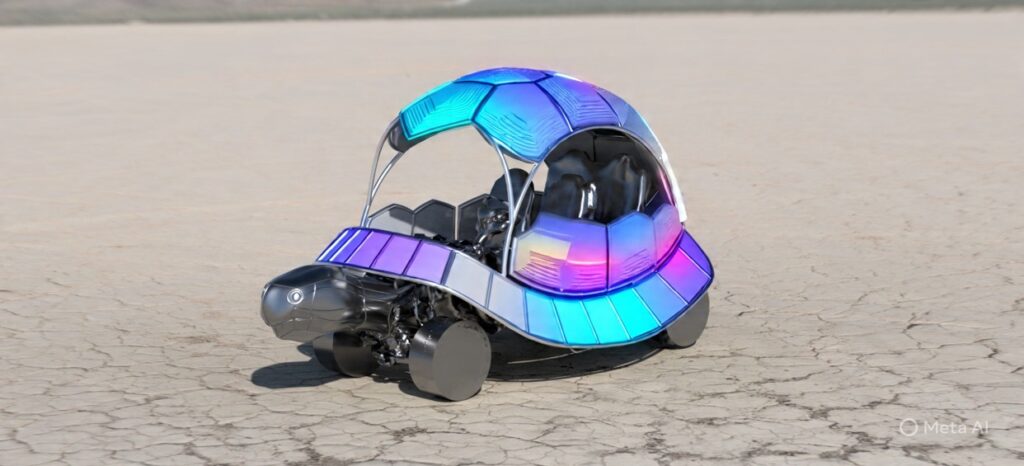
The cross-pollination between desert art cars and precision fabrication is further exemplified by Flash the Tortoise, an utterly charming mobile art vehicle inspired by a real-life pet tortoise named Flash. Built by the designers at CooLab, the project began its life as a standard 2002 Gem electric car before undergoing a radical structural transformation. The team engineered a custom-designed and welded aluminum frame, integrated a high-capacity custom lithium battery pack, and utilized vacuum-formed high-density polyethylene to mold the creature’s realistic scutes. Enhanced with sophisticated LED backlighting and subtle pebble lighting, the finished vehicle bears a startlingly accurate resemblance to the initial conceptual renderings produced by its creators.
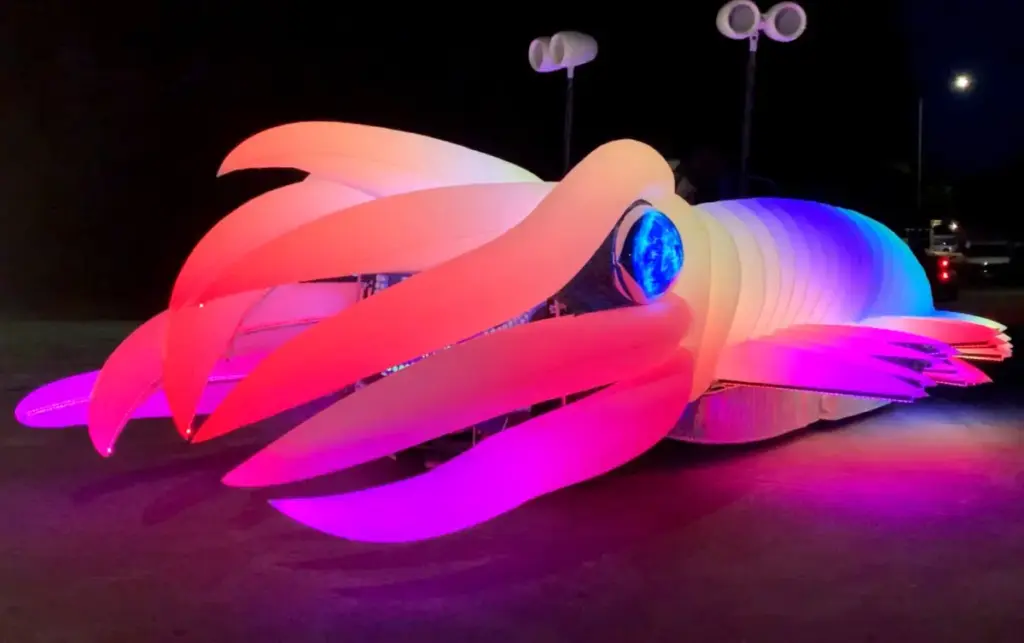
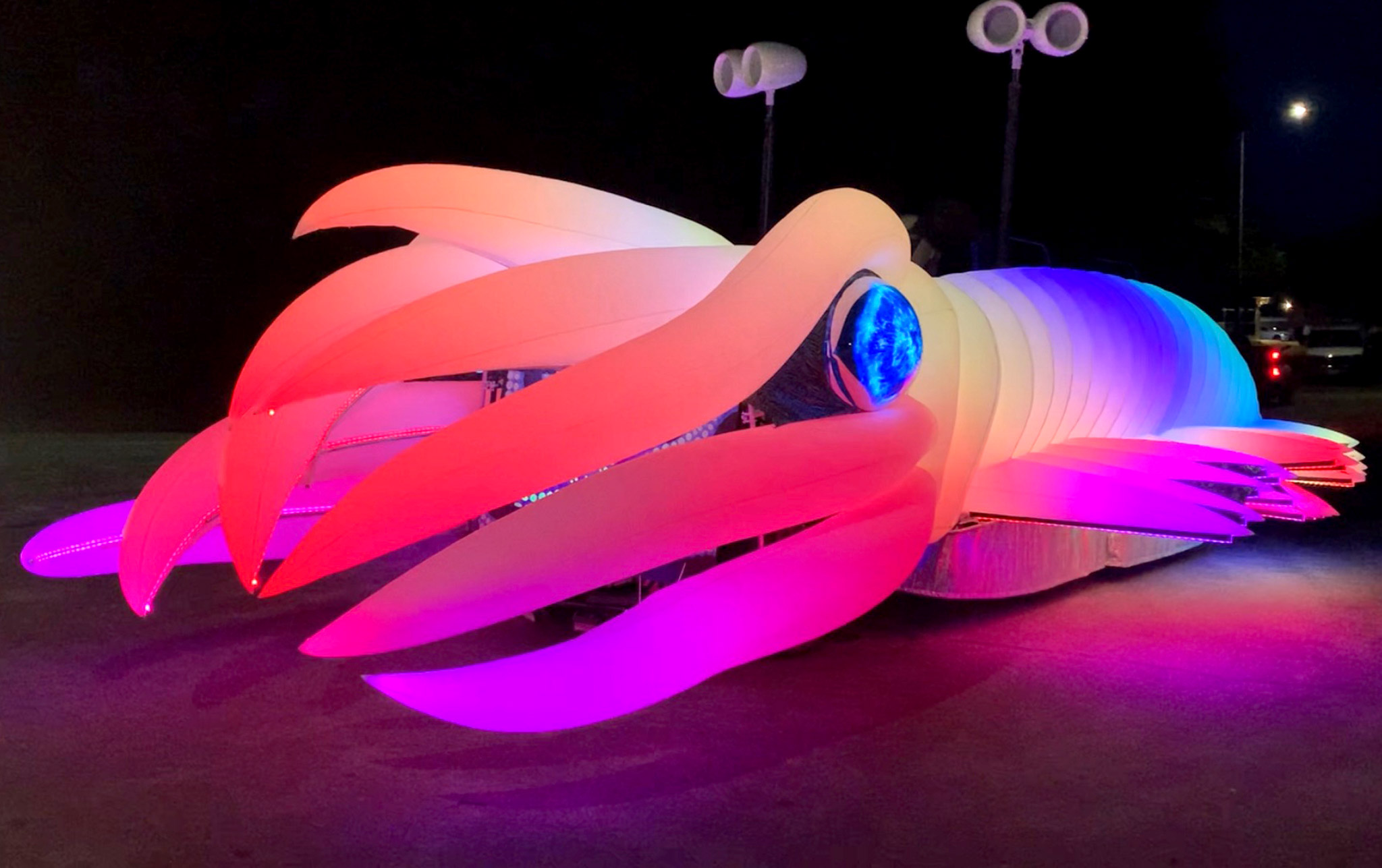
Long before Flash rolled onto the scene, however, the maker community was captivated by Sepia Lux, a colossal, mobile luminescent cuttlefish equipped with a booming, high-fidelity sound system. The arduous creation of Sepia Lux stands as a testament to the resilience and resourcefulness of makers during times of economic uncertainty. When the COVID-19 pandemic severely disrupted traditional event businesses in late 2020, Bill Kennedy—a Santa Rosa, California-based fabricator—found himself worried about meeting the rent on his workshop. Having previously earned industry recognition and the affectionate moniker “Inflatabill” due to his extensive Burning Man fabrication background, Kennedy answered a Facebook call seeking specialized labor for an ambitious inflatable art car project.

Driven by necessity, Kennedy traveled to San Rafael and stepped into an expansive airplane hangar, where he encountered the monumental project that would consume the next twenty months of his life. A project manager introduced him to a strange, twenty-three-foot vehicle comprising a modified Polaris General side-by-side ATV chassis coupled with a specialized trailer. It was the raw, unfinished skeleton of an art car designed to mimic a cuttlefish, an organism widely celebrated as the chameleon of the sea due to its remarkable ability to rapidly shift body colors.
To bring the cephalopod to life, the vehicle required complex inflatable fins capable of undulating in a coordinated wave motion along both flanks, alongside an intricate control system capable of dynamically modulating the brightness and color mixing of its extensive lighting arrays. Crowning the structure was a cephalopod head featuring prominent eyes and multiple articulated arms. Through the dedication of Kennedy, Loren Crotty, and a dedicated community of collaborating makers, the build evolved into an engineering marvel, and its ongoing legacy continues to inspire new iterations within the community.

The exploration of biomechanics and animal form is also central to the work of New York artist Adrian Landon, whose equine sculptures have captivated audiences for over a decade. Landon began his creative journey experimenting with modeling clay before deciding that formal academic schooling was not for him, choosing instead to focus on building practical fabrication skills and tackling complex engineering challenges. In 2014, he completed his first mechanical horse, subsequently bringing the creation to World Maker Faire New York in 2015, where its complex internal mechanisms allowed it to gallop smoothly before enthusiastic crowds.
In 2019, Landon received a Burning Man honorarium grant to produce Wings of Glory, an entirely new kinetic sculpture that reflected a deeper, more sophisticated understanding of equine biomechanics and structural movement. His latest prominent installation, Nebula Rider, represents his most detailed equine sculpture to date and has found a temporary home on the esplanade at Mare Island. Fabricated from stainless steel, Nebula Rider features a highly polished, mirrored surface that reflects its natural surroundings during daylight hours, while transforming into a dynamic, color-shifting entity via programmable LED illumination after dark. Building on this momentum, Landon was awarded another honorarium grant to bring his latest conceptual exploration, The Sound of Time, to the community.

The integration of heavy industrial fabrication and thematic storytelling is further demonstrated by Zulu Heru’s monumental Farmer the Rigger. Weighing in at an impressive 9,000 pounds and towering 21 feet tall, the massive metal mask was forged with the explicit intention of acting as a guardian spirit over creative community spaces. Heru, who works as a crane operator by trade, views the sculpture as a physical manifestation of his personal and professional evolution, symbolizing both his artistic maturation and his vocational transition from agricultural work to heavy rigging.
The placement of Farmer the Rigger at the historic Mare Island Naval Shipyard carries profound symbolic weight, connecting the maritime history of industrial labor with contemporary artistic fabrication. The shipyard serves as a fitting backdrop for a piece born from the same heavy-metal traditions that once built naval vessels.

Rounding out this convergence of engineering and avant-garde performance is Project Empire, a culmination of decades of collective art car mastery, avant-garde costuming, and immersive performance art. Brought to life by the visionary creators behind earlier crowd favorites The Golden Mean and The Serpent Twins—both of which earned widespread acclaim at past Maker Faire Bay Area events—Project Empire merges sophisticated mechanical design with cinematic world-building.
Ultimately, whether these projects originate in remote desert encampments or urban warehouses, their migration to venues like Maker Faire Bay Area underscores the enduring strength of the maker movement. For those unable to journey out to the harsh conditions of the Black Rock Desert, gatherings on Mare Island offer a vital opportunity to witness the ingenuity, resilience, and boundless creativity of makers who continue to push the boundaries of what is possible.