
By Staff Reporters
For generations, the global stock market has continued to surprise investors, defying predictions of sustained downturns while reaching new, unprecedented valuations. This persistent upward trajectory has routinely triggered a familiar anxiety among savers and retirees: the fear that an era of record-breaking growth must inevitably culminate in a catastrophic market crash. Today, that pervasive anxiety is increasingly channeled into a singular focus on the artificial intelligence boom, drawing frequent comparisons to the frenzied tech speculation of the early 2000s.

Financial commentators and market participants alike have expressed growing concern that the rapid pace of artificial intelligence development and its subsequent market mania will mirror the dot-com bubble. For veterans of past financial cycles, this dynamic evokes distinct memories. Decades ago, the early internet boom helped launch early retirement paths for many savers, only for the subsequent crash to severely test job stability and economic security. As new generations of investors navigate the current economic climate, questions regarding the sustainability of AI-driven market valuations have taken center stage.
Addressing these concerns requires examining not only market metrics, but also the psychological mechanisms that drive financial anxiety. Long-running financial commentators note that public apprehension about economic stability is a perennial feature of modern life, though the specific targets of worry shift over time.

The Evolution of Market Anxiety
Reflecting on financial sentiment over the past two decades reveals a consistent pattern of existential and economic worries. Twenty years ago, public discourse was dominated by fears concerning geopolitical instability, surging national debt, inflation, and outsourcing to developing economies. At that time, a prominent debate centered on the concept of "peak oil," with forecasters warning that rising global fossil fuel consumption would inevitably outstrip dwindling supplies and precipitate global scarcity.
In hindsight, many of those catastrophic scenarios failed to materialize. Despite the onset of the Great Financial Crisis—triggered by irrational exuberance in the housing market and complex financial leverage—broad economic indicators and long-term equity performance continued an upward trajectory over the ensuing twenty years. Broad market indexes absorbed major historic disruptions, including the 2008 financial collapse and the 2020 pandemic-related volatility, while ultimately delivering substantial long-term gains for disciplined, long-term investors.

Simultaneously, broader global indicators demonstrated significant improvements in human living standards. Over a comparable twenty-year span, the proportion of the global population living in extreme poverty declined markedly, while global infant mortality rates were halved. Technological and industrial shifts also accelerated clean energy adoption, highlighted by a dramatic reduction in the cost of solar panels and a rapid expansion in electric vehicle manufacturing worldwide.
These historical parallels suggest that public apprehension often fixates on immediate, highly visible risks while underestimating long-term human adaptability and technological progress. Yet, skeptics of the current market cycle continue to question whether the modern economic environment is fundamentally different. Concerns persist regarding the unprecedented scale of the United States national debt, the potential economic fallout of an AI market correction, or more speculative risks regarding advanced automation.

Prosperity Roots and the Productivity Engine
Financial analysts arguing against perpetual doomsaying point out a fundamental economic principle: true societal prosperity originates from productivity rather than fluctuations in financial market indices or computerized wealth calculations. The global capitalist system is inherently volatile, characterized by cyclical booms and sharp corrections. Beneath these surface-level financial swings, however, real people continue to perform tangible labor, drive innovation, and develop practical inventions.
Economic systems and financial markets are fundamentally human-made constructs. Historically, when financial systems have faced severe disruptions, institutional mechanisms have adapted to recalibrate monetary frameworks and restore operational continuity. The foundation of modern living standards, economic growth, and the feasibility of early retirement lies firmly in sustained increases in productivity.

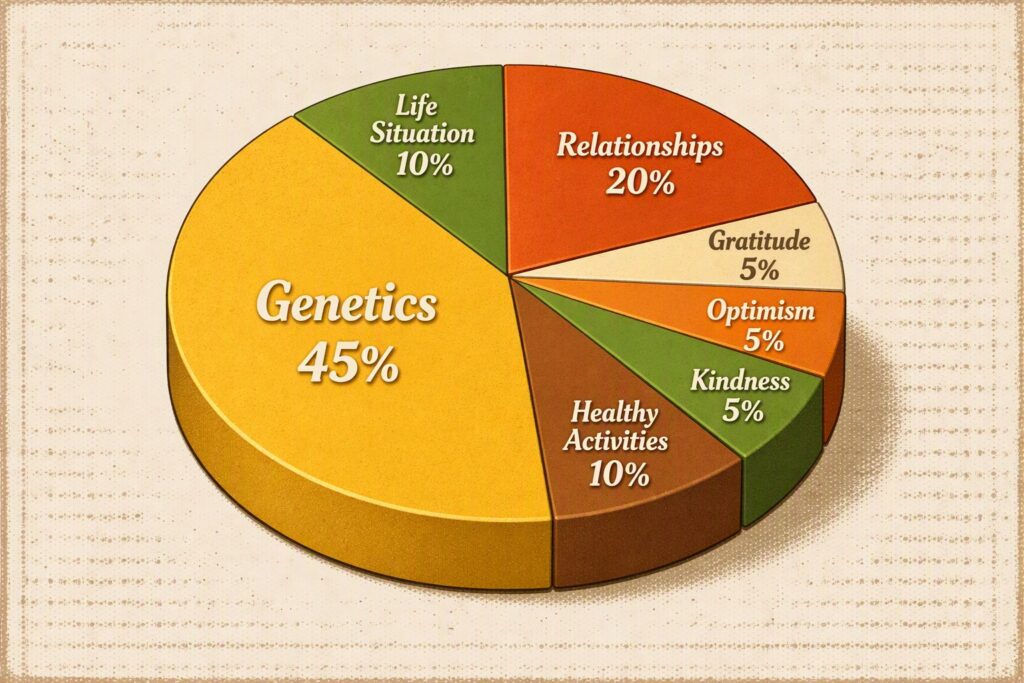
Beyond economic metrics, human well-being and happiness are influenced by a complex interplay of psychological and social factors. While basic economic security is a prerequisite for stability, advanced societies surpassed minimum material requirements decades ago. Psychological research and qualitative observations suggest that long-term satisfaction is predominantly driven by personal relationships, community engagement, gratitude, and physical health, rather than incremental accumulation of wealth beyond a comfortable threshold.
Navigating Psychological Fear and Modern Stress
Despite historical evidence demonstrating economic resilience, background financial anxiety remains prevalent among savers and retirees. Psychologists and financial educators attribute this phenomenon to basic human evolutionary biology. As a species, humans evolved as danger-detection machines, utilizing vigilance as a vital survival mechanism against predators and scarcity.

However, this detection machinery often misfires in modern environments where immediate physical threats have been largely mitigated. Once basic survival and financial security are achieved, the human mind frequently shifts its focus to new sources of worry, ranging from social acceptance and tax strategies to neighborhood compliance and long-term inheritance planning. This continuous shifting of goalposts ensures that anxiety persists even as objective living standards improve.
Overcoming this pervasive background fear requires a combination of self-awareness, historical perspective, and behavioral adjustment. Understanding the personal or generational origins of scarcity mindsets—such as childhood experiences or familial memories of economic depressions—can help individuals separate past trauma from current financial realities. Analyzing worst-case scenarios objectively often reveals that catastrophic fears are statistically improbable.

Taking concrete action remains one of the most effective methods for mitigating fear. Familiarity breeds confidence, and cultivating personal resilience—the capacity to adapt to changing circumstances—reduces reliance on predictable environments. Furthermore, reducing exposure to continuous sensationalized media consumption can significantly improve mental well-being. Modern news cycles are frequently structured to highlight extreme risks, whereas meaningful progress relies on sustained positive behaviors, physical activity, and constructive social engagement.
The Artificial Intelligence Era as an Ongoing Experiment
Framing major technological shifts as experiments rather than existential threats offers a constructive framework for evaluating developments like artificial intelligence. Change often breeds uncertainty, which triggers apprehension among observers who rely heavily on continuous risk-monitoring media.

Proponents of artificial intelligence view the technology through the lens of economic efficiency, likening advanced language and analytical models to a cognitive equivalent of a industrial tool like a nail gun. By augmenting human capabilities, AI promises to enhance productivity, accelerate problem-solving, and drive broad economic prosperity, much like previous technological revolutions sparked by the internet and mobile computing.
At the same time, technological transitions frequently cause labor displacement, affecting entry-level administrative, financial, and eventually transportation sectors. Historical precedent indicates that while specific job roles evolve or disappear, productivity gains tend to lower service costs and foster the creation of entirely new industries. Economic rewards during such transitions often concentrate among capital owners and shareholders, contributing to broader wealth disparities unless balanced by adaptive policy and personal financial preparedness.
Ultimately, whether artificial intelligence is viewed as a source of existential risk or an unprecedented opportunity depends largely on individual perspective and proactive adaptation. By focusing on continuous learning, rational risk assessment, and active problem-solving, individuals can navigate market volatility and technological transformation without letting fear dictate their long-term financial and personal decisions.