

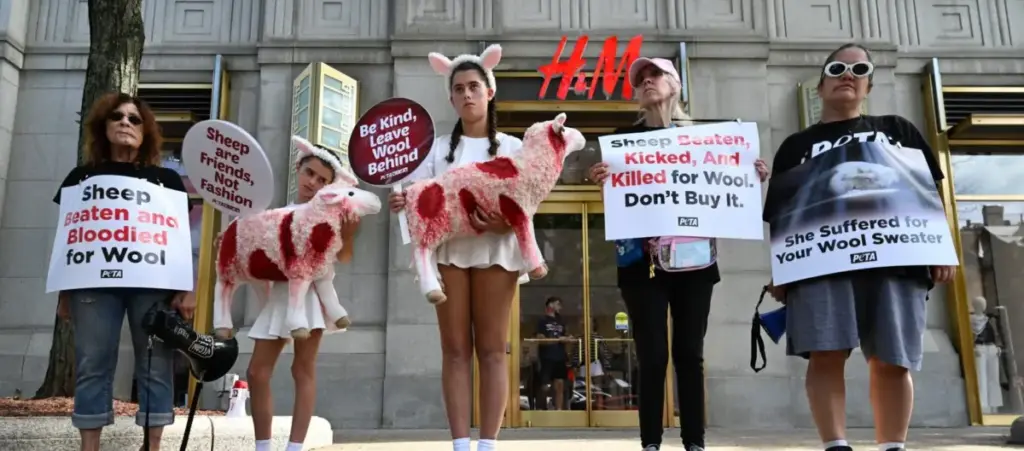
NEW YORK — New York Fashion Week took a volatile turn when animal rights activists bypassed security to stage a high-profile runway disruption, aiming to draw international attention to the hidden suffering behind the global wool industry. The protest, which rapidly went viral across social media platforms, placed the spotlight directly on luxury-adjacent brand COS, a subsidiary of retail giant H&M Group, and reignited fierce debates regarding animal welfare and physical safety within the upper echelons of the fashion world.
On September 13, PETA supporters infiltrated the COS runway presentation in Manhattan, unfurling banners and chanting slogans to expose the realities of wool production. Among the activists was Mason Melito, a senior campaigner for People for the Ethical Treatment of Animals (PETA), who entered the high-end venue to speak on behalf of animals incapable of advocating for themselves. According to organizers, the peaceful demonstration was designed to deliver a clear message to shoppers and industry leaders: sheep cannot walk onto a runway to describe the conditions they endure, making human intervention necessary.
However, the peaceful demonstration quickly escalated into physical turmoil. Widely circulated video footage captured a fashion executive aggressively intervening to suppress the protest. The official pinned a female PETA supporter to the floor, wrapping a leg around her and forcibly covering her mouth and nose as she attempted to vocalize the cruelty inherent in wool harvesting. When Melito attempted to document the altercation and continue speaking out, he was similarly shoved, physically grabbed, and obstructed by the executive, who forced a hand over Melito’s face to silence him.
The stark contrast between the luxury garments on display and the aggressive response from event personnel drew immediate condemnation from animal rights advocates. Organizers noted the profound irony of the situation, observing that representatives of an industry built on aesthetic presentation and high fashion responded with physical violence when confronted with the realities of its supply chain.
Why Did the Protest Target COS at New York Fashion Week?
Throughout history, fashion has often positioned itself as a cultural rebellion—a medium designed to challenge societal complacencies, push cultural boundaries, and make invisible realities impossible to ignore. PETA and allied organizations have spent decades leveraging this dynamic, crashing high-profile runway shows to expose the environmental and ethical costs of animal exploitation, while simultaneously collaborating with designers and brands shifting toward ethical alternatives.

Industry pressure and persistent activism have yielded historic victories over the years. Following sustained campaigns, protests, and shareholder resolutions, numerous luxury houses and major retailers—including Gucci, Prada, Armani, Chanel, Burberry, Michael Kors, Coach, Macy’s, Nordstrom, Saks Fifth Avenue, and Zappos—have enacted total bans on animal fur. Furthermore, New York Fashion Week officially banned fur from its runways following years of PETA demonstrations and pressure from more than 50,000 active supporters. Activists arrived at the COS show with the explicit goal of establishing wool as the next primary material the fashion industry must phase out.
Despite marketing campaigns portraying the wool industry as pastoral and benign, organizational investigations paint a dramatically different picture. PETA entities have collectively released 17 comprehensive exposés documenting more than 150 wool-industry operations spanning eight countries across four continents. Investigators report encountering systematic violence, distress, and exploitation at virtually every facility examined, challenging the narrative that humane wool production is widespread. Even operations marketed under "ethical" or "responsible" certifications have repeatedly failed to protect animals from abuse.
Of particular concern to investigators is a recent PETA Asia inquiry—the first of its kind into a NATIVA-certified wool operation. Investigators documented workers kicking and stomping on sheep, dragging fragile lambs by their legs, and leaving animals with gaping, untreated shearing wounds. Crucially, the farm in question supplied wool through a broker to the H&M Group, which markets the material using labels denoting "responsibly" sourced origins. For activists, the findings reinforced a central thesis: no certification label can sanitize an industry built on mass shearing and slaughter.
What Happens to Sheep Used for Wool?
Domesticated sheep are curious, highly sensitive animals known to form deep social bonds and experience acute panic when separated from their flocks by human intervention. Over generations, selective breeding by humans has caused sheep to grow abnormal quantities of wool, locking the animals into a permanent cycle of biological dependence on artificial shearing. However, because commercial shearers are frequently compensated based on the sheer volume of wool they process rather than the quality of care they provide, shearing operations routinely prioritize speed over animal welfare.
When shearing floors prioritize velocity over the wellbeing of individual animals, sheep bear the physical consequences. Workers frequently pin animals down with heavy body weight, violently twist their anatomies, and pass sharp mechanical clippers rapidly across sensitive skin. Independent investigations have repeatedly documented sheep suffering severe lacerations, blunt-force trauma, and abandonment without veterinary care. Once an individual sheep’s body ceases to produce commercially viable quantities of wool, the animal is routinely transported to slaughterhouses.
Why This COS Wool Protest Mattered
The disruption of the COS runway forced an industry accustomed to sanitized marketing to confront its biological costs on a global stage. Millions of viewers worldwide engaged with the viral footage, prompting public discourse regarding why animal advocates would willingly subject themselves to physical removal, potential arrest, or assault to protest a textile.
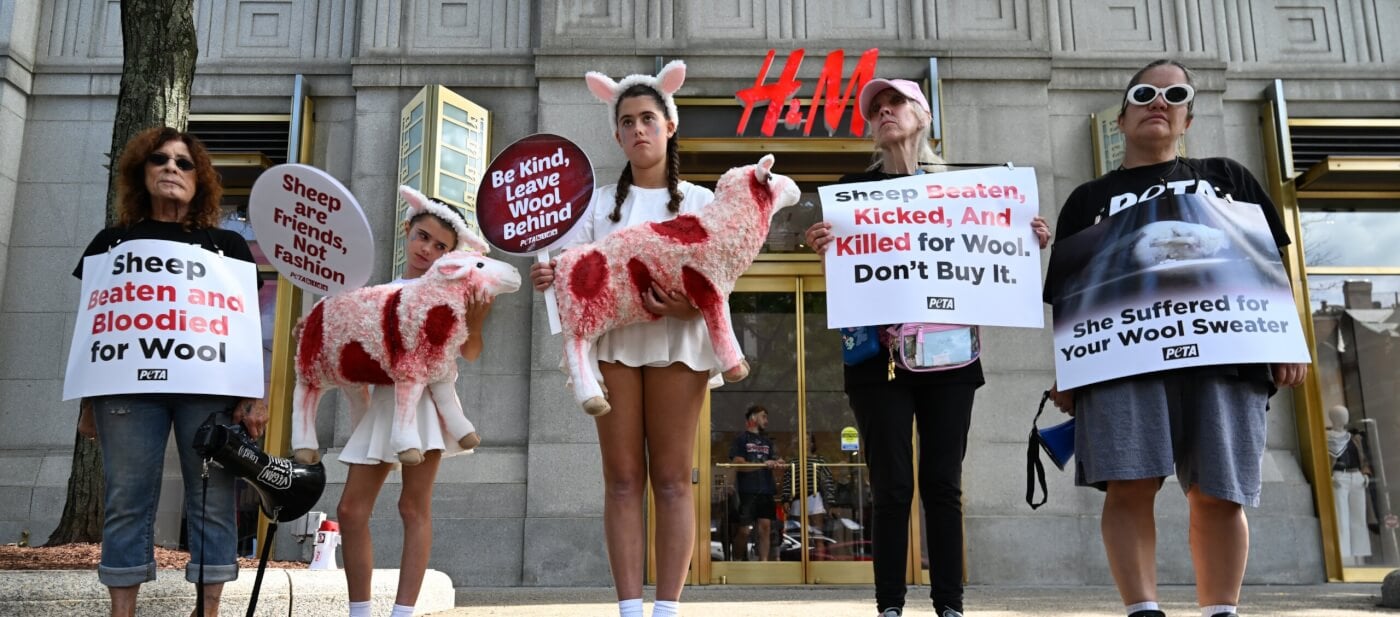
For campaigners, the equation remains straightforward. While human demonstrators absorbed physical force and were subsequently released to return home, the animals exploited for their coats face an inescapable trajectory. Restrained, cut, left bleeding, and ultimately dispatched to slaughterhouses when their productivity wanes, sheep endure a lifetime of institutionalized distress that activists argue is entirely unjustified by consumer luxury.
What Should COS and H&M Group Do Now?
As public scrutiny intensifies, animal rights organizations are increasing pressure on corporate leadership to address the systemic cruelty documented within their supply chains. Activists maintain that if fashion executives are genuinely committed to ethical standards, they must look past public relations messaging and confront the inherent violence defining the global wool market.
PETA continues to urge COS and its parent organization, the H&M Group, to abandon misleading certification schemes and implement an immediate ban on the use of wool.
How Consumers Can Help Sheep
Industry analysts note that consumer purchasing power remains one of the most effective catalysts for corporate change. Shoppers seeking to protect animals can opt for cruelty-free textiles, including organic cotton, linen, bamboo, hemp, Tencel, and advanced recycled synthetics. Modern apparel brands already manufacture vast arrays of stylish, durable, and warm alternatives; however, widespread adoption often depends on sustained pressure from conscious consumers demanding accountability.
Advocates emphasize that no sweater, scarf, winter coat, or runway ensemble justifies the suffering of a living creature. As the fallout from the New York Fashion Week demonstration continues to ripple through corporate boardrooms and consumer markets, the future of wool in modern luxury remains a central battleground for the ethical fashion movement.