
How about that stock market? It is a phrase financial observers and everyday investors keep having to dust off and reuse as the years go by and equity markets continue to defy expectations. When the market crashes, anxiety flares as retirement portfolios shrink. Yet, even when stocks climb to record levels and cross into what many deem super-crazy record valuations, a different kind of worry emerges: the nagging fear that an even bigger crash is just around the corner. This apprehension is particularly pronounced today, as the current economic boom is fueled by the frenzied excitement surrounding Artificial Intelligence.
For those who have managed to tune out the daily market drama and simply focus on living their lives, the detachment is commendable. However, understanding the broader financial context involves recognizing the core narrative driving the AI wave. Investors worry that while artificial intelligence is unquestionably a major technological breakthrough, the market mania surrounding it is moving too fast and reaching too high. This has triggered widespread concerns that the global economy is heading toward a magnified version of the dot-com crash of the early 2000s—a historical market bubble that shaped the early career of prominent financial commentator and blogger Mr. Money Mustache before an ensuing market correction nearly derailed his professional trajectory and citizenship application.

As an established voice in the personal finance space, the veteran blogger frequently receives inquiries about the current investment cycle, mirroring questions asked during previous economic booms and busts. To address these widespread anxieties, he recently developed a presentation delivered for the first time at Camp FI Midwest, with an updated version scheduled for the upcoming Bogleheads conference. By examining historical market panics, human psychology, and the fundamental mechanics of economic growth, financial analysts and commentators are attempting to put the current AI phenomenon into a calmer, more rational perspective.
Will the AI Bubble Ruin Our Retirement?
Having reached two decades of retirement, comfort with the lifestyle is well-established, yet questions from concerned peers continue to surface. Friends frequently ask how anyone can remain retired and sleep soundly at night given the state of the world, assuming that ongoing crises should be a constant source of stress. When presented with a list of modern worries—ranging from political instability and inflation to the looming US national debt, international conflicts, and the psychological weight of the AI bubble—it becomes clear how easily anxiety can dominate public discourse.

Yet, a historical look back reveals a striking parallel. More than twenty years ago, during the mid-2000s, investors were plagued by an entirely different set of catastrophic predictions. Back then, public anxiety centered on geopolitical leaders like George W. Bush and Saddam Hussein, the ongoing war in Iraq, soaring national debt, and rising inflation. The stock market was viewed with intense suspicion, though the primary fear then was a massive housing bubble rather than an AI bubble. Instead of artificial intelligence threatening job security, the dominant fear was that white-collar jobs would be permanently outsourced to India and China. There was even a fierce debate over "peak oil," with widespread warnings that the world was doomed because fossil fuel consumption was rapidly outpacing dwindling supplies.
Looking back at what actually unfolded over the subsequent twenty years provides a profound lesson in perspective. The world did indeed experience the Great Financial Crisis, driven by irrational exuberance in housing prices and complex financial leverage, marking the steepest market downturn since the Great Depression. Yet, viewed through the lens of a multi-decade timeline, even that monumental crash appears as a minor dip on a long-term upward trajectory. A standard $100,000 investment made during that era still managed to grow substantially over the next twenty years, absorbing subsequent shocks like the 2020 pandemic crash along the way.

Simultaneously, global living standards improved dramatically across several measurable metrics. The proportion of the global population living in extreme poverty dropped from 20 percent in 2005 to just 8 percent two decades later. Infant mortality rates were cut in half. Clean energy expanded exponentially as solar panel costs plummeted, making solar generation the dominant source of new energy capacity worldwide. Meanwhile, electric vehicle sales surged from near zero to roughly a quarter of all global auto sales.
These historical realities challenge the premise that fear and pessimism are more reliable guides than optimism and resilience. The critical question remains: is the current economic environment fundamentally different? Skeptics argue that the towering US national debt could finally destabilize the economy, that the AI bubble dwarfs the housing market excess, or that artificial intelligence could evolve into an uncontrollable superintelligence. Financial media outlets readily amplify these frightening scenarios, often overlooking a foundational economic truth: true prosperity does not originate from financial systems or stock market ticker symbols, which are ultimately human constructs built on digital data.

Prosperity, Productivity, and Human Happiness
At its core, prosperity is driven by productivity. Financial markets are inherently volatile, prone to wild swings and emotional cycles. Beneath the surface turbulence, however, real people perform real work and invent tangible solutions. The concept of an economy is simply a mechanism for organizing human effort. If a financial system experiences a severe collapse due to unsustainable valuations, society has repeatedly demonstrated the capacity to recalibrate the metrics and resume productive labor, just as it did following the 2008 financial crisis and prior historical downturns.
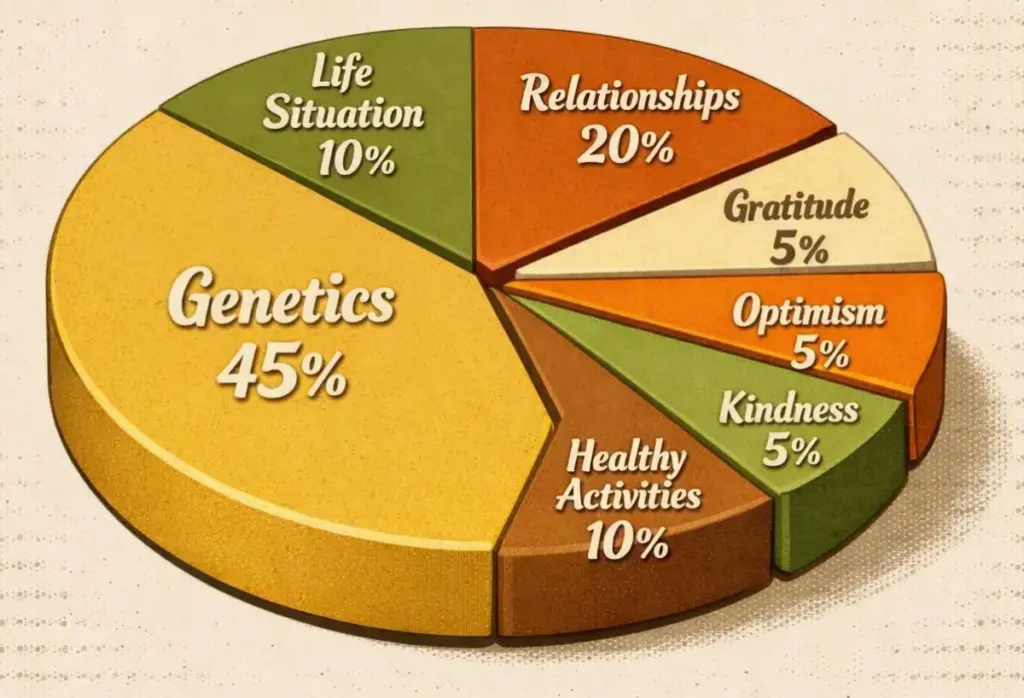
The tools that enhance productivity—along with the resulting standards of living, economic growth, and the viability of early retirement—remain intact regardless of market fluctuations. Beyond economic output, human happiness operates according to different rules. Once a society achieves a stable baseline standard of living, additional wealth yields diminishing returns regarding overall well-being. Modern psychological observations suggest that happiness is influenced primarily by factors outside financial accumulation, such as genetics, strong interpersonal relationships, acts of kindness, lifelong optimism, and regular engagement in healthy physical activity.

Despite these established principles, many individuals remain consumed by fear. Psychologically, human beings function largely as danger-detection machines, an evolutionary trait designed to ensure survival against physical threats. When immediate physical dangers are mitigated, this detection machinery does not simply turn off; instead, it shifts the goalposts, seeking out new sources of anxiety. Once basic survival needs are met, people worry about food scarcity, social exclusion, financial comparisons, neighborhood property standards, tax strategies, and even government regulations regarding required minimum distributions for excess wealth.
Combating this persistent background fear requires self-awareness and rational evaluation. Understanding personal history—such as childhood experiences with financial scarcity or past trauma—can help contextualize why certain economic conditions trigger disproportionate anxiety. Identifying the specific worst-case scenarios associated with financial fears often reveals that even the most extreme outcomes are manageable. Taking deliberate action transforms the unfamiliar into the familiar, fostering resilience and confidence.

Furthermore, managing one’s mental diet by filtering out sensationalized daily news reports helps reduce unnecessary psychological distress. Human beings are biologically wired to solve practical problems through physical and mental engagement in real-world environments, making sedentary lifestyles combined with constant exposure to media alarmism a recipe for mental fatigue. Aligning daily habits with physical health, reducing excessive reliance on digital panic, and surrounding oneself with optimistic, productive peers can fundamentally alter one’s outlook on the future.
Viewing Technological Shifts as Experiments
Adopting a mindset that treats life events as experiments can reframe how individuals approach uncertainty, whether it involves minor lifestyle changes or major career transitions like early retirement. This experimental framework applies directly to the current anxiety surrounding artificial intelligence. Rather than succumbing to sensationalized headlines predicting economic ruin, examining the practical mechanics of AI reveals a technology best understood as a cognitive productivity tool.

Artificial intelligence functions as a high-efficiency accelerator for human intellect, boosting operational efficiency and driving broader economic productivity. Much like previous technological revolutions—including the advent of the internet, personal computers, and mobile smartphones—AI will inevitably displace certain entry-level administrative, software, and logistical roles over time. However, history shows that such technological shifts simultaneously reduce costs, enhance efficiency, and catalyze the creation of entirely new industries and job categories.
While technological revolutions often concentrate financial rewards among capital owners and shareholders, they also expand the productive capacity of the broader economy. Artificial intelligence, therefore, represents another significant pivot point requiring intentional human choices. Rather than yielding to preemptive fear, individuals have the opportunity to engage with new technologies through education, adaptation, and practical problem-solving. By addressing the root causes of anxiety and viewing uncertain futures as experimental frontiers, people can navigate evolving economic landscapes while pursuing fulfilling, resilient, and balanced lives.