



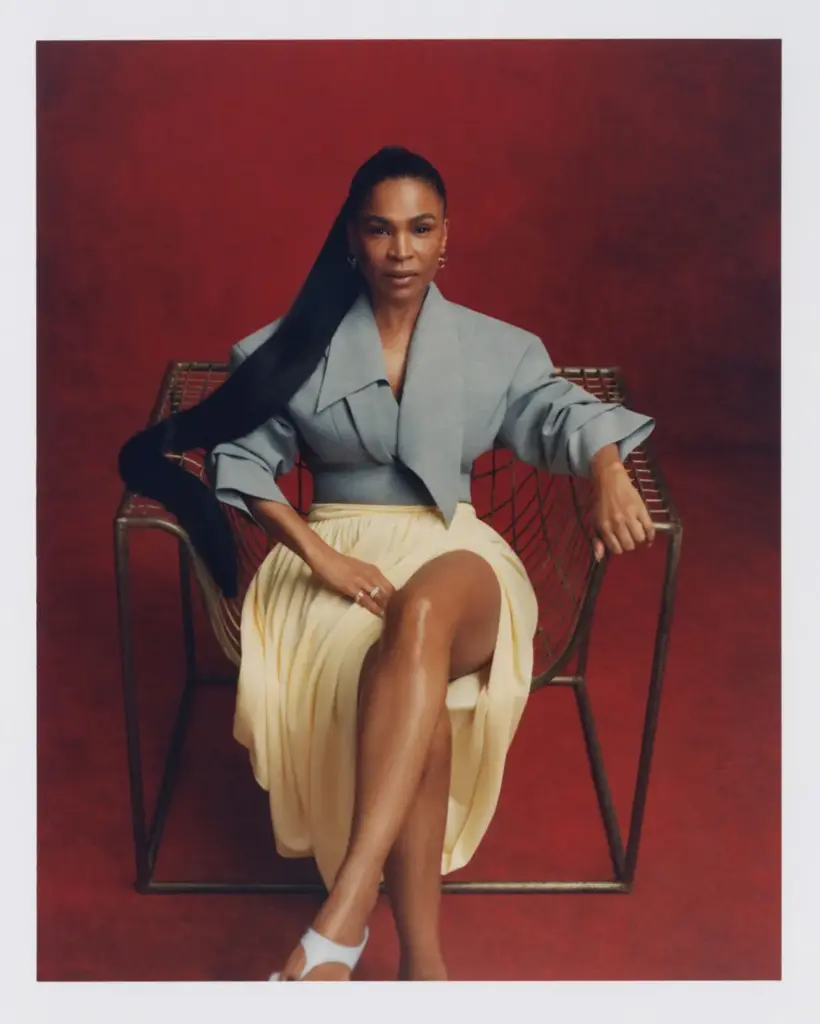
There is a specific kind of vertigo that comes with leaving a movie theater in the middle of the day. The world is suddenly too bright, too loud, and slightly unreal. You have, after all, been inside someone else’s carefully constructed reality for two hours. And then you are back outside, blinking into the afternoon light, not quite returned to yourself, the movie still clinging to you like perfume. It is in this particular state that journalist Zeba Blay met Nia Long for an early lunch in a quiet corner at the legendary Chateau Marmont.
The meeting took place just a month ahead of the April release of Michael, the highly anticipated new Michael Jackson biopic. Blay was still processing the film when Long arrived, looking chic yet low-key in an oversized blazer, wide-leg jeans, and a Miu Miu baseball cap pulled low. As they eased into the conversation, the interviewer was struck by the strange doubling effect of movie vertigo: the woman sitting right before them and the woman they had just watched on screen, layered like two transparencies held up to the light.

On screen, Long plays Katherine Jackson, the Jackson family matriarch, with a studied stillness. The first time the audience sees her, watching her boys rehearse, the camera frame holds on her loving face for just a few beats. She says almost nothing, yet she doesn’t have to. Juxtaposed against Colman Domingo’s blustering portrayal of Joe Jackson and Jaafar Jackson’s uncanny performance as his late uncle Michael, Long has found a way to make silence load-bearing. Restraint is the most visible thing in any scene she occupies.
In person, however, she seems the opposite of restrained. She is blunt, remarkably warm, possesses a dry sense of humor, and carries a deep well of emotional intelligence. As a Scorpio, she notices everything around her. In playing Mrs. Jackson—who remains alive at the age of 95—Long has tapped into the part of herself that understands how to let silence do the heavy lifting. The word she continually reaches for when discussing her experience portraying the matriarch is grace.
“There have been moments in my life where I’ve been required to be more graceful than I’ve ever had to be in the past,” Long shares. “And that requires a sense of really being able to dig deep into some sort of self-examination. Like, what do I stand for? What’s important to me, ultimately, regardless of Hollywood, the noise? And number one, for me personally, my children come before anything. And so I think when you look at Michael’s journey, and you look at Katherine’s journey, the only way you thrive and survive is through a tremendous amount of grace.” She pauses before adding, “What I think I learned from her is that sometimes grace is really quiet.”

Long occupies a place in cultural memory that few actors ever attain. For a massive generation, she stands as the platonic ideal of nineties fine, a phrase that encompasses not just physical beauty or aesthetic appeal, but a specific feeling and era. Watching her as Nina in Love Jones, Jordan in The Best Man, or Lisa in The Fresh Prince of Bel-Air immediately conjures a place, time, and attitude synonymous with her name. But alongside the enduring image stands the human eating her go-to order of salmon with a side of mustard, reflecting on the iconography and nostalgia that persistently surrounds her career.
“My commitment to work is not for accolades or attention, or even to be famous, quite honestly,” she says. “लेकिन I do think because of my commitment to truth and purpose, there is a thing, and I don’t know what that thing is, that people see in my work. And it makes them feel good. It makes them feel inspired. It makes them feel like they know me.”
Navigating a fickle Hollywood landscape that is notoriously even more challenging for Black actors, Long does not take her longevity and the public’s enduring love for granted. Acknowledging the natural cycles of the entertainment industry, she notes that while she is having a great year, she remains grounded in the reality of the business.

Throughout her decades-long career, Long has starred in several iconic Black films, always maintaining strict intentionality regarding how she portrays her characters. Much like her approach to Katherine Jackson, she works to construct versions of people that feel fundamentally true to life.
“The only strategy I have in this game is my bank account. Let’s strategize how we’re going to make money and create generational wealth. That is where I’m strategic,” she laughs, playfully scratching her palm. “My hand just started itching the minute I said money. That’s a good thing. Maybe something’s happening. Something’s coming.”
Once she steps fully into a role, however, the labor becomes deeply personal. She works diligently to ensure that her representation of community figures remains authentic, steering clear of external agendas dictating her hair, makeup, wardrobe, or lines.

With her eldest son now in his 20s and her youngest son, 14, old enough to stay home alone, Long feels prepared to expand her creative footprint in all directions. She aims to continue producing films and crafting new stories from both behind and in front of the camera. She recently wrapped shooting on a new romantic dramedy in New York titled Don’t Ever Wonder, a project three years in the development pipeline that marks an onscreen reunion with her Love Jones leading man, Larenz Tate. Directed by Eugene Ashe and featuring an ensemble cast including Blair Underwood, Susan Kelechi Watson, and Algee Smith, the film explores the territory of second acts.
“This is not a continuation of Love Jones,” she emphasizes. “This is a continuation of love, and of what happens once you’ve had your kids, they’re off to college, and you’re empty nesters. And that’s kind of where the story begins. There’s a lot of funny and there’s a lot of heartbreak, and I think it’s a really honest story.”
That valuation of honesty and truth in storytelling mirrors what she values in her personal life. That openness prompted a moment during the interview when the conversation turned personal, with Blay mentioning they were conducting the interview shortly after ending a 12-year relationship. When Long asked when it was truly over, the candid exchange naturally circled back to the concept of grace.

In 2022, Long navigated the intense public scrutiny that accompanies fame when a private heartbreak—her partner’s widely publicized cheating scandal that ended their 13-year relationship—became public overnight. While she maintains a healthy co-parenting relationship today, she looks back at the ordeal with unflinching clarity.
“The amount of pouring into myself that I’ve done is strong and mighty and intentional,” Long reflects. “I’ve now identified the things that I need to work on and the things that I need to heal. But I have also identified what is intolerable.”
That hard-won clarity has been balanced by deep nuance. While fans rallied around her with an overwhelming protectiveness, Long expresses pride in her ability to handle the high-stakes news cycle without letting bitterness dictate her life.

“I’m proud of myself for giving so much grace. For being able to say people make mistakes and things happen. It’s life. When the stakes are high, the news is big. I can’t do anything about that, but I don’t have to protect my ego in any of this,” she states matter-of-factly.
Offering pragmatic advice, she suggests writing out unresolved feelings without sending them, noting that healing centers on personal commitment to self-love rather than another person’s poor behavior. Managing the noise through writing, meditation, or prayer helps prevent individuals from reacting out of their own unhealed trauma.
Beyond acting, Long is currently immersed in writing her first memoir, a project she describes as one of the biggest, bravest, and most challenging undertakings of her life. A two-year process involving continuous revisions, the book draws inspiration from her late father, Doughtry Long Jr., a poet who passed away in 2020 and taught her that the hardest part of writing is knowing when to stop.

The memoir explores her childhood, including the six years she spent in Iowa City while her mother attended university. Born in Brooklyn into a Trinidadian household within a tight-knit Black neighborhood, moving to the Midwest during her formative years presented a jarring culture shock that complicated her relationship with race and identity.
“In writing this memoir, I realized the impact that experience had on my own view of beauty,” she says. “And my own self-acceptance of being a pretty brown-skinned little girl growing up in Iowa. I thought I was beautiful because my mother said it and my family said it, but the world told me something different. So to now be a face for Estée Lauder, it’s kind of ironic, because I didn’t feel beautiful until Black Hollywood said I was beautiful.”
That realization speaks volumes about the historical weight of beauty standards and the cultural labor required to transform them. The "nineties fine" phenomenon was never accidental; it served as Black Hollywood’s powerful corrective to an industry that routinely rendered Black women invisible or controlled their narratives. Three decades later, Long continues to redefine what it means to age and thrive publicly as a Black woman.

While culture constantly hurls phrases like "Black don’t crack" as a compliment, Long refuses to pretend that physical changes do not happen. At 55, she speaks openly about hormonal shifts and a changing body without any wistfulness or apologies, happily indulging in truffle parmesan fries and looking forward to the upcoming press tour for Michael without falling into dietary restrictions.
Beauty, she maintains, was never her primary currency. Instead, she draws strength from the deeper inheritances passed down by her parents: her father’s intellectual curiosity and her mother’s fierce, unapologetic self-possession. Remembering how her mother wore leg warmers in the dead of summer simply because they matched her outfit—unfazed by her young daughter’s embarrassment—Long now recognizes the profound freedom in that attitude.
As their lunch concluded and plates were cleared away, Long prepared to head home to host a pizza party for her youngest son and his friends. Asked what freedom means to her at this stage in life, her definition was simple and grounded.

“Being able to do what you want to do when you want to do it, because it serves your spirit, not what everyone else thinks you need to be or should be,” she says. That type of freedom, she adds, requires no audience or big stage. It can be found anywhere, even in a kitchen making pizza.