



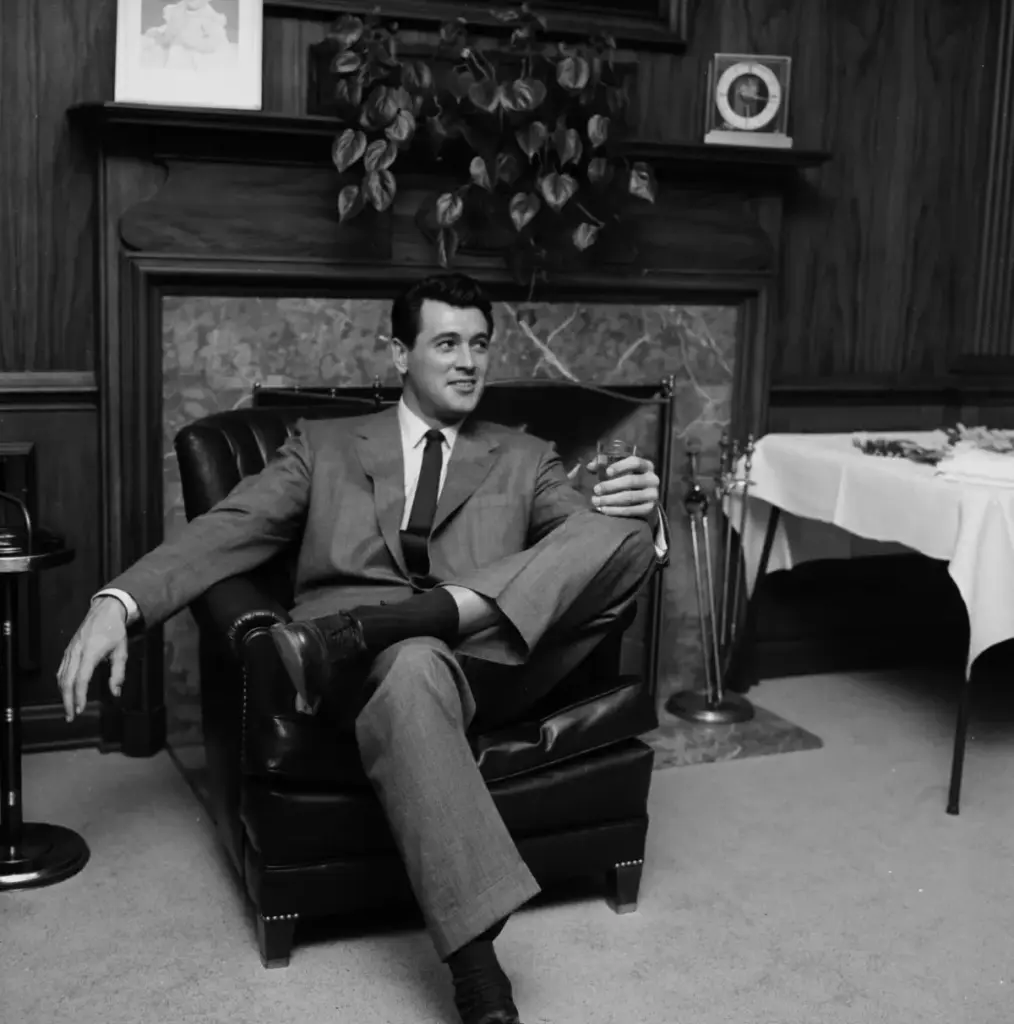
Long before he became an indelible symbol of Hollywood’s Golden Age—and a definitive leading man whose towering physical presence and romantic charm lit up screens in timeless classics like Giant, Pillow Talk, Lover Come Back, and All That Heaven Allows—Rock Hudson’s life was anchored in much more modest realities. Born Roy Harold Scherer Jr. on November 17, 1925, the future superstar spent a formative part of his childhood sharing a cramped, suburban Chicago living arrangement with his parents and maternal grandparents. According to Sara Davidson’s biographical work Rock Hudson: His Story, young Hudson called a modest one-bedroom bungalow at 719 Center Street home, a tight space where a single bathroom was shared among six adults and five children.
As his professional profile soared and his face became one of the most recognizable in the global cinematic landscape, Hudson increasingly sought refuge from the intense, unyielding glare of public scrutiny. The overwhelming celebrity apparatus of mid-century Tinseltown meant that virtually every professional and personal move he made was watched, recorded, and scrutinized by the press and public alike. For Hudson, domestic spaces evolved from mere living quarters into heavily guarded sanctuaries of privacy and personal autonomy.
Reflecting on this sanctuary-like status of his residences, Hudson famously observed in Rock Hudson: His Story that his home was the singular place where he truly possessed any privacy. Outside those walls, he noted, everything he did was a matter of public consumption, but once he passed through his gates, he could finally let go and relax. He took a hands-on approach to his environments, harboring a deep-seated love for manual labor around his properties—often spending his downtime tearing down walls, laying bricks, and physically shaping his own living spaces. Across his life, Hudson cultivated a succession of distinctive homes, culminating in the expansive estate where he resided until his passing in 1985.

Cohabitation in North Hollywood
During the early stages of his burgeoning career, specifically in a 1952 chapter of his personal life, Hudson shared a residence in Los Angeles with actor Bob Preble. As detailed in biographical accounts, the pair lived together across a span of three years, moving through four different homes. Their final shared dwelling, situated on Avenida del Sol, was notably forward-thinking and modern for its era, incorporating futuristic glass architectural fixtures and offering sweeping, panoramic views of the surrounding valley and picturesque mountains. Ultimately, Preble moved out of the residence following his marriage to actor Yvonne Rivero.
During and long after this period, persistent rumors circulated in Hollywood suggesting that Hudson, who lived as a closeted gay man throughout his lifetime, was romantically involved with Preble. Preble appeared to touch upon the nature of their relationship when speaking for Rock Hudson: His Story, sharing that he and Hudson engaged in "a little experimenting… but nothing you would call a definite relation." Preble added that while he suspected Hudson hoped the social and personal barriers of the time might come down, the situation ultimately did not cross boundaries foreign to his own behavior, prompting his departure and subsequent marriage.
9151 Warbler Place

By 1955, Hudson had married secretary and interior designer Phyllis Gates. The couple was frequently photographed at home in Los Angeles that same year, following Hudson’s purchase of the property near Sunset Boulevard in 1954, after which he asked Gates to move in. The residence, a two-bedroom ranch-style house located at 9151 Warbler Place, featured a warm, inviting kitchen built with traditional brick and wood elements. Because Hudson had poured virtually all of his financial resources into acquiring the property itself, the living room initially lacked conventional interior seating; instead, it was furnished with simple redwood lawn chairs.
Outdoor living furniture was far from the primary focus inside the heart of the home, largely because Gates was widely noted to be an exceptional traditional cook. Her culinary specialties included hearty comfort foods such as pork chops, meatloaf, and homemade mashed potatoes smothered in rich gravy.
A Rocky Marriage and Its Aftermath
The marriage between Hudson and Gates was later widely reported and discussed as having been an arrangement orchestrated to conceal Hudson’s homosexuality from the public and the studio system. Decades later, Gates addressed their union in the press and in biographical interviews, maintaining that her emotional investment in the relationship had been genuine. She noted in Rock Hudson: His Story that she had been deeply in love, describing him as charming, gorgeous, standing six-foot-six inches tall, and possessing a career that was red-hot at the time, leading her to wonder how any woman could have turned him down. She acknowledged that while rumors regarding his sexuality had reached her, she consciously pushed them to the back of her mind, adopting an attitude of indifference toward the gossip.

When the marriage eventually dissolved in a 1958 divorce, the proceedings resulted in Gates being awarded alimony of $250 a week for a duration of ten years. Additionally, she received ownership of the Warbler Place residence, which at that time held a market valuation of approximately $35,000.
The Beach House in Malibu
Following his divorce from Gates, Hudson relocated to the coastline, moving into a distinctive stilt-supported beach house perched directly over the sand in Malibu. Captured in a 1958 photograph standing on the open deck, Hudson utilized this coastal retreat as his primary residence while heavily engaged in filming the classic 1959 romantic comedy Pillow Talk. The architectural placement of the home meant that during periods of high tide, ocean waves would rush directly underneath the wooden structure, creating an immersive, kinetic coastal living experience.
According to accounts compiled in Rock Hudson: His Story, Hudson integrated smoothly into a tight-knit local community of actors and stuntmen who resided along the beachfront. Actor Don Burnett recalled the vibrant, active lifestyle shared by the group during that era, noting that they swam in the Pacific Ocean without wetsuits throughout the entire year, ran extensively through the rugged Malibu hills, and engaged in frequent sailing and scuba diving sessions—activities through which they ultimately taught Hudson how to dive. Hudson’s tenure in Malibu was relatively brief, however, as he departed the area in the summer of 1959 for a short-lived stay in Newport Beach.

9402 Beverly Crest Drive
As Hudson prepared for and filmed the 1961 romantic comedy Lover Come Back, Universal Studios leased a nearby hillside residence for him at 9402 Beverly Crest Drive. Captured in a 1963 photographic series, the striking property originally belonged to prominent Hollywood agent and producer Sam Jaffe. Its architectural exterior drew heavy inspiration from classic Spanish-style homes, defined by a distinct red-tile roof, textured stucco walls, and heavy dark wood beams. Nestled amid steep cliffs, the three-and-a-half-acre property immediately captivated Hudson, who desperately wished to purchase and own it.
Despite his soaring stardom and box-office success, Hudson lacked the liquid capital required to acquire the estate outright at that moment. Recognizing the actor’s profound attachment to the property, Universal Studios leveraged the residence as a critical bargaining chip when Hudson’s studio contract approached expiration in 1962. The studio drafted an agreement to purchase the home from Jaffe for $167,000, conditioning the purchase on Hudson re-signing his contract with them. Hudson agreed to the terms, and Universal formally acquired the property, transferring the deed and title directly to the actor five years later.
Home Sweet Home: Transforming a Rental into a Sanctuary

Determined to transform the former rental property into a deeply personalized sanctuary, Hudson embarked on an extensive, comprehensive architectural and interior overhaul. Relying on specialized literature to guide his creative vision, Hudson turned to comprehensive reference books focusing on Mexican colonial architecture—tomes he affectionately referred to as his "Bibles." These instructional texts helped him translate his aesthetic ambitions into reality, incorporating traditional design elements drawn from homes across Mexico and the American Southwest.
The redesigned residence featured dramatic stone archways, hand-painted decorative tiles, heavy wooden doors, and exposed ceilings constructed from raw tree limbs. To complement the architecture, Hudson filled the expansive interior spaces with an eclectic array of striking decorative details, including zebra-skin rugs, authentic African tribal masks, and imposing four-foot-tall pewter candlesticks.
The Castle
Hudson developed a deep personal connection to the Beverly Crest estate, affectionately referring to the sprawling property as "The Castle." The grounds and interior spaces were punctuated by a diverse collection of sculptural figures representing the animal kingdom. These included giant statues of eagles and horses, an ornate lion’s head outdoor fountain, and mounted brass elephant heads prominently displayed on the walls of the primary bedroom, where the protruding brass trunks cleverly functioned as functional towel racks.

Another prominent thematic element woven throughout the property was the artistic celebration of the nude male form. Hudson displayed striking nude male metal sculptures created by Mexican artist Victor Salmones across the sprawling gardens and grounds. Inside the primary suite, a custom nude male figure inspired by traditional Spanish mythology was intricately carved directly into the wooden headboard of his bed. Beyond its artistic curation, the estate offered extensive resort-like amenities designed for leisure and privacy, including a 40-foot swimming pool, a dedicated spa, a private screening room, and an expansive outdoor fireplace.
An Open-Door Policy
Despite his intense need to escape the public eye and protect his private life from tabloid exposure, Hudson maintained a surprisingly open-door policy regarding his personal home, frequently refusing to lock the doors of the estate. Actor George Nader provided context for this paradoxical philosophy in Rock Hudson: His Story, explaining that the actor welcomed the possibility of spontaneous, unexpected encounters and liked the excitement of the unknown brought by visitors entering his space.
Furthermore, Hudson harbored a lifelong enthusiasm for connecting with his fanbase through correspondence. His longtime housekeeper, Joy, noted that the star would consistently beat his own dogs to the front door when visitors arrived, and would eagerly lunge for the telephone the moment it began to ring, prompting her humorous observation that Hudson would likely try to answer the telephone from beyond the grave.

A Passion for Gardening
Inheriting Sam Jaffe’s longtime gardener, Clarence Morimoto, upon acquiring the estate, Hudson leaned heavily into his own green thumb while tending to the extensive grounds of The Castle. The property’s greenhouse flourished with vibrant orchids, delicate tulips, brilliant zinnias, and an array of roses. Hudson’s agricultural pursuits extended to practical, edible cultivation as well; he successfully grew limes intended for his signature frozen daiquiris, fresh mint for mint juleps, and peaches utilized to make homemade peach ice cream every summer. The productive gardens also yielded steady harvests of fresh corn, squash, and tomatoes.
Reflecting on his dedication to horticulture in Rock Hudson: His Story, Hudson emphasized that gardening provided him with a level of relaxation unattainable anywhere else. He explained that whenever he found himself deep in thought over career decisions or struggling to work out complex character roles in his head, he would head outside to the gardens to physically exert himself. Whether pruning plants, watering foliage, or spending hours lost in thought while pulling weeds, the activity allowed him to completely detach, leading him to remark that had his life taken a different path, he likely would have pursued a career as a landscape architect.
A Forever Home and Lasting Legacy

The Castle remained Hudson’s primary residence for the remainder of his life, serving as his home until his passing on October 2, 1985, resulting from complications related to AIDS. Captured in photographs earlier that same year in January, the actor’s enduring presence at the estate remained strong through his final months. In a poignant testament to the deep bonds he forged within the Hollywood community, Hudson’s memorial service was held directly on the grounds of his home, drawing approximately 300 mourners, including his lifelong friend and Giant co-star Elizabeth Taylor.
In the years following his passing, the historical and real estate value of the property soared. Appraised at $3 million in the year of his death, the estate was eventually purchased in 1997 by late Microsoft co-founder Paul Allen for $9 million. Allen retained ownership of the historic compound until his own passing in 2018. Three years later, in July 2021, Allen’s estate officially placed the legendary Rock Hudson property on the open market for the first time in decades, listing the sprawling compound for $55.5 million.