

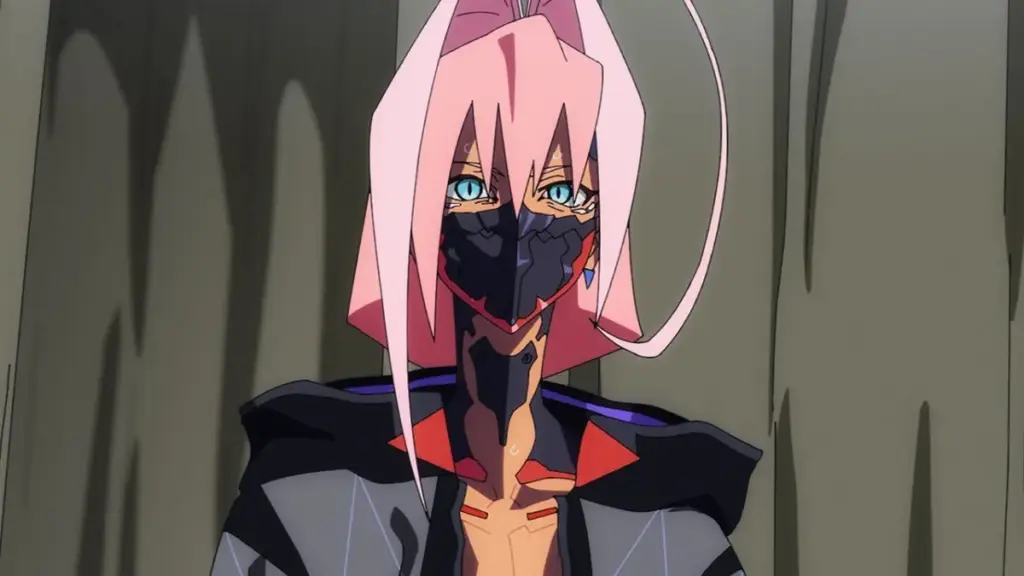
The runaway success of Cyberpunk: Edgerunners proved that CD Projekt Red’s gritty, neon-drenched futuristic universe could transition seamlessly from the realm of interactive role-playing games into the high-octane medium of animation. Developed in collaboration with Studio Trigger, the Netflix anime series captured the very essence of Cyberpunk 2077, winning over both die-hard fans of the source material and newcomers alike. Following the release of Season 2—which jumps forward to explore a fresh, self-contained narrative set just one year after the events of the main video game in 2078—viewers have been left dissecting every frame for clues about the overarching state of Night City.
Among the most heavily discussed talking points from the latest batch of episodes is a fleeting visual reference tucked away within a data archive scene. Sharp-eyed fans pouring over the background details noticed an image gallery featuring a silhouette that strongly resembles female V, the protagonist of Cyberpunk 2077. Naturally, this discovery sent the community into a frenzy of speculation, igniting intense debates over whether CD Projekt Red has finally codified a definitive canon ending for the video game, and whether that specific narrative path serves as the foundational springboard for post-game spin-offs like Edgerunners.
To get to the bottom of these burning questions, IGN caught up with Edgerunners writer, producer, and showrunner Bartosz Sztybor during the Lucca Comics and Games festival. During the conversation, Sztybor addressed the delicate balancing act of expanding a sprawling multimedia franchise while respecting player choice, the philosophy behind the show’s subtle universe-building, and the prospects of a potential third season.
The Mystery of V and the Canon Ending Debate
Addressing the elephant in the room, Sztybor was asked directly whether the visual nod to female V discovered in the data archive was an intentional easter egg meant to be interpreted as concrete lore, or merely a background detail left up to individual viewer interpretation.
"It’s left for interpretation," Sztybor explained, keeping his cards close to his chest. However, he was quick to point out that the surrounding context should not be overlooked entirely. "Also, the dialogue that they’re having there is, I think, very important. So yeah, it’s left for interpretation."
When the conversation shifted toward how the creative team approaches the sensitive subject of post-game timelines, Sztybor shed light on the collaborative process between the writers and CD Projekt Red’s internal lore team. Setting a story in the wake of Cyberpunk 2077 inherently forces creators to confront the multiple divergent conclusions available to players in the video game. According to Sztybor, the writers deliberately avoid locking down a single, immutable version of events as the absolute truth.
"It’s both, I would say," Sztybor noted when asked if the team establishes a strict canon ending or keeps things abstract. "It’s not like super abstract, but also, we don’t want to set a canon ending. So there were a lot of conversations again with the lore team to see what we can do to somehow satisfy all the endings, and what will be the state of the world after the game."
This careful negotiation is precisely why ambiguous elements are woven into the background. Rather than spelling out exactly how V’s story concluded, the creative team prefers to drop breadcrumbs that hint at the broader geopolitical and social state of Night City. These hints are designed to harmonize with whatever path a player chose, ensuring that individual gameplay experiences remain valid while still allowing the expanded universe to move forward.
"That’s why the scene that you asked about, we don’t want to be straightforward, but we are giving some suggestions that will probably reveal the state of the world in more comic books and other stuff," Sztybor continued. "So there are discussions. There are discussions, but we are not setting one kind of ending."
Elaborating further on the concept of canon within the franchise, Sztybor clarified that while overarching truths do exist—such as the canonical weakening of the monolithic Arasaka corporation following the events of the game—they are intentionally kept broad. This high-level status quo shift provides fertile ground for storytellers to explore the city from fresh perspectives without stepping on the toes of the video game’s interactive storytelling.
"There is canon, of course," Sztybor said. "When we were creating Edgerunners Season 1 and multiple comic books and board games, the canon was before the game. So we knew the state of the world. And for the things post-game, it’s not that there are super detailed canon things, but one important canon information is that Arasaka is weakened and that’s it. And it gives us a lot of opportunities to show the city in a different way. But again, it’s not detailed. So it doesn’t make any of the endings canon. But the things that happened in the game could lead to that, whatever your choice was."
Building a Living Universe Through Interconnected Stories
For fans who spend hours dissecting background art, character cameos, and cross-media references, Sztybor’s approach to world-building offers plenty of validation. However, the showrunner pushed back against the traditional industry label of "easter eggs," arguing that these interconnected details serve a much deeper narrative purpose than simple fan service.
"It’s not important at all. That’s why I wouldn’t call it Easter eggs," Sztybor explained. "I think that’s the way we are trying to create a franchise for Cyberpunk. So, to create standalone stories that are self-sufficient, that you can just read one comic book and you are having the catharsis and you don’t need to know any other comic book or a game or other stuff."

Instead of gating narrative comprehension behind homework—requiring audiences to consume multiple television shows and graphic novels just to understand a villain’s motivations—Sztybor prefers a philosophy where every piece of media stands firmly on its own feet. The subtle cross-references, such as the inclusion of characters like Sal Bigelow from the comic book Cyberpunk: Big City Dreams appearing in Edgerunners Season 2, or fixer Arthur Cormac making a cameo across different comic titles, are included purely to foster a sense of immersion.
"We are putting those things that are not as a fan service, but for the audience or the readers to feel that this world is alive," Sztybor said. "That’s why we don’t want to create anime or animation or a comic book that will need the audience to read three other comic books and two TV shows to understand why this guy is a villain. But I like to put those many things… only if there’s a reason. So it’s never thinking that, oh, what we should put in this scene to make fans happy? It’s about building a bigger narrative."
This methodology rewards observant fans without alienating casual viewers. Sztybor pointed to specific instances where background details went largely unnoticed by the broader public, noting that only a tiny fraction of dedicated readers caught certain overlapping character appearances. By leaving dots unconnected and trusting the audience to piece the puzzle together themselves, the franchise encourages active engagement and long-term community discussion.
"As a fan, you can create their story, you can connect the dots, and I think this is the best way to create a franchise, because you let the fans stay with the story, think about the story, and you don’t give them answers. You just give them questions and they can connect things," he added.
The Prospects of Cyberpunk: Edgerunners Season 3
With two seasons of the hit anime now firmly established in the cultural zeitgeist, attention naturally turns toward the future. As CD Projekt Red continues to expand the broader intellectual property—including the in-development sequel Cyberpunk 2 and a live-action film adaptation that will chart its own original course rather than retelling the game’s plot—fans are left wondering if Edgerunners might return for a third outing.
Sztybor revealed that the mindset of looking ahead is baked into the creative process from the very beginning. Even while heavy at work on the inaugural season, the wheels were already turning regarding potential future stories within the universe.
"When writing Season 1, I was already thinking about other seasons, about other stories because there’s a lot of stories to tell," Sztybor said. "Always when I’m creating, I’m searching for answers to questions that I don’t know how to answer. So I knew that after Season 1, I didn’t answer all the questions. So there was a dream of creating more seasons."
However, bringing subsequent seasons to life is never a foregone conclusion. It requires a precise alignment of creative vision, institutional backing from CD Projekt Red, and the availability of the right animation partners. Following the completion of the first season, the grueling production schedule left the acclaimed artists at Studio Trigger hesitant to immediately dive back into the frantic pace of Night City.
Yet creative momentum has a way of shifting. During the gathering in Lucca, conversations between the creative leads and Studio Trigger yielded a change of heart, opening the door for further collaboration.
"After Season 1, Studio Trigger said, ‘No, we are just too tired.’ But then here in Lucca, right after the release of Season 1, we talked with Studio Trigger and they said, ‘Okay, we are not that tired anymore, so maybe we should do it,’" Sztybor recalled. "And I already had ideas. So two months later I presented a pitch to them, because also they said we don’t want to do a sequel, like a classic sequel. And we have CDPR and we as well, we didn’t want to do that as well. We wanted to do something different. So when I presented them a pitch for Season 2, they were super impressed and that’s why Season 2 happened."
Whether that same collaborative lightning will strike for a potential Season 3 remains an open question. Sztybor emphasized that any future continuation hinges entirely on the existence of a compelling narrative and a director equipped with a distinct creative vision matching the caliber of previous installments. Without the right elements in place, the team has no desire to push out mediocre content just to keep a brand active.
"I think that’s the same story with Season 3. So I have some stories, but we need to see," Sztybor concluded. "If there’s no studio or director with a vision like Ikarashi, it doesn’t make sense. We don’t want to do things that will be mediocre or not good enough. So the ideas are there, but I’m also with how Season 2 completes Season 1. So I think as a package, it already works."